


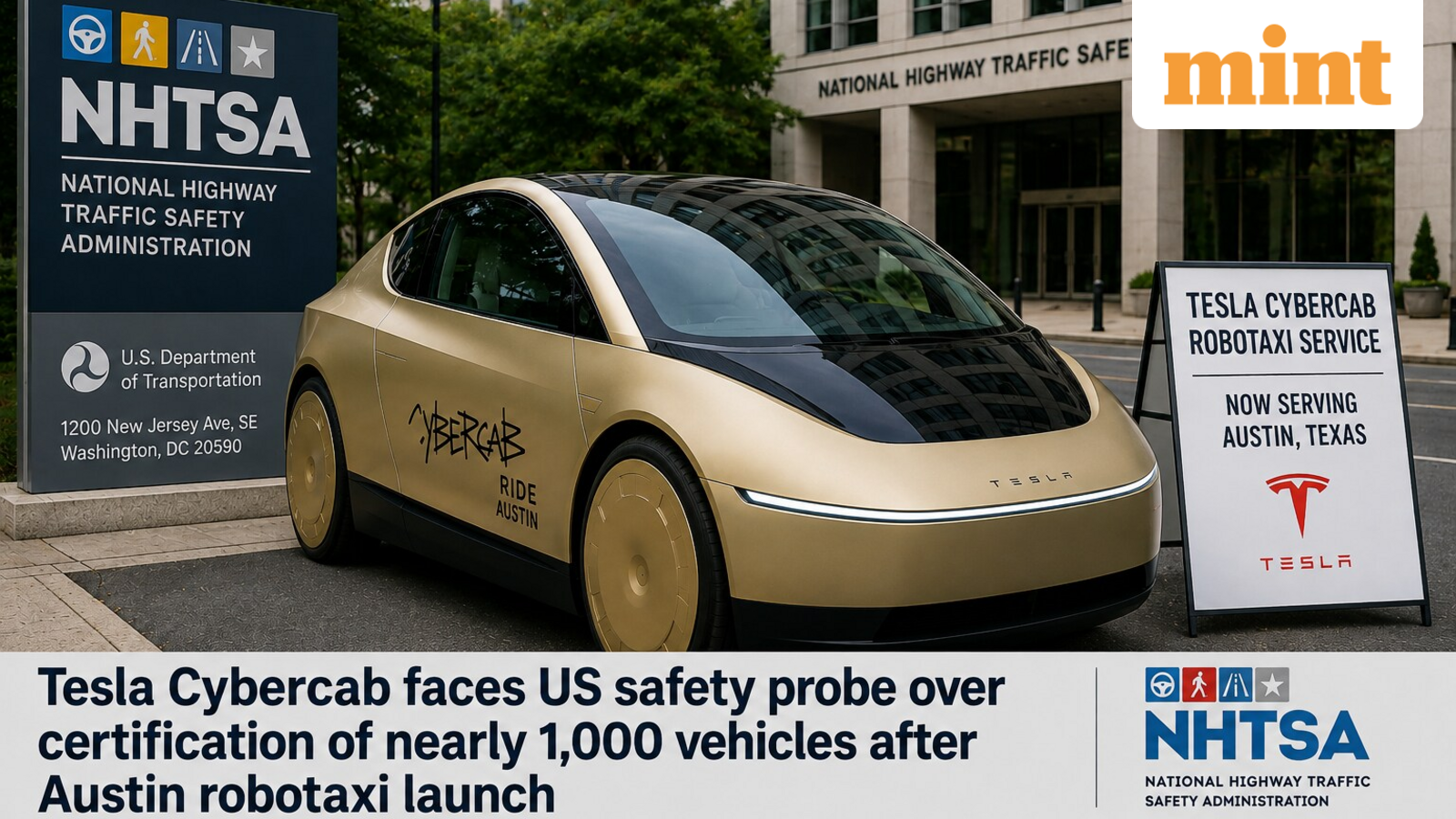
US regulators are investigating how Tesla certified 1,000 Cybercab without steering wheels, pedals or mirrors, just as the company began commercial robotaxi operations in Austin and prepared to expand the service.


The US National Highway Traffic Safety Administration has opened an investigation into the certification of nearly 1,000 Tesla Cybercabs, putting the electric vehicle maker’s newly launched driverless taxi programme under immediate regulatory scrutiny.
Tesla Cybercab faces US safety probe just a day after launch
The investigation began as Tesla started commercial deployment of a small number of the two-seat Cybercabs in Austin, Texas, on Thursday. The company has said it intends to expand the service gradually, adding more vehicles and eventually taking the robotaxis to other locations.
At the centre of the NHTSA inquiry is a basic question: how did Tesla certify a vehicle designed to operate without a human driver when it does not have the conventional controls normally associated with a road-going car?
The Cybercab has no permanently attached steering wheel, brake pedal, accelerator pedal or conventional mirrors. NHTSA said it is examining the process and technical information Tesla relied upon when certifying the vehicles as compliant with federal motor vehicle safety standards. It will also consider how Tesla determined that some of those standards did not apply to the Cybercab.
Tesla has not immediately responded to requests for comment.
Why is Tesla in this complicated position?
The timing is significant. The company is trying to make the Cybercab the centrepiece of a much larger robotaxi business, but the regulatory framework governing vehicles without human controls is still being reshaped
Under the existing system, manufacturers generally self-certify that vehicles comply with Federal Motor Vehicle Safety Standards. The unusual design of the Cybercab, however, puts Tesla in a more complicated position because many existing standards were written around vehicles that have a person sitting behind a steering wheel.
NHTSA itself has been moving towards changing those rules. In June, the agency proposed removing the requirement for conventional manual brake pedals from certain self-driving vehicles and has been considering other changes that could allow autonomous vehicles to be built without equipment intended for human drivers.
That makes the Cybercab investigation particularly notable. Regulators are working towards rules that could make vehicles like it easier to deploy, while Tesla has already put its own interpretation of the current rules into practice.
There is already a recent example of a different approach.
In July, NHTSA approved a petition from Amazon’s autonomous vehicle unit Zoox allowing limited commercial deployment of its steering-wheel-free robotaxis. Federal law gives the agency authority to grant exemptions covering up to 2,500 vehicles per manufacturer each year when required safety equipment is not present. Reuters reported that the Zoox decision was the first such approval for a novel autonomous ride-hailing vehicle.
Tesla, by contrast, has relied on its own certification for the Cybercab vehicles now entering service.
The difference could prove important as the company seeks to scale up. Texas records showed 420 autonomous Tesla vehicles registered in the state as of Friday morning, including 45 Cybercabs. The current Cybercab operation is therefore still small, but the NHTSA audit covers a much larger population of vehicles and could affect Tesla’s plans for future deployment.
The Austin launch itself marks a major step for Tesla’s autonomous-driving ambitions. Unlike the company’s existing robotaxi operations, which use modified Model Y vehicles retaining conventional controls, the Cybercab was designed from the outset around the idea that no human driver would be needed.
Tesla’s approach also places considerable weight on software and onboard sensors rather than giving passengers a conventional means of taking control. The absence of a steering wheel and pedals is central to the vehicle’s design rather than an optional feature.
For Tesla, the regulatory question now arrives at the same moment as the commercial test. The company wants to demonstrate that a purpose-built vehicle without traditional driving controls can safely operate on public roads and eventually be deployed at scale.
The NHTSA investigation does not itself establish that the Cybercab is unsafe or that Tesla violated federal law. It is an examination of the certification process and the technical basis for Tesla’s claims.
But with the first vehicles already carrying passengers in Austin, the outcome could determine how quickly Tesla can turn its driverless-car ambitions into a wider commercial operation.