



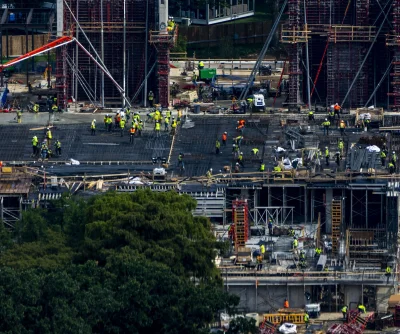
Construction continues on a new ballroom Aug. 11 on the South Lawn at the White House in Washington, D.C. On Monday, the Supreme Court ruled that ballroom construction could continue. Photo by Bonnie Cash/UPI | License Photo
Aug. 31 (UPI) — The Supreme Court ruled Monday that President Donald Trump‘s massive $400 million White House ballroom project can continue — over dissent from Chief Justice John Roberts and three other justices.
In the 5-4 ruling, the conservative-leaning high court said the National Trust for Historic Preservation likely lacks the legal right to challenge the project and that national security reasons favor its continuation. This could give the Trump administration time to finish the project as lawsuits over it continue.
“The government has established that it is likely to succeed on the merits of a significant legal question, that it would likely suffer irreparable harm without a stay, and that the balance of equities tips in its favor,” the ruling states.
The court did not say if the project was legal. In dissent, Roberts said that it likely is not, as the project was not approved by Congress.
“The White House is not just any building,” he wrote. “In failing to appreciate as much, the court misconceives the plaintiff’s injury, allowing the executive’s likely infringement of the legislature’s power of the purse and authority to regulate federal property in the District of Columbia to continue.”
Roberts called Monday’s decision “no victory for the separation of powers.”
The decision replaces a temporary court order from earlier in August that allowed construction to continue.
Trump has long argued for the need for a White House ballroom to host foreign heads of state for events including state dinners, and its construction is one of several projects he has undertaken during his second presidency to remake the capital in his own image.
The National Trust for Historic Preservation sued to halt its construction in December, arguing the project has not been authorized by Congress as required by U.S. law.
With demolition work on the East Wing having begun in October, the Trump administration argued Congress already gave him authority, pointing to a statute that permits the president to conduct maintenance and repair work on the White House.
Federal courts said earlier that the ballroom project needed to halt because it had not been approved by Congress. Administration lawyers had argued that Trump has total authority to renovate federal buildings and that the ballroom and connected security features are necessary.
In its ruling, the Supreme Court said the trust does not have standing to bring the case, stating it must have “concrete and particularized injury” from the project to make such an argument.
“Perhaps nearly any government action or project offends someone’s sensibilities. And adopting the Trust’s ‘unprecedented and limitless’ view that offense alone suffices to establish a concrete and particularized injury would seemingly usher in a world where ‘virtually every citizen had standing to challenge virtually every government action that they do not like,'” the court said.
Trump celebrated the ruling online, claiming that Americans were “living in the Golden Age of America” and that “this Building will be one of the Greatest ever constructed in Washington, D.C.”
“When completed in the Summer of 2028, the magnificent Ballroom and Military Complex will be something that the entire County is very proud of,” Trump said in a statement while claiming without proof that it is under budget and fully funded by donors.
While “deeply disappointed” with the ruling, the National Trust for Historic Preservation said the case is not over as the merits of its argument remain to be tested, stating it anticipates the Trump administration will file an application for a writ of certiorari.
“We urge the Supreme Court to expeditiously consider the government’s certiorari petition, and we will continue to advocate with our partners on behalf of the American people, the democratic values of our nation and the preservation of our country’s most historically significant places,” Brent Leggs, president and CEO of the trust, said in a statement.
The nearly 90,000-square-foot ballroom will be located on the former site of the East Wing, which Trump ordered demolished. The president initially said that it would cost $200 million and be paid for by private donations, but The Washington Post has reported that the project, which it estimated will cost $600 million, will include $300 million in tax dollars.