






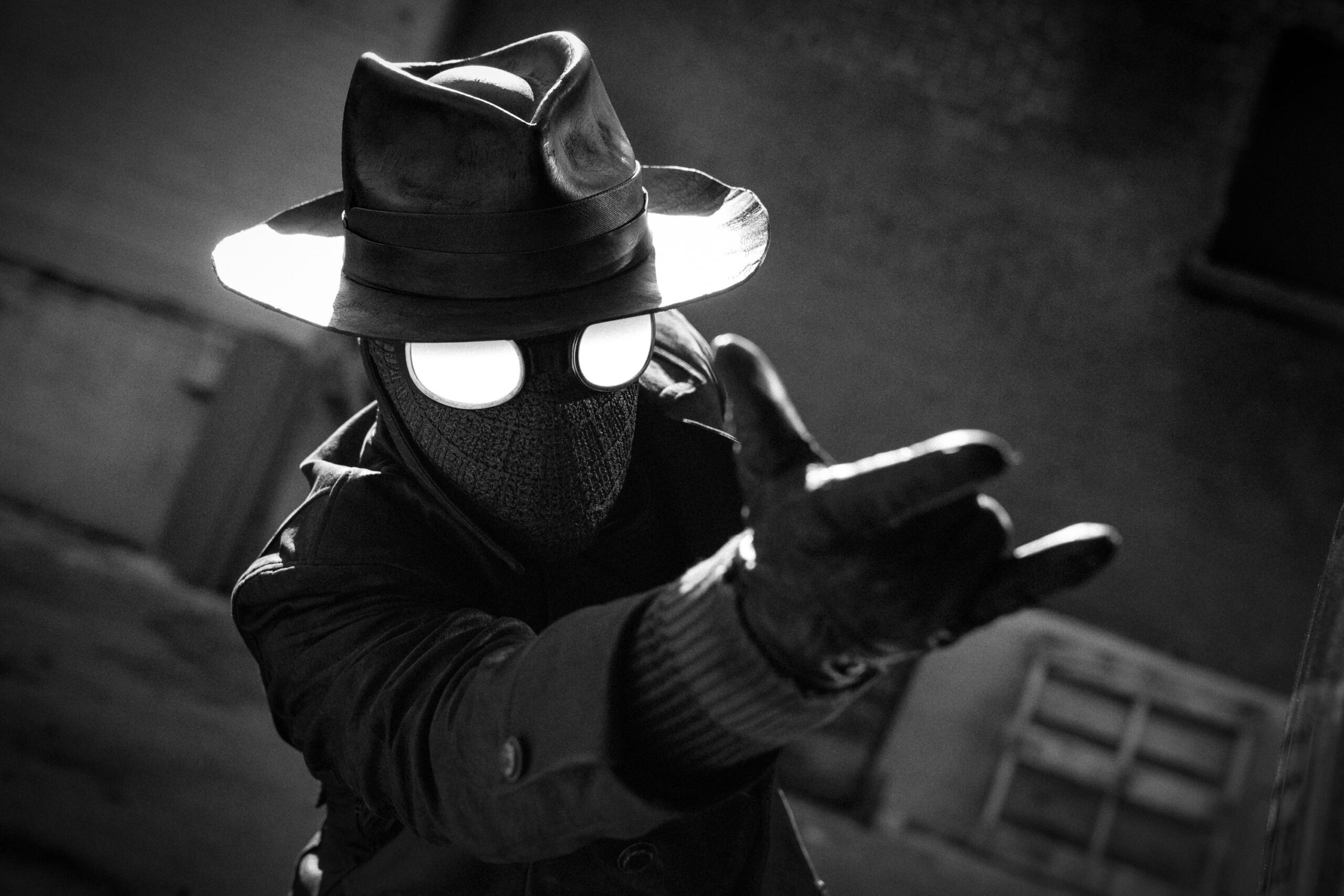
AT THE START of 2018’s Spider-Man: Into the Spider-Verse, Peter Parker reminds the audience of everything we already know about Spider-Man: bit by a radioactive spider, death of Uncle Ben, great power and great responsibility, etc. But then the movie throws that aside to introduce a very different type of Spider-Man—not just our star Miles Morales, but a bevy of Spider-People across the multiverse, including a fedora-sporting, purple-prose-spouting, hard-boiled detective voiced by Nicolas Cage.
Now, with the release of the Prime Video/MGM+ series Spider-Noir, that Spider-Man gets his time to shine… well, as much as anyone can shine in black and white. Cage reprises his role as a trench-coat wearing hero with spider-powers, but Spider-Noir has little else in common with any other Spider-Man, let alone his character from the Spider-Verse films. Instead, Spider-Noir creators Oren Uziel and Steve Lightfoot have put together a proper hard-boiled mystery, albeit one in which the hero and the bad guys have superpowers.
The approach makes Spider-Noir a surprisingly effective series, driven by an incredible lead performance by Cage, a compelling gumshoe plot, and some of the sharpest dialogue this side of a Howard Hawks movie. But for those going into the show cold, the very existence of Spider-Noir itself can be a mystery. So pull on your most wrinkled suit, take a slug of whiskey, and come with us into the rainy streets as we follow the web of clues that leads to Spider-Noir.
Superheroes in Shades of Grey


Spider-Noir draws primary inspiration from Spider-Man Noir, a 2009 miniseries written by David Hine and Fabrice Sapolsky and illustrated by Carmine Di Giandomenico. Part of a Marvel Comics initiative that also saw the release of X-Men Noir, Daredevil Noir, and Luke Cage Noir, Spider-Man Noir took an established hero and relocated him to the 1930s. Borrowing from the hard-boiled fiction of Dashiell Hammett and Raymond Chandler, even more so than the film noirs that give the miniseries its name, Spider-Man Noir reimagines Peter Parker as a poor kid living in New York City slums with his Aunt May, reimagined here as a Leftist radical in the vein of Emma Goldman. After gaining powers from the magic of a spider-idol, Peter becomes the Spider and goes up against gangster Norman “the Goblin” Osborn and his freak henchmen.


Anyone inspired by Into the Spider-Verse to check out Spider-Man Noir might be a little surprised. Where Nicolas Cage played a goofy, self-conscious hero, the Peter Parker of Spider-Man Noir is younger, angrier, and meaner. Hine and Sapolsky work political commentary into their story, tying the death of Uncle Ben and the power amassed by the Goblin to the economic disparities of the era. When Peter becomes the Spider, he’s motivated less by a feeling of responsibility to help others and more by vengeance. He may not be quite the killer he seems in the first issue’s attention-grabbing splash page, holding a gun and hunched over the bloody body of Daily Bugle editor J. Jonah Jameson, but he’s certainly not the fun-loving quipster we know from the main universe.
At least, not until recently. The first series spawned a sequel, Eyes Without A Face, that continued that dark tone. However, the post-Spider-Verse follow-up miniseries Twilight in Babylon(2020), by Margaret Stohl and Juan Ferreyra, and especially the 2024 series The Gwen Stacy Affair, written by famed artist Erik Larsen and illustrated by Andrea Broccardo, sand the rough edges off the character, bringing him closer to the likable hero that Cage played in Into the Spider-Verse—which makes Spider-Noir all the more surprising.
A Tangled Web of Mystery


Spider-Noir certainly isn’t as nasty as the original Spider-Man Noir comics. Yes, it has its share of violence and cursing. But Cage retains some of the goofiness that he brought to the character in animation. However, Spider-Noir isn’t a spin-off of Into the Spider-Verse, either. Not only does the show never make mention of Miles Morales or a multiverse, but Cage has a sadness not even implied by the animated films.
In fact, Cage may not even be playing the same guy. Set in the 1940s, Cage plays Ben Reilly, a cynical private investigator who once fought crime as the Spider, using the powers he gained when liberating a secret laboratory in World War II. With the help of his secretary Janet (Karen Rodriguez), Ben takes on any cast that earns him a buck. When the Irish gangster Silvermane (Brendan Gleeson) starts gathering superpowered henchmen—including the Sandman Flint Marko (Jack Huston), Lonnie Lincoln aka Tombstone (Abraham Popoola), and the electrical Dirk Leydan/Megawatt (Andrew Lewis Caldwell)—Ben’s reporter friend Joseph “Robbie” Robertson (Lamorne Morris) urges him to become the Spider again. Complicating things is Ben’s attachment to singer Cat Hardy (Li Jun Li), who may genuinely need his help to get free from Silvermane, or may be working her own angle.
As those plots suggest, Spider-Noir owes a great debt to classic film noir, even more than it does to Marvel Comics. It’s no spoiler to say that Ben does, from time to time, pull on his mask and go swinging through the city again as the Spider, nor to say that Sandman and Megawatt use their powers against him. But the plot is driven by the same things that drive any hard-boiled detective story: a knotty mystery that involves corruption in government, an alluring femme fatale, and sharp dialogue. That last point is actually where Spider-Noir is at its most fun, as Cage finds plenty of places to do his classic bits as Ben Reilly, including impressions of Humphrey Bogart and Edward G. Robinson.
Spider-Noir isn’t exactly Spider-Man, and it isn’t exactly Spider-Man Noir. But it is its own thing, and that’s enjoyable enough.
Deeper Into Darkness


Well, Spider-Noir is mostly its own thing. The series owes a clear debt to film noir of the 1930s and ‘40s, and often pays homage to the classics. So anyone who wants more adventures in the vein of Spider-Noir would be better served by going to the movies instead of the comics.
Spider-Noir has direct references to everything from Great Guy, the 1936 Jimmy Cagney movie that Ben pauses his investigation to watch, to the underrated Orson Welles picture The Lady from Shanghai from 1947.
However, Spider-Noir may owe its greatest debt to 1941’s The Maltese Falcon, and not just because writer and director John Huston’s grandson Jack plays Sandman on the show. Rather, Cage based his performance on Humphrey Bogart, who does some his best work as selfish sleuth Sam Spade. After the death of his partner, Spade gets pulled into a search for the titular relic, desired by the imposing Kasper Gutman (Sidney Greenstreet). Complicating things is a woman (Mary Astor) who changes her identity and has her own intentions for Spade.
The Maltese Falcon has a plot far twistier than that of Spider-Noir. But its sharp dialogue, larger-than-life villains, and morally-complex protagonist make it the perfect follow-up to anyone ready to continue heading down the dark path of film noir, a place where there are no superheroes, but there’s plenty of drama.


