







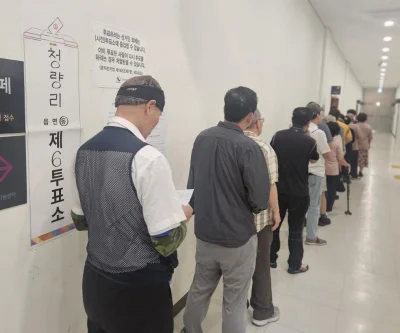
1 of 3 | Voters wait in line at a polling station at the Cheongnyangni-dong Community Service Center in Dongdaemun Ward, Seoul, on Wednesday, the day of South Korea’s ninth nationwide local elections. Photo by Asia Today
June 3 (Asia Today) — Voters lined up before dawn Wednesday as South Korea opened voting in its ninth nationwide local elections, with some Seoul polling stations seeing early morning crowds before ballots were cast.
“I came out early because I thought it would be hot and crowded during the day,” one voter said.
At around 6 a.m., voters were already waiting outside the Cheongnyangni-dong Community Service Center in Dongdaemun Ward, Seoul. Elderly residents arrived early to avoid the heat and crowds, merchants stopped by before opening their shops and families began the public holiday by voting before heading out for the day.
Voting was scheduled from 6 a.m. to 6 p.m. at 14,288 polling stations nationwide. Unlike early voting, Election Day voting is allowed only at the polling station assigned based on a voter’s registered address.
Kim Myung-ok, 77, who stood at the front of the line at the Cheongnyangni-dong polling station, said she woke up at 5 a.m. and went straight to vote.
“People have to vote for the country to run well,” Kim said. “I went to a campaign rally in Jongno last night, and after hearing the candidates’ speeches, I was looking forward to voting today even more. I came here as soon as I woke up.”
“I hope whoever wins does a good job for citizens,” she said.
The line grew longer as the morning went on. Kang Young-il, 70, said he wanted to vote before spending the holiday with his family.
“My children will wake up late, so I came out to vote first and start the day,” Kang said.
Some residents said they had expected fewer people. Kwon Jae-soon, 82, said she came early to vote before the crowds arrived but found a long line already waiting.
“I guess everyone had the same idea,” she said with a laugh.
The polling station at Daeun Elementary School in Daejo-dong, Eunpyeong Ward, was also busy around the same time. Election workers directed voters to show identification, receive ballots and enter voting booths, while the sounds of voter rolls being turned and ballots being separated filled the school gym.
The gym was divided into two polling areas. Voters showed their identification at the entrance, confirmed their assigned polling station and then moved to the appropriate side. Shortly after 6 a.m., about 20 people waited on the stairs leading from the ground floor to the basement.
Older voters who came alone were especially noticeable early in the morning.
Choi Kwang-hee, 71, who runs a vegetable shop at a nearby market, said he stopped by before opening his store.
“I have to open early in the morning, so I came here briefly before that,” Choi said. “It is a holiday, so I think more customers will come, and I need to prepare in advance.”
Families with infants also came to vote. Kim Se-hee, 34, visited the polling station with her husband, who carried their son, less than 1 year old, in a baby carrier.
“Our baby is too young to leave alone at home, so we brought him with us,” Kim said. “The three of us came out early because we plan to go somewhere. We are thinking of driving out near the city for some fresh air.”
The line that formed immediately after voting began eased briefly after 7 a.m. Some voters also turned back after realizing they had come to the wrong polling station.
Kim Sung-hyun, 23, who said he had moved to the area a month earlier, said he came because it was the closest polling station to his home but was told it was not his assigned location.
“It is my first time experiencing this, so I was flustered,” he said.
In contrast, the polling station at the World Vision Seongnam Social Welfare Center in Jungwon Ward, Seongnam, Gyeonggi Province, was calmer than some Seoul locations. There were not many people waiting, but middle-aged and elderly residents from the neighborhood steadily arrived. After voting, some went shopping or took a walk, making the election feel like part of an ordinary morning.
Jung Hee-sun, 68, who has lived in Jungwon Ward for more than 30 years, said she always votes on Election Day.
“Early voting may be convenient, but I always vote on the main Election Day,” Jung said. “I feel more comfortable voting after checking directly at the polling station in my own neighborhood.”
“Prices have risen a lot, and the local commercial district is not what it used to be,” she said. “I chose based on how well the mayor or ward chief can take care of residents’ daily lives.”
Other voters said local development and housing issues were their main concerns.
Lee Jung-jin, 59, who runs a shop in the neighborhood, said housing is a major issue in Seongnam because the area has many aging residential neighborhoods and ongoing redevelopment discussions.
“Every election, candidates say they will change the area, but there has not been much change that residents can actually feel,” Lee said. “Rather than development promises that are just words, I looked at whether the candidate can actually solve daily problems such as transportation, parking and safety.”
Across the country, voters cast ballots at assigned polling stations in community centers, schools and welfare centers. The atmosphere varied by neighborhood, with some Seoul polling stations drawing long lines before dawn while parts of Seongnam remained relatively calm.
But voters who arrived early said they came with the same sense of civic duty.
“It is something I should do as a citizen,” several voters said.
— Reported by Asia Today; translated by UPI
© Asia Today. Unauthorized reproduction or redistribution prohibited.
Original Korean report: https://www.asiatoday.co.kr/kn/view.php?key=20260603010000905


