

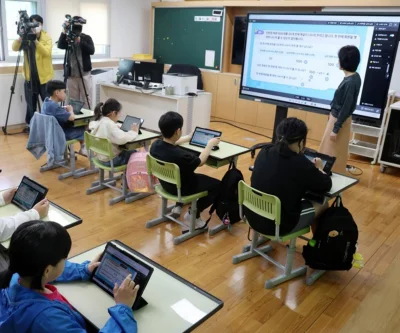
Pupils learn how to do division as they attend an open math class utilizing digital versions of print textbooks, provided on tablet computers with additional video and audio information, at Namsan Elementary School in Chuncheon, Gangwon Province, South Korea. Photo by YONHAP / EPA
June 18 (Asia Today) — South Korea is again considering changes to a local education funding system that automatically receives a fixed share of national tax revenue, as a semiconductor-driven rise in government receipts is expected to increase grants despite a shrinking student population.
The debate centers on local education finance grants, the main source of funding for elementary, middle and high schools administered by regional education offices.
The grants have risen to about 76 trillion won ($50 billion) under this year’s supplementary budget, according to the National Assembly Budget Office and education officials.
Some projections suggest the total could exceed 80 trillion won ($52.6 billion) if stronger tax revenue from the semiconductor industry is fully reflected.
The grant system receives 20.79% of internal tax revenue along with part of the national education tax. That means the amount increases when tax receipts rise, regardless of changes in student enrollment.
The number of elementary, middle and high school students fell from 5.96 million in 2016 to 4.92 million this year, a decline of 1.04 million, or 17.4%.
Over the same period, local education grants increased from 43 trillion won ($28.3 billion) to 76 trillion won, an increase of 33 trillion won ($21.7 billion), or 76.7%.
Budget officials and public finance experts say the automatic link to tax revenue makes government spending less flexible.
They argue that funding for primary and secondary education continues to expand despite falling enrollment while early childhood, higher education and lifelong learning programs face comparatively greater financial constraints.
Proposals include adjusting the percentage of internal tax revenue allocated to the grants or incorporating changes in the school-age population and nominal economic growth into the funding formula.
Education officials have strongly opposed reducing the grants based mainly on student numbers.
Superintendents-elect from South Korea’s ninth nationwide local elections issued a joint statement Monday warning that students would ultimately bear the cost of a funding overhaul driven primarily by fiscal considerations.
“Personnel expenses for teachers and other employees, school operating costs and facility safety and maintenance expenses arise at the school and classroom level, not simply on a per-student basis,” they said.
Schools also face growing fixed costs for meal services, after-school care and administrative support.
Personnel costs for permanent contract employees at public schools, including cafeteria workers, care staff and administrative assistants, reached 5.74 trillion won ($3.77 billion) last year.
That was a 61% increase from 2021. The figure is expected to exceed 6 trillion won ($3.94 billion) this year.
Three major teachers’ organizations also rejected claims that regional education offices have excess money.
They said the combined initial budgets of special education accounts fell by about 1 trillion won ($657 million) this year.
Funding for teaching and learning support declined 14.9%, while spending on school facility improvements fell 22.4%, they said.
The groups described education office reserve funds as a financial safeguard rather than unused money.
The Education Ministry is reportedly considering alternatives to immediately lowering the legally mandated allocation rate.
Possible measures include retaining the link to internal tax revenue while placing a ceiling on annual increases or allowing regional education offices to use more of the money for early childhood, higher education and lifelong learning.
The approach is intended to avoid a sudden reduction in primary and secondary school funding while directing more resources toward other parts of the education system.
Park Nam-gi, an emeritus professor at Gwangju National University of Education, said many necessary programs remain underfunded despite claims that schools have surplus resources.
“There are many things schools cannot do because they lack funding,” Park said.
He cited the expansion of special education, separate spaces and personnel needed to protect teachers and investment in education suited to the artificial intelligence era.
“It is wrong to conclude that education funding is excessive without properly supporting these needs,” Park said.
He said cash assistance programs introduced by some superintendents should be corrected where necessary, but that such concerns should not be used to justify reducing the overall education budget.
“Unlike welfare spending for the present, education funding is an investment in the country’s future,” Park said.
— Reported by Asia Today; translated by UPI
© Asia Today. Unauthorized reproduction or redistribution prohibited.
Original Korean report: https://www.asiatoday.co.kr/kn/view.php?key=20260618010006611
