






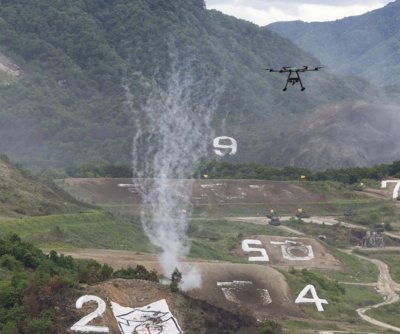
A South Korean Drone Unit operates during a joint South Korea Combinde Joint Live-Fire Military Exercise 2026 at the Seungjin Fire Training Field in Pocheon, South Korea, 21 May 2026. Photo by JEON HEON-KYUN / EPA
June 28 (Asia Today) — South Korea will introduce its first national performance-testing standard for counter-drone systems as small unmanned aircraft emerge as a major security threat in the wars in Ukraine and Iran.
The Korean Agency for Technology and Standards said Sunday that the standard, designated KS W 8100, will be formally issued Monday.
The standard establishes testing methods for systems designed to protect airports, power plants, military installations and other critical infrastructure from unidentified or hostile drones.
It covers radar systems, radio-frequency scanners, electro-optical and infrared cameras and electronic jammers used to detect, identify and neutralize drones.
The tests will assess factors including detection range, detection capability, identification accuracy and the ability to disrupt a drone’s communications or control signals.
South Korea previously lacked a uniform method for independently verifying the performance of counter-drone equipment. That made it difficult for operators of critical facilities to evaluate and purchase systems offered by different manufacturers, the Ministry of Trade, Industry and Resources said.
The battlefield use of drones in Ukraine and the Middle East has increased the urgency of establishing reliable performance standards, the ministry said.
Radio-frequency scanners covered by the standard analyze communication signals between drones and their operators to locate the aircraft. Radar detects drones through reflected radio waves, while electro-optical and infrared cameras provide visual identification during daylight or at night.
Jammers interfere with the radio signals used to control drones or transmit navigation data, potentially forcing an aircraft to land, return to its operator or lose its ability to continue its mission.
The standard does not cover so-called hard-kill systems that physically destroy drones with bullets, explosives, fragments or other weapons.
Government officials expect the new rules to accelerate efforts by the National Intelligence Service and other agencies to establish a certification system for counter-drone equipment.
South Korea plans to connect its standards and certification programs under a broader national strategy aimed at closing security gaps at critical infrastructure sites and developing the country’s drone and counter-drone industries.
The standard was developed through a civil-military standardization project led by the Defense Acquisition Program Administration and the Defense Agency for Technology and Quality.
The Korea Testing Laboratory began developing the testing methods in 2021 in cooperation with experts from industry, universities, research institutes and the military.
Officials evaluated the standard’s practical application through two public hearings with industry representatives and four field tests organized by the National Intelligence Service and the government’s Counter-Terrorism Center.
“South Korea’s counter-drone industry is still in its early stages,” said Kim Dae-ja, president of the Korean Agency for Technology and Standards.
“We expect the standard to provide a fair basis for technological competition and contribute to building an industrial ecosystem,” Kim said. “We will continue working with the relevant ministries to actively support standardization.”
— Reported by Asia Today; translated by UPI
© Asia Today. Unauthorized reproduction or redistribution prohibited.
Original Korean report: https://www.asiatoday.co.kr/kn/view.php?key=20260628010009818


