

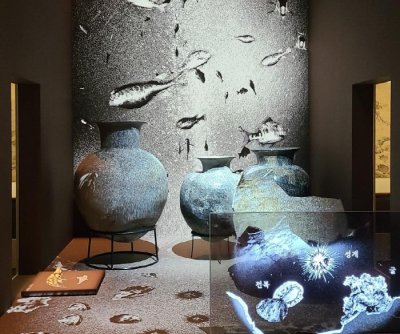
1 of 2 | The National Museum of Korea’s “Our Table” exhibition explores about 3,000 years of Korean food culture through archaeological objects, paintings and historical documents. Photo by Asia Today
June 30 (Asia Today) — “Have you eaten?”
The National Museum of Korea’s new special exhibition, “Our Table,” begins with a familiar Korean greeting that reflects the central role food plays in everyday life and personal relationships.
The exhibition invites visitors to consider how an ordinary meal represents a record of culture and daily life stretching back about 3,000 years. Archaeological objects, historical documents, paintings and folk materials trace how Koreans have grown, prepared and shared food over the centuries.
“Our Table,” which opens Wednesday and runs through Oct. 25, is the museum’s first special exhibition offering a comprehensive examination of Korean food culture.
Fifty-one institutions and private collectors contributed 684 objects grouped into 488 entries. The display includes five state-designated Treasures and two items recognized as National Folklore Cultural Heritage.
The exhibition is divided into two sections: “Our Table Through Life” and “Our Table Shaped by Nature.”
Visitors first encounter charred rice grains excavated from Heunam-ri in Yeoju, a Bronze Age site southeast of Seoul. The grains provide evidence of early rice cultivation on the Korean Peninsula and serve as a starting point for understanding the development of Korea’s rice-centered food culture.
The exhibition continues with a spoon and chopsticks excavated from the tomb of Baekje King Muryeong, a late 19th-century diagram explaining traditional table-setting rules and cookbooks from several historical periods.
One display places a wooden cutting board excavated from a third- or fourth-century site in Gochon-ri, Busan, beside Park Soo-keun’s 1952 painting “Dried Yellow Corvina on a Cutting Board.”
By presenting objects separated by about 1,700 years, the exhibition illustrates the continuity of everyday work involved in preparing a meal.
Genre paintings offer another view of Korean dining customs.
In Kim Hong-do’s “Tavern,” a traveler wearing a traditional horsehair hat raises a bowl and scrapes up the final grains of rice. Kim’s “Midday Snack” and Kim Deuk-sin’s “Gathering to Eat and Drink by the River” portray people sharing food in fields and along a river during the Joseon Dynasty.
Seong Hyeop’s “Grilling Meat” depicts diners gathered around an iron griddle, presenting a scene that resembles modern Korean group dinners.
The second section examines how Korea’s seasons and natural environment shaped its cuisine.
Heo Gyun’s 17th-century book Domundaejak, written while he was in exile, records regional delicacies from across the country.
Other exhibits include a jar containing seafood excavated from the Seobongchong tomb in Gyeongju, bird eggs discovered at the Cheonmachong tomb and Byeon Sang-byeok’s painting “Hen and Chicks.” Together, the pieces document the history of seafood, meat and foods traditionally consumed for nourishment and health.
Charred soybean clusters dating from the third to fifth centuries are presented as possible early forms of meju, the fermented soybean blocks used to make soybean paste and soy sauce.
Charred perilla seeds from the Bronze Age and a Goryeo Dynasty celadon maebyeong vase that once contained honey further illustrate the long history of fermentation, seasonings and sweeteners in Korean cuisine.
The museum uses sounds of rice cooking, food-preparation videos and Korean words that imitate sounds and movements to create a multisensory exhibition without serving actual food.
Audio commentary by actor Ryu Soo-young and video interviews with food culture specialists are also available.
“Choosing the dining table as a museum exhibition subject is an invitation to reconsider both the roots of K-food and the scene closest to our everyday lives, which we have often taken for granted,” museum Director Yoo Hong-jun said.
“I hope the exhibition helps visitors recognize that our table was created through the natural environment of this land and the efforts of earlier generations who regarded food as something as precious as heaven,” Yoo said.
— Reported by Asia Today; translated by UPI
© Asia Today. Unauthorized reproduction or redistribution prohibited.
Original Korean report: https://www.asiatoday.co.kr/kn/view.php?key=20260630010010708
