




Founder’s Briefs: An occasional series where Mongabay founder Rhett Ayers Butler shares analysis, perspectives and story summaries.
In a forest reserve on the edge of Singapore, volunteers spend hours scanning the canopy for a primate they may not see. The exercise points to a simple constraint of conservation in a dense city: most habitats are small and separated.
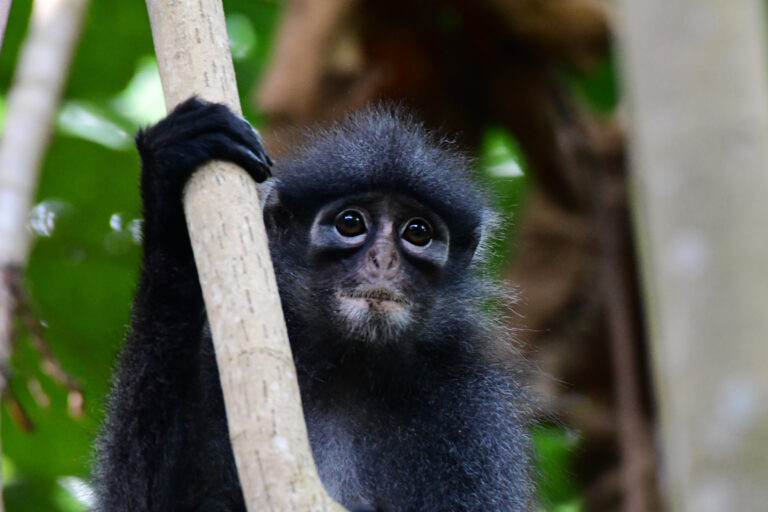
The Raffles’ banded langur (Presbytis femoralis) survives in these pockets, reports Mongabay’s Carolyn Cowan. Its numbers are low, and to move and feed it relies on continuous tree cover — something that has largely been broken up.
Conservation has focused on workable measures. Volunteers record group sizes and behavior, while agencies plant food trees and install rope bridges to span gaps in the canopy.
There are signs of progress. The population has doubled since 2011 to 80 individuals today, according to Andie Ang, a researcher at Mandai Nature, a local conservation organization. What comes next will depend on land-use decisions, in particular whether remaining forest patches are preserved and linked.
The volunteer program has helped fill gaps in knowledge and build public awareness. That may prove as important as the data. In a city where land is scarce, conservation competes with other priorities.
Read the full story by Carolyn Cowan here.
Banner image of a Raffles’ banded langur, courtesy of Andie Ang.