






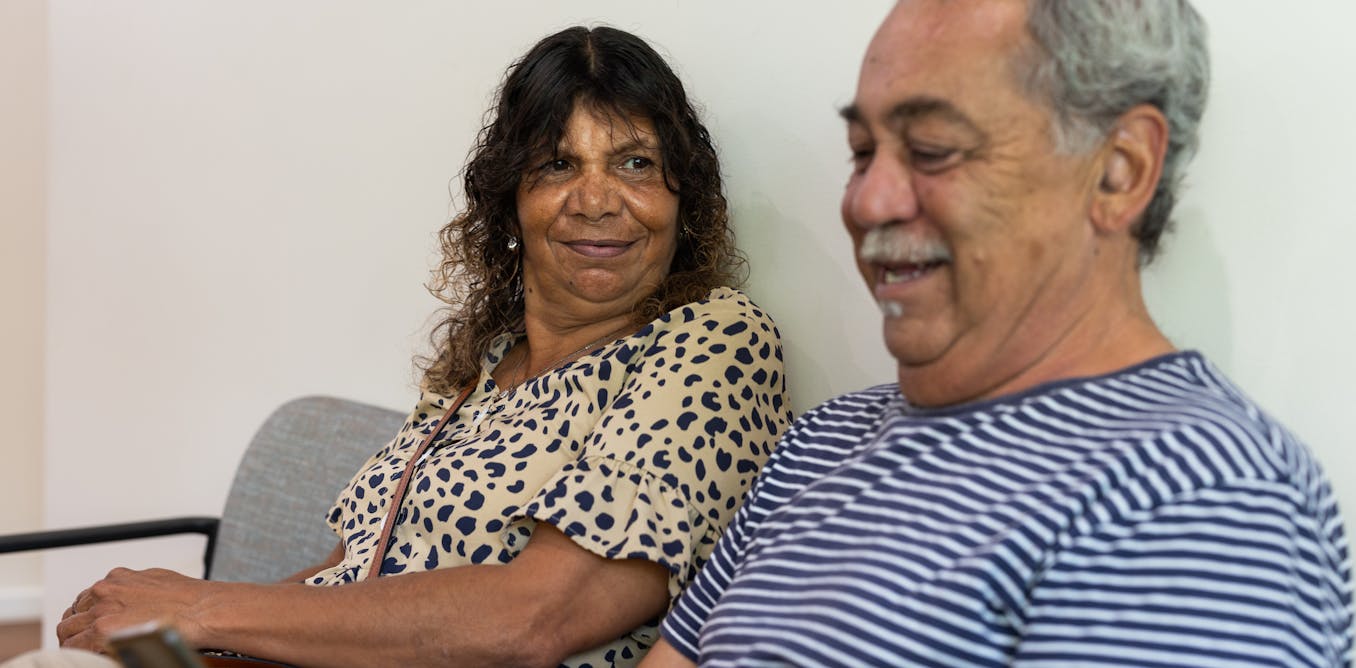
Aunty Mary stands reluctantly back from the busy counter at her local community pharmacy, not quite sure how to get some help.
She notices a colourful poster on the wall that shows all the language and cultural groups of Aboriginal and Torres Strait Islander people in Australia and relaxes a little.
Then the pharmacist in the dispensary catches her eye and smiles. The pharmacist had recently met Aunty Mary at the local Aboriginal Health Service, introduced by an Aboriginal Health Worker who knew she had some worries about her medicines.
The pharmacist comes out of the dispensary and finds a quiet place to chat with Aunty Mary. Together they work through her questions about how to take her new medicine and whether it may be making her feel unwell.
Ideally, culturally appropriate and accessible medicines advice, like in this fictional example, should be easy to access.
Unfortunately, many Aboriginal and Torres Strait Islander people face barriers to accessing medicines advice, and this can make them more vulnerable to health issues from using medicines.
But our new research, published today, shows the solution is simple.
Health problems related to medicines
Medicines are the main treatment for many conditions. But issues with how they’re used are common.
These include overuse (using a medicine when it may be harmful), under-use (not using a medicine when it could be beneficial) and inappropriate use (using a medicine in a way that may change its intended effects).
This can cause other serious health problems, make chronic conditions worse, and lead to unplanned hospitalisation and even death.
In OECD countries such as Australia, as many as one in ten hospitalisations are caused by a medication problem.
These high rates show there is currently not enough support for people to use medicines safely and effectively.
A preventable problem
Our 2025 research highlighted the extent of the issue for First Nations people for the first time.
We analysed five years of linked hospital and primary health-care data for 80,232 Aboriginal and Torres Strait Islander people in Queensland.
We found between 16% and 74% of hospitalisations for cardiovascular issues, including heart attacks and strokes, were linked to preventable medication problems.
Our results showed higher rates of preventable hospitalisations in rural areas compared to remote and urban areas. This may be due to fewer GPs and less access to services in these areas.
There are some limitations to this data, as medicine use is not consistently recorded in remote areas. But as we used linked data across primary care and hospital services, the results are highly representative for Queensland.
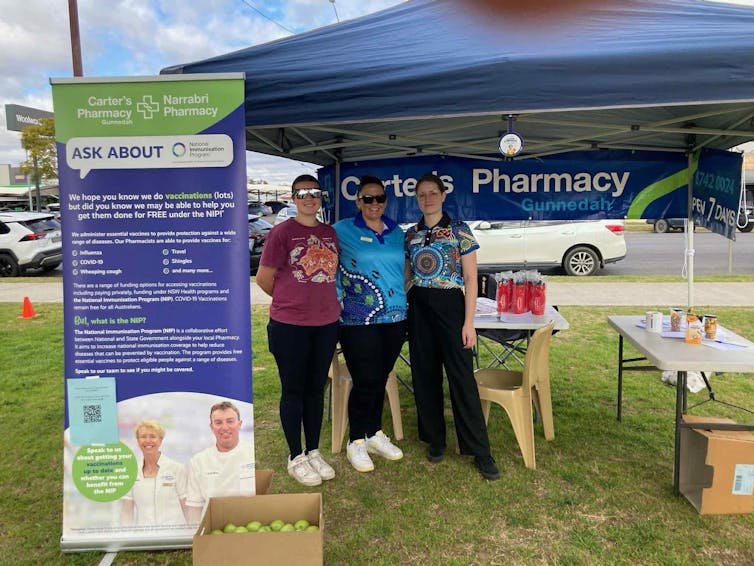

Author provided (no reuse)
How to make medicine use safer
For most people, community pharmacists are a highly accessible source of advice. Not only can they provide information about a medicine when they fill someone’s script, they can also do a comprehensive review of all the medications a person takes and write a report for their doctor.
But pharmacists may not be a culturally safe resource for First Nations people.
Culturally safe care is free from racism and discrimination. It means health-care providers understand that colonisation can still be felt in power imbalances between them and First Nations people. So they work to build trusting relationships to make the person receiving care comfortable.
For example, Aboriginal and Torres Strait Islander people may not feel comfortable asking for help from a pharmacist wearing a white coat, based on a platform and behind a screen in a dispensary.
So one way to reduce medicine-related problems for First Nations people is to improve access to advice about medicines use in a culturally safe way, where they can build relationships.
The federal government currently funds pharmacist services designed to help people with medication problems. But they don’t do anything to address cultural safety.
What culturally responsive care looks like
Our new research shows what can actually work to reduce Aboriginal and Torres Strait Islander people’s medication problems.
We designed and evaluated a culturally responsive medication service for 225 Aboriginal and Torres Strait Islander people in urban, rural and remote locations in the Northern Territory, Queensland and New South Wales. They were at risk of health problems from medication use. Participants also had a chronic condition, were pregnant or had given birth within the last two years.
We found the service reduced the number of serious medication problems, and significantly increased the likelihood participants would take medications that were needed, and increased people’s confidence in how to manage their medicines.
Here’s what we found works:
-
allowing the person to choose a safe place for a medicines review, such as the Aboriginal Health Service. Currently, the funding rules require services to be provided at home, which is not preferred by many people
-
allowing other trusted care providers – not only GPs – to refer someone for a medication review and introduce the pharmacist if needed. These could include Aboriginal Health Workers and nurses
-
requiring pharmacists and pharmacy staff to undertake cultural awareness training and use strengths-based motivational interviewing when reviewing medications. This is a way of having yarns that helps identify support people and things that keep you strong, as well as setting goals.
Evidence also shows having pharmacists embedded within Aboriginal and Torres Strait Islander health services can improve First Nations people’s health, including lower blood pressure and cholesterol.
One of the people who used the culturally appropriate service designed in our research described their new relationship with the local pharmacist:
Mostly, Aboriginal people are wary of strangers, wary of people with that position [of power] asking questions on a personal level. Well, she made us feel comfortable and able to spill our guts. […] I don’t know how she made us do that but it was unanimous… She’s really affected us in the most positive way possible just with one short visit… We always talk about her.
Simple misunderstandings about medicines can have life-changing consequences.
Our findings show that by funding a tailored medication review program for Indigenous people, the government could help reduce medication harm for Aboriginal and Torres Strait Islander people.
We acknowledge the support of the National Aboriginal Community Controlled Health Organisation (NACCHO) and the Pharmacy Guild of Australia to undertake our research. We also thank Mike Stephens from NACCHO for his contribution to this article.


