




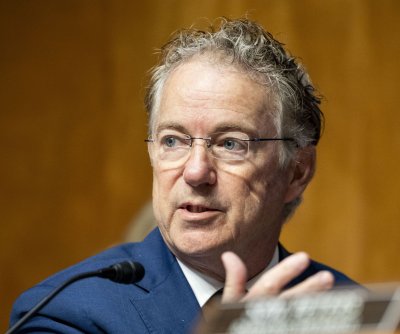
1 of 5 | The chairman of the Senate Homeland Security and Governmental Affairs Committee, Rand Paul, R-Ky., speaks during an oversight hearing on the Department of Homeland Security in the Dirksen Senate Office Building near the U.S. Capitol in Washington, on Thursday. Photo by Bonnie Cash/UPI | License Photo
WASHINGTON, Feb. 12 (UPI) — Republican and Democratic senators questioned ICE’s methods during testimony by Department of Homeland Security officials about violence during Operation Metro Surge, the immigration crackdown in Minnesota.
“Americans protesting shouldn’t give ICE the right to exert lethal force,” said U.S. Sen. Rand Paul, R-Ky., chairman of the Senate Homeland Security and Governmental Affairs Committee.
The session was an oversight hearing focused on the Trump administration’s immigration enforcement actions in Minnesota and elsewhere.
The hearing came just a day before a deadline for Congress to pass a DHS funding bill or risk a partial shutdown. Democrats have demanded that ICE officers and agents carry identification, stop wearing masks and cease racial profiling.
Just before the hearing, White House border czar Tom Homan said that the surge operation would end and Minnesota would see a “significant drawdown” in federal officers.
Paul and the committee’s top Democrat, Sen. Gary Peters of Michigan, presented a New York Times video of the lead-up to protester Alex Pretti’s fatal shooting Jan. 24 in Minneapolis by two ICE agents. The senators took turns stopping the video and making comments.
“I don’t see a hint of something that was aggressive here,” Paul said, pausing the video when Pretti put his hands up.
Commissioner U.S. Customs and Border Protection Rodney Scott argued, however, that Pretti wasn’t complying with the ICE agents, noting, “He’s fighting back non-stop.”
The DHS officials testifying at the hearing maintained that violence by ICE personnel came as response to protesters in the city.
“Officers are taught to employ force when they feel there is a threat,” said Rodney Scott, the director of U.S. Customs and Border Protection.
Scott and Tom Lyons, acting director of ICE, declined to answer questions about whether Renee Good, who also was shot and killed, or Alex Pretti were domestic terrorists. Lyons indicated that making such a judgement would impede on ongoing investigations.
“If you say it would impede or bias your investigations, why wouldn’t it impede for Secretary [Kristi] Noem and [White House aide] Steven Miller to say the same thing?” asked Sen. Maggie Hassan, D-N.H., referring to comments Noem and Miller made about Good and Pretti.
Despite the bipartisanship on display by Paul and Peters, the rest of the committee split down the middle regarding ICE’s actions. Republicans largely defended ICE agents, while Democrats were critical of their actions.
“A lot of the federal reasons for targeting Minnesota are not based on the law,” Minnesota Attorney General Keith Ellison said in an earlier panel before the committee.
He cited President Donald Trump‘s TruthSocial post after Operation Metro Surge was announced that it was “retribution,” implying it was a reaction to the state’s record of favoring Democrats in elections.
He also took issue with the Trump administration’s justification for sending ICE agents and other federal troops to Minnesota because of the state’s tolerance of illegal immigration.
Ellison said that Minnesota does not have a large population of illegal immigration.
“Every rationale the administration has offered for this surge is a pretext,” he said.
Ellison’s comments sparked outbursts from some Republican lawmakers, who accused him of dispatching “trained activists” to ICE operations and urging them to intervene.
“People are dead because you encouraged them to put themselves in harm’s way,” Sen. Ron Johnson, R-Wis., said, raising his voice. “A tragedy was going to happen, and you encouraged it, and you ought to feel damn guilty about it. You disgust me.”
“Do you want me to respond?” Ellison replied. “That was a nice theatrical performance. But it was all lies.”
Other Republicans accused Ellison of being complicit in the financial fraud in Minnesota tied to Somalian daycares, about which a hearing was held last week.
Later in the hearing, Ice Acting Director Lyons indicated that he had requested an increase in staffing in Minnesota in response to the protests and had called for Operation Metro Surge. He declined to comment on Homan’s decision to withdraw ICE from the city.
Ellison said he approved of the border czar’s call. “It’s a good thing,” he said.
Ellison also praised the people of Minnesota for standing up for their rights amid the operation.
“I’ve never been prouder to be a Minnesotan. I’m so proud of the people who helped their neighbors who stood up for their First Amendment rights,” he said.
Lyons indicated that what set Minnesota apart from the deportation efforts elsewhere in the country is an aspect of cooperation with local law enforcement, which he said was absent during Operation Metro Surge.
However, Minnesota Commissioner Paul Schnell had testified less than an hour earlier that local law enforcement did not receive communication from ICE.
“There have not been efforts to coordinate or discuss their targets,” Schell said during the earlier panel.
Lyons also spoke out strongly against proposals to unmask ICE agents, citing threats to the agents and their families.
“These are honorable men and women,” he said. “They don’t want to be masked.”
Border Protection’s Scott denied that officers entered churches, elementary schools, and hospitals to arrest aliens. He said that suspects went to these locations to seek sanctuary, but denied officers targeted churches.
However, the Trump administration cancelled a Biden administration rule that classified these locations as “sensitive zones” that ICE cannot enter.
Sen. John Fetterman, D-Pa., pointed out that even if the DHS were to shut down Friday, there would be little functional change or few limits to ICE operations, which are largely funded by the Big Beautiful Bill Act.
Other departments within the DHS, like Cybersecurity and Infrastructure Security Agency, the Coast Guard and Federal Emergency Management Agency, would face significant funding cuts and obstacles to their operations.
“A shutdown wouldn’t have any meaningful impact on ICE, you have practically unlimited money right now,” Fetterman said. “But you’re going to punish all these other parts.”