







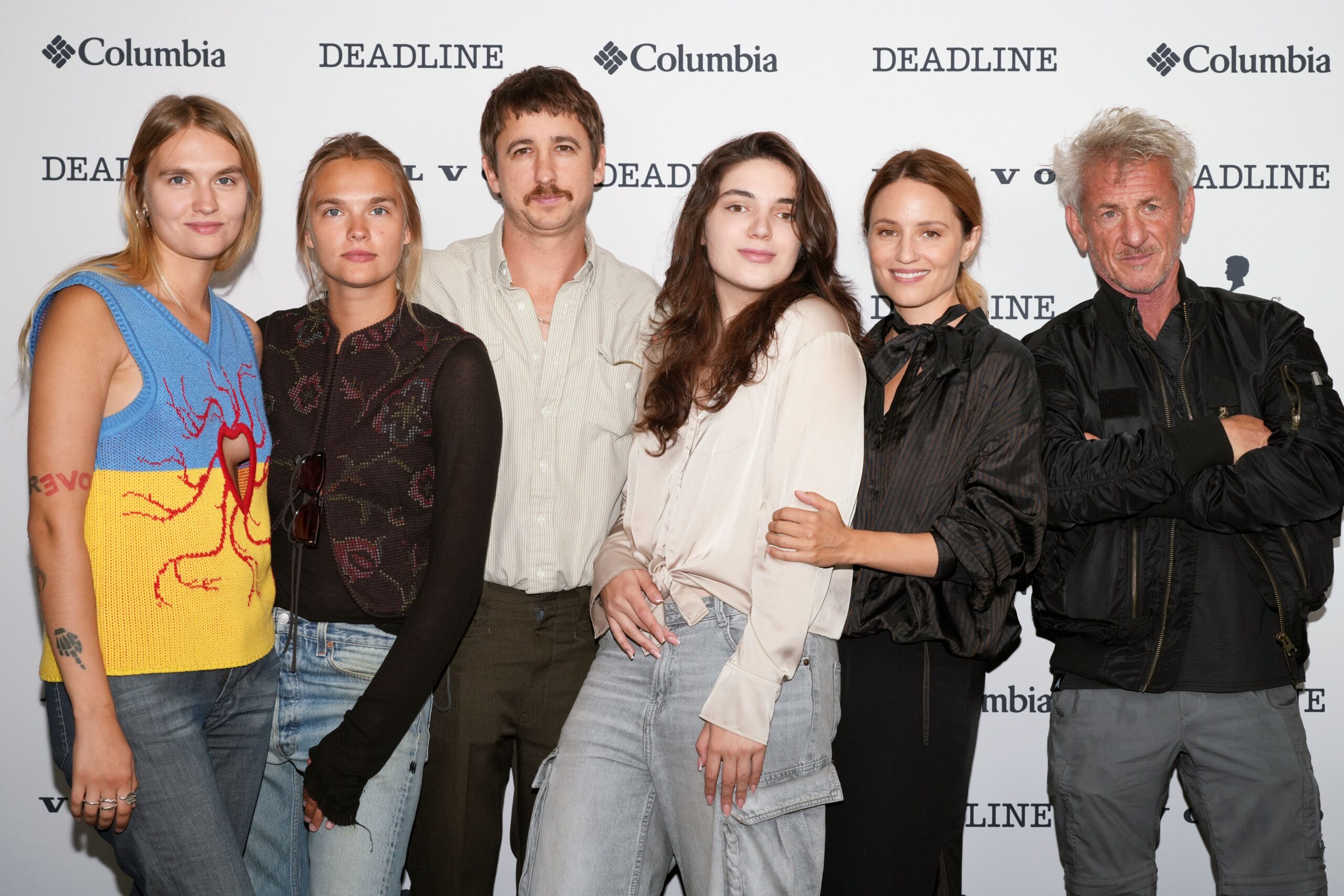
At Friday’s premiere of Marcus Haney’s documentary about youth living in Ukraine during wartime, executive producer Sean Penn referred to the film as “a call to human arms.” In Black Sunflowers, Haney follows a group of young people whose lives are tied together by two things—the war in Ukraine and rave culture. Haney’s camera follows the kids, some of whom are as young as 18, into battle, onto the dance floor, having political conversations with their grandparents, watching Donald Trump get elected, watching Trump and Vice President JD Vance meet with President Volodymyr Zelensky, and fall in love.
Some of the characters are soldiers, some are artists, some believe it is their duty to fight in this war while others are not sure that is the way through this conflict. What they all are is young. There is a constant hum of war in the background of every scene, whether it be drone strikes or stray gunfire. Many of the kids in the documentary went from the COVID-19 pandemic straight into the war with Russia. They seem incredibly adult, and then they go on social media or FaceTime their boyfriend.
Haney’s film is a brisk 95 minutes but it packs a punch. The day after the premiere (post after-party and an after after party), I sat down with Haney and Penn to discuss the film and what they hope audiences will glean from this unique perspective.


Black Sunflowers
Vanity Fair: The movie grapples with the sense of hope, and some of the kids have it and some seem devoid of it. After filming this movie, how do you feel personally about the situation in Ukraine and for these kids? Should they have hope?
Marcus Haney: I don’t know the answer to that. I feel like I know less than I did when I was first going in. It’s not going to stop until [Russian President Vladimir] Putin stops it or is forcibly stopped. When you talk to [people], especially military, they don’t have any anticipation of it stopping soon. So when you hear these kids talk who are fighting on the front lines, they see this as a war they might be potentially fighting their whole lives. And that colors how I might interpret that.
Sean Penn: I have to be very careful with words like victory and defining that as one of the kids’ positions. In terms of victory, that got done a long time ago. Ukrainians won. Ukrainians represented anything worth having hope for humanity over and over again. What military resolution will happen is not really something for anybody to comment on. To me, this movement, these kids, and their very embrace of what we’re calling hope or lack thereof is the hope. What’s happening in the world has never happened before. And I, of course, talk partly about the influence of social media and all of that technology in general.
Do you feel the kids in the documentary lost some currency on social media after the first two years?
Haney: Way beyond social media. Hard donations, support from other countries, including the United States, of course. But it started off, donations are a great measure of just seeing how much the world’s plugged in and it’s like a cliff drop.
Do you think that they’ve been upstaged by say the war in Gaza?
Penn: Yes. There’s a lot of levels. I would say this without a bias, in there is a perversion of leadership. They’ve made such chaotic choices and we can Monday-morning quarterback a lot of things. Confusion and manufactured crises and distraction is now systemic from the top of the world. Of the world banking structure. Of the world military structures. Certainly of the world humanitarian structures and of the fourth estate. So it goes back to ‘how’s any of this going to get better’? And this movie, it’s so much more of a documentary. This is what I think is great cinema, it should be next to Apocalypse Now or Five Easy Pieces.
Imagine the wildfires in the Pacific Palisades. What happens? Everybody reaches out to each other. The horror of it, the immediate horror, goes on for five days and then you just have Gaza West in the Palisades to look at and say, “oh my God, how’s California going to fix this?” America’s not very good, often not very good at embracing its greatest aspects of the time. They wait till it trends and proves itself before they say, “Hey, that’s great.”


Black Sunflowers
In the middle of the film, Trump revokes USAID and you see how it affects the gay soldier and then the people who use the grants for amputees. Do you think that is one of his greatest crimes as president?
Penn: Oh yeah. I mean, a kind way to put it would be negligent homicide, but we’ve been told not to use those terms. It’s not polite, which is ironic. We are accepting a great degree of denial and we still believe that we’re bulletproof.
The kids sort of have a funny reaction to Trump when they watch him. What was the Ukrainian youth’s overall attitude toward him?
Haney: I was really surprised at how receptive they were to Trump in the beginning, and it all comes into that one quote, “I’ll end the war in 24 hours.” So when you, as a Ukrainian, you’re not growing up with the context, the nuance of growing up in America and Trump every day. When you hear that in the news as a Ukrainian, that’s the best thing you could possibly hear. That’s salvation, that’s the end of the war. So for them, that stuck above everything. And there was this huge, “Okay, hold on. Let’s take this chance. If that’s what he’s saying, that’s the best we’ve been told by far.”
So there’s this kind of rallying behind Trump, and then it became evident, this guy’s absolutely full of shit. There was this crazy backlash.
This meeting with Zelensky, Trump and Vance was embarrassing to watch in the theater. Did that change things on the ground?
Haney: Absolutely. And it was after that was when I went into the bunker with them. I’m a liability to them. Me being there makes them less safe. There was a lot of thoughts that night of post-Trump. That was a crystallizing moment for Ukraine.
Sean, do you remember watching that?
Penn: Yeah. A guy said to me early on, at the beginning of the war, disillusionment is a national pastime. There was so much criticism going on about Zelensky not kissing the ring and saying thank you again and again.
Criticism from where?
Penn: A lot of the mainstream media in North America.
You mean Fox News?
Penn: No, even I was even seeing it on CNN. It wasn’t the only coverage. It wasn’t the only one, but it was there. There was nothing that was going to change the outcome of that meeting.

Black Sunflowers
Would you want the Trump administration to watch this movie, and has Zelensky seen the film?
Haney: I mean, I want everyone possible to watch the film. I don’t know if they’re in a place where they could be self-reflective enough to watch the film. I would love if there was any shot of having any impact on that. Yeah, of course I’d want the Trumps to watch this. But I don’t have much faith and if nothing else has encouraged self-reflection, I don’t know if this would.
Penn: I’d like to see [Jared] Kushner and Ivanka Trump watch it. This film makes no effort to attack any president. And these kids’ stories are so familiar that there’s no reason not to present something that lets somebody connect and have a chance to reflect. And some will and some won’t. We know what we think mostly about leadership, but I’m willing to be wrong anytime he wants. It’s worth the chance.
We’re entering the midterms and the next presidential election. Do you think the Democrats will prioritize this as an issue?
Penn: I am not confident in the Democrats at large. I think most of our politicians prioritize what’s trending. Not everything our government does is on government, right? We got to get in there.
I couldn’t help but feel like the Ukrainian youth has such moral certainty. And then I thought about us Americans, and it’s like, are we just entitled brats?
Penn: A lot of us, but not all. Leadership means something, right? You can even look at somebody like Charlie Kirk. If there’s some young, great human leader out there at some university who’s articulate and gives a shit—and there are—who sees this movie and could light their fire. We still have kids that could be those kids if we would remember our courage in all aspects.
Haney: If we were put in the same situation, would we rise to the occasion like Ukrainians would? This is a question I ask myself personally all the time while making this film. If I was put in their shoes. None of these kids ever saw themselves as becoming soldiers. I think that’s so important to understand. So if I put myself in those shoes, if we are being invaded and we were outnumbered and my home was being threatened, my family was being threatened, my freedom was being threatened, who am I? I think that’s one of the questions I’d like for people to ask. Who are you in this film? What would you do? And my answer is I wouldn’t know until that moment.


Sean Penn backstage at 76th Annual Academy Awards on February 29, 2004, when he won his first Best Actor Oscar for Mystic River.
Bob Riha Jr/Getty Images
Sean, you want to get this movie out there. You want to get this message out there. You didn’t go to the Oscars, yet you won. Do you think the Oscars stage would have been a place to speak about Ukraine? Do you think it would have been received?
Penn: When I see value added in something that is bigger than me, I do it. I’ve been quite outspoken on Ukraine. I’m uncomfortable in the setting [of the Academy Awards]. I am Switzerland on those who choose to speak politically there and those who don’t. I realized in my 60s that I’m not good in crowds of more than eight, not because I’m avoiding the bad people or the superficiality of Hollywood, but because there’s too many people in the room I want to say hi to and I can’t.
And so I was in Ukraine at the time [of the Oscars]. I had great excitement about it. I would have liked to have seen somebody who wouldn’t have represented a redundancy as I might have at that moment. But it’s hard to find the knockout of punches. I didn’t have this film to articulate what I was processing. If I did, I would have gone there and done that and experienced the anxiety of social circumstances and self-consciousness of cameras.
Haney: I’d hazard a guess that Sean being [in] Ukraine at the time might have spoken more than him speaking at the Academy Awards.
The scene where the missile strikes nearby the bunker. Would you go back and film scenes like that again?
Haney: I don’t want to at all. It was beyond hell and I was scared for my life. And I really, throughout my career, there’s always this line and I thrive on dancing right on that line. That was past the line and I had a lot of time in there after that strike to contemplate a lot of things. They, and I, take constipation pills to reduce having to go above and use the bathroom outside. It’s so horrendous at the same time, six hours on, six hours off, the rotations they do. When they’re off, they’re sleeping or they’re [being] kids again: on TikTok sharing memes, teaching me about American memes, catching me up on pop culture in America while. They go back to being 18 years old again.
-
From Prince George to Princess Leonor: Where Young Royals Will Attend School This Fall
-
The Pitt’s Patrick Ball on Shipping, Stardom, and Season 3
-
From Cowboys to Clean Girls: The State of American Style, in Pictures


