







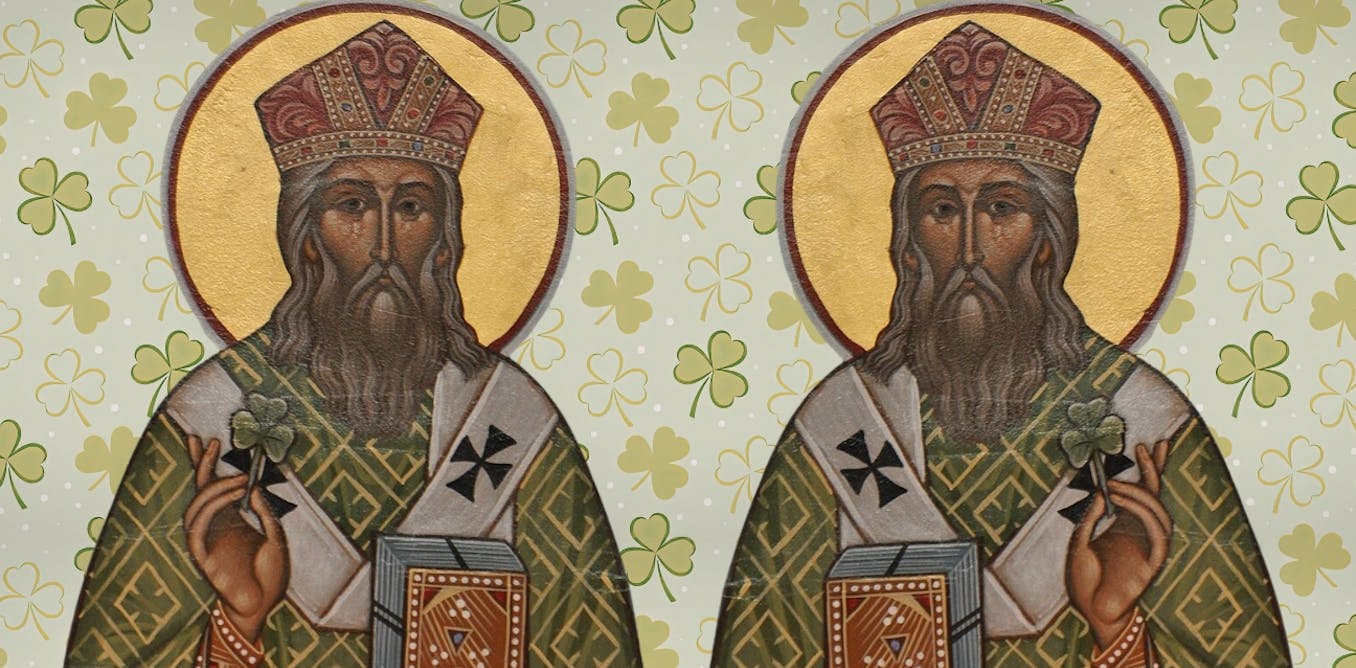
Celebrated every year with swathes of green and pints of Guinness, Saint Patrick is the most famous of Ireland’s trio of patron saints (the others are Brigid and Colm Cille, aka Columba).
Saint Patrick’s story is well known. Not just because of the annual global phenomenon his feast day has become, but also thanks to a considerable body of original written evidence. Chief among this are his personal writings – the Confession and Letter to the Soldiers of Coroticus. But there are also many others – annals, biographies, hymns, poems – written centuries after his lifetime.
The standard story of Patrick goes like this. At some undetermined date in the 5th century AD, while the western Roman Empire collapsed politically, the teenage Patrick was kidnapped from his home in Britain, or possibly Gaul, by Irish raiders. He was then sold into slavery for six years where he tended sheep somewhere in Ireland until, with divine help, he escaped home to his family. Eventually, he felt compelled to return to Ireland and proselytise the Christian faith there. The rest is history, so some say.
But a lesser known story exists concerning not one, but two 5th century characters named (or assumed to be named) Patricius, or Patrick. According to one tradition, both men knew one another closely and were each involved in promulgating Christianity in Ireland.
The two Patricks
One of the earliest references to two Patricks is Saint Fiacc’s Hymn on the Life of Patrick. It was written in the 5th or 6th century but survives in an 8th-century manuscript. Fiacc, a professional royal poet turned bishop, wrote: “When Patrick departed [died], he went to visit the other Patrick and together they ascended to Jesus Son of Mary.”

The Potteries Museum & Art Gallery
The Martyrology of Tallaght, an 8th or 9th century calendar of saints’ feast days, gives August 24 as the commemorative date for “Old Patrick … beloved foster father/mentor”. The Annals of Ulster, meanwhile, records the “repose of the elder Patrick, as some books state” in 457.
There are also Irish and continental references to an official papal mission to Ireland in AD431, led by a man named Palladius. But, to further complicate matters, another annular entry, albeit retrospectively added, says that Patrick came to Ireland in AD432, the year after Palladius.
Researchers have tentatively investigated whether this Palladius was either surnamed Patricius, or had had his life and work conflated with the later Patricius.
An even later entry in the 9th century Book of Armagh states that Palladius was “Patrick by another name”.
This small sample of evidence for another Patrick is by no means conclusive. But it makes a good case for two original Patricks operating in Ireland about the same time – a father figure mentoring his younger charge perhaps.
Such relationships were common in early Ireland. Long before Christianity’s arrival on Irish shores, fosterage had been an integral and widespread social institution. The early Irish church adapted the custom to its own organisation, thereby allowing senior clerics, men and women, to assume parental roles for their novices.
Even the Latin name Patricius, with its paternal connotations, suggests this. However, there are other meanings for such a name, including a predecessor. In the Roman world, though, Patricius could be a personal name or an honorific title indicating senior political or military rank. Any of these definitions of the name go some way to understanding the interchangeability of Patricius and Palladius in the early written record.
Why do we only celebrate one Patrick?
So, if there is evidence for two distinct Patricks, each with their own cult following and feast day, how did they merge into one singular tradition? The transition really begins in late 7th century Armagh, a powerful Christian establishment in the north of Ireland.
Armagh’s ecclesiastic authorities sought control over all the Irish churches. Arguing for the legitimacy of its claim, Armagh propagandists, like Muirchú, enhanced its Patrician connections by incorporating all Patrician traditions into one cohesive story. Essentially, enter the official Patrick, with a March 17 feast day, ready to banish snakes.

Christ’s Hospital/Alamy
Historically, scholarly opinion over the two Patricks’ story has been mixed. In 1942, Thomas F. O’Rahilly revived a much earlier theory arguing coherently for the existence of two Patricks. His thesis, while attracting supporters, ignited a controversy that descended into rancour and farce, culminating in a libel case taken against a popular journalist who poked fun at the debate. To some extent, the argument over an original dual Patrician tradition has still not gone away.
Today, however, there is a general openness among modern scholars to at least the possibility of two Patricks. Though, sadly, it probably won’t give the world an extra Saint Patrick’s Day every year.


_-_St_Patrick_-_1936.FA.244_-_Potteries_Museum_%5E_Art_Gallery.jpg)