





analysis
The network is finally fighting back — and hitting the president where it hurts
Published
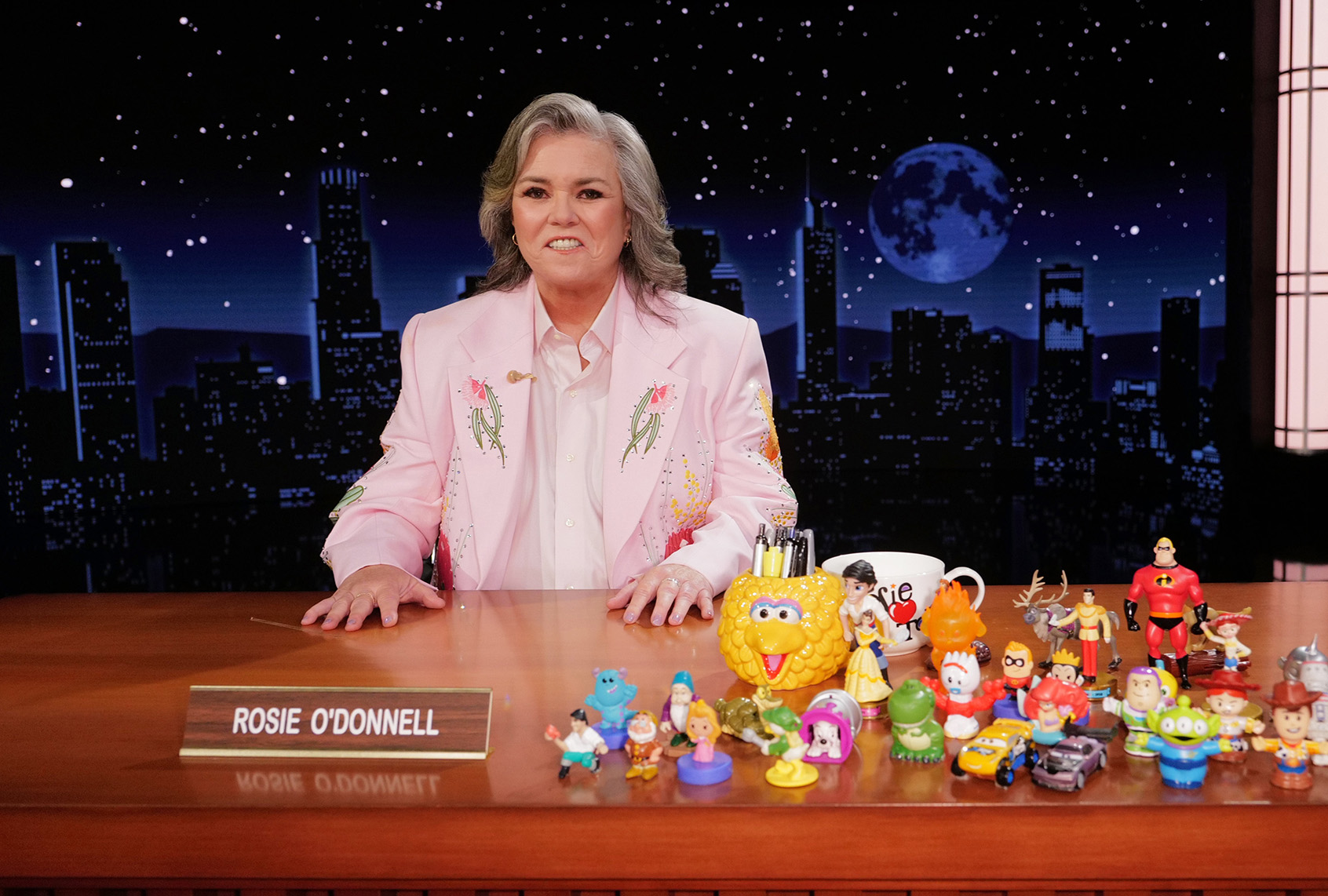

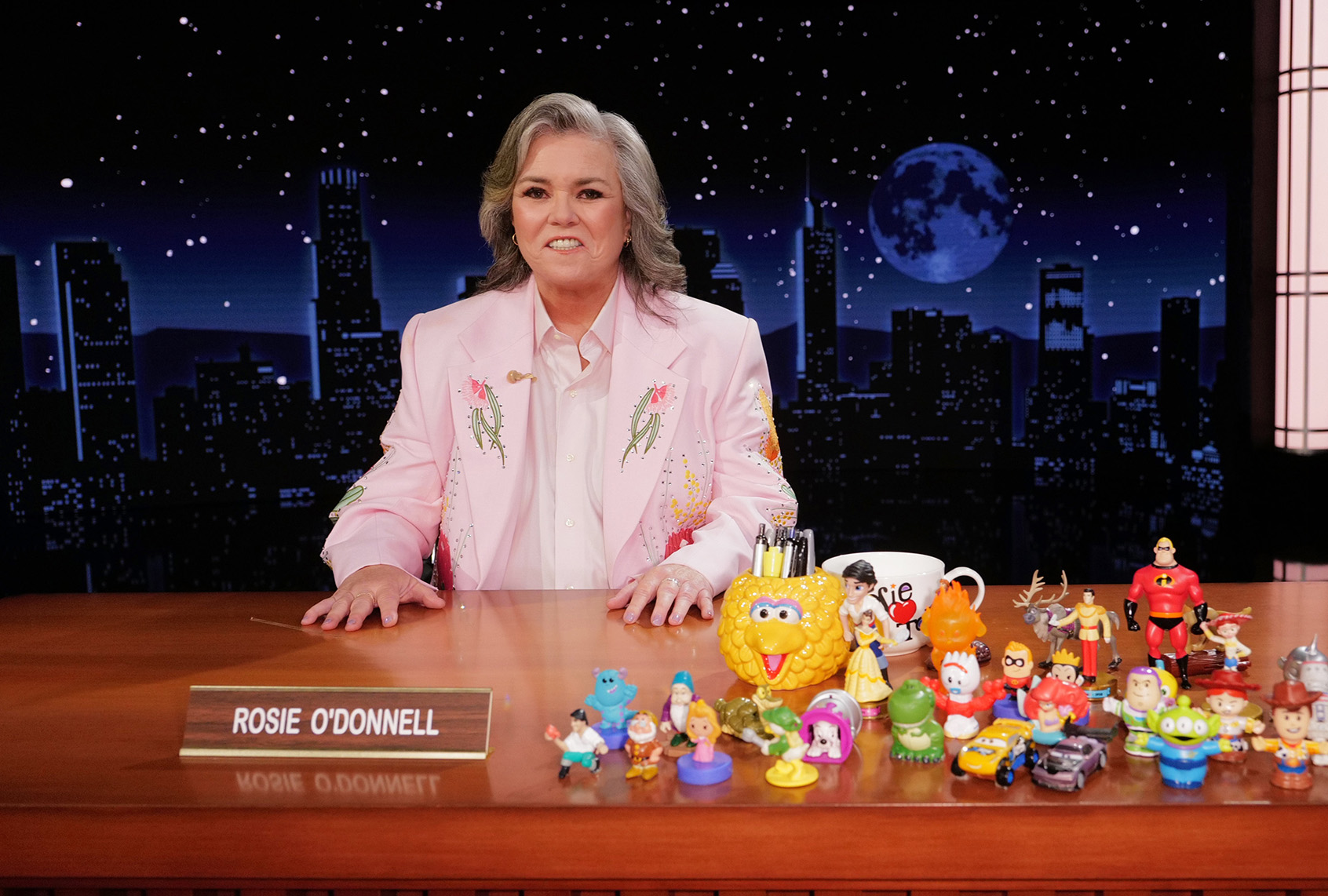
Rosie O’Donnell guest-hosted “Jimmy Kimmel Live!” on Aug. 17. (Disney / Randy Holmes)
Donald Trump thought that if he could scare television executives badly enough, eventually the jokes would stop. Probably more than any other president, he understands television’s power because he was manufactured and insulated by it. So Trump thought that if Stephen Colbert could be pushed off his late-night perch at CBS and Jimmy Kimmel could be suspended by ABC, and Brendan Carr could dangle the Federal Communications Commission over ABC like a regulatory sword, the message would sink in across the television industry: Criticize the president at your own peril.
For a while, Trump’s gameplan seemed to be working. But it’s now clear that ABC and Disney, the network’s parent company, have decided they are done running.
That is what makes Rosie O’Donnell’s unlikely return to television so delicious. On the surface, it is just a bit of summer programming: Kimmel is taking a vacation, so O’Donnell is filling in for him this week. But Kimmel tapped O’Donnell for the gig deliberately, framing it as “a special treat” for Trump — a delicious nod to the president’s notoriously thin-skinned, two-decade-long vendetta against her for mocking his business failures back when she co-hosted “The View,” another ABC franchise. O’Donnell has been one of Trump’s most persistent celebrity antagonists since. And Trump has spent that same stretch periodically threatening to strip her of her American citizenship in Truth Social posts that read like ransom notes. (After he returned to the White House, she famously moved to Ireland.)
Now O’Donnell is back behind a network television desk and, by all appearances, is having a blast. There was a comforting nostalgia in watching her surrounded by tchotchkes, radiating the loose, warm confidence that made “The Rosie O’Donnell Show” such a phenomenon in the 1990s. She handed out copies of her longtime friend Madonna’s new album to the studio audience, told stories about ordinary life and looked completely at home.
Love her or not, seeing O’Donnell back in her element was a master class in unapologetic cultural resistance. She didn’t waste any time getting down to business.
Love her or not, seeing O’Donnell back in her element was a master class in unapologetic cultural resistance. She didn’t waste any time getting down to business. In Monday’s opening monologue, she tipped her hat to Trump by dubbing him the “Mango Mussolini” and offering a stark warning: “If you thought that the president hated ‘Jimmy Kimmel Live!’ when it was hosted by Jimmy Kimmel, buckle up, people!”
On Tuesday night, O’Donnell twisted the knife even further by referencing Trump’s humiliating, tightly guarded escape from Air Force One in a catering truck during a recent Turkey trip — quipping that he was currently watching the show from inside a mobile food cart. After calling him “President Oompa J. Loompa,” she thanked Trump sarcastically for making her “re-famous.” She looked directly into the camera and said, “Hi! I know you’re watching!” Then she moved on. Nothing enrages Trump quite like being ignored.
But while O’Donnell’s return provided the cultural fireworks, the real earthquake was happening inside a federal courtroom. On the very morning after her debut, ABC and Disney officially sued the FCC, marking a monumental escalation against an administration that has weaponized federal agencies to settle personal vendettas. The suit is one of the most muscular legal challenges mounted by a major media corporation against this administration, and it arrives after nearly a year of Disney choosing concession.
The lawsuit involves eight Disney-owned ABC stations whose license renewals were moved up years ahead of schedule. ABC claims that government pressure from the action has already affected programming decisions, including political coverage on “The View.” The long-running daytime talk show has reportedly gone months without booking a single political candidate and has quietly declined to air clips it otherwise would have used, out of fear that footage could be weaponized against the network in the FCC’s ongoing review. The lawsuit seeks emergency relief to stop the agency’s early renewal proceeding and any resulting threat against ABC’s station licenses.
The company also concedes, remarkably, that it aired one of Trump’s primetime speeches on its streaming platform — a speech that recycled thoroughly debunked claims about the 2020 election — specifically because it worried about the consequences of not airing it, something it says it normally would not have done.
Sit with that for a second. A multinational conglomerate, worth an estimated $106 billion, that owns Marvel, Pixar, ESPN and a chunk of the American entertainment imagination, admitted in a federal court under oath that it is self-censoring its own airwaves out of fear of a government agency.
The FCC, for its part, insists that its scrutiny concerns Disney’s diversity, equity and inclusion (DEI) practices, not ABC’s speech. Carr has called the lawsuit “meritless” and said the commission is merely following facts and law. But this explanation has a glaring problem: The pattern is impossible to ignore.
Start your day with essential news from Salon.
Sign up for our free morning newsletter, Crash Course.
Carr, a Trump appointee, has publicly echoed Trump’s attacks on ABC. In September, he dangled a naked ultimatum: Either ABC “took action” against Kimmel, or the network would face severe regulatory consequences. In April, Carr ordered an early review of the network’s broadcast licenses just after Kimmel used the White House Correspondents’ Dinner to needle the president. The move followed months of Trump publicly demanding, on Truth Social and in impromptu Air Force One gaggles, that ABC’s licenses be “taken away” because the network’s coverage of him is “almost 100% Negative.” Documents uncovered by the Guardian this week laid bare the cozy coordination between Carr, his top staffers and Trump’s inner circle — including nearly a dozen scheduled calls and White House meetings between senior officials and the supposedly “independent” regulator.
Disney, meanwhile, has not exactly distinguished itself as a fearless corporate warrior against Trump. The company previously chose accommodation over confrontation. In December 2024, ABC agreed to pay $15 million toward Trump’s presidential library and museum to settle a defamation lawsuit over comments made by anchor George Stephanopoulos.
Disney’s newfound spine did not appear out of nowhere, and it’s worth being honest about what actually moved it. The company’s current CEO, Josh D’Amaro, who took over from Bob Iger in March, has told business reporters that the company intends to stand on “journalistic integrity” and refuses to be told how to run its news operations — a fine sentiment, and one that would carry more weight if it had arrived before a federal regulator forced the company’s hand rather than after.
That is precisely why O’Donnell’s presence behind that desk this week functions as something closer to a renaissance than counterprogramming. O’Donnell has explicitly framed her Kimmel hosting role as solidarity with the late-night community and a defense of First Amendment rights. She is, in her own telling, guest-hosting partly to show support for Kimmel and partly out of grief for Stephen Colbert, whose “Late Show” was canceled by Paramount amid its own merger maneuvering — and who, in O’Donnell’s estimation, never got the public defense he deserved. In interviews, she has been unsparing about what she sees as coming next in American media consolidation, warning that a CNN controlled by David Ellison — who purchased Paramount and CBS — would be “tragic.” O’Donnell has compared the current wave of right-wing ownership takeovers to a future in which Fox News wouldn’t be one outlier conservative network among many, but the mainstay of the entire industry.
Whatever you think of O’Donnell — and conservative media has spent the week insisting that her return to network television constitutes some sort of Trump Derangement Syndrome case study — she understood something Disney’s legal department only recently caught up to: Capitulation doesn’t buy safety. It buys an appetite for more capitulation.


