



Our father was a servant leader — not only to our family, but to the oppressed, the voiceless, and the overlooked around the world,” his family said in a statement


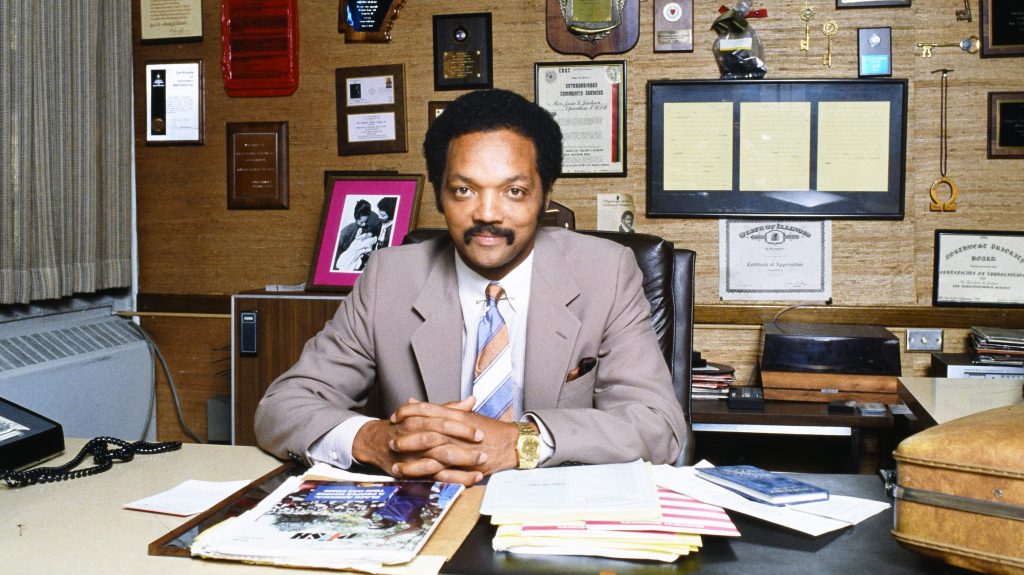
Reverend Jesse Jackson at his Operation PUSH office in August 1982 in Chicago.
Steve Kagan/Getty Images
Rev. Jesse Jackson, the towering civil rights activist and religious leader who worked to improve economic conditions for Black communities and advocated for social justice causes around the world, died on Tuesday. He was 84.
Jackson’s death was confirmed by his family, who said in a statement that he “died peacefully” while surrounded by family. “Our father was a servant leader — not only to our family, but to the oppressed, the voiceless, and the overlooked around the world,” the family’s statement continued. “We shared him with the world, and in return, the world became part of our extended family. His unwavering belief in justice, equality, and love uplifted millions, and we ask you to honor his memory by continuing the fight for the values he lived by.” A cause of death was not immediately available.
In November 2025, Jackson was hospitalized in Chicago, where he was put under observation for progressive supranuclear palsy (PSP), a neurological disorder that can affect body movements and balance. PSP is similar to Parkinson’s, which Jackson was originally diagnosed with in 2013. His PSP diagnosis was confirmed in April 2025.
For more than 50 years, Jackson was one of the most prominent activists in the United States. He got his start in the Sixties, working closely with Martin Luther King Jr., before founding two advocacy groups, Operation PUSH (People United to Serve Humanity) and the National Rainbow Coalition. (These two were later consolidated into the Rainbow PUSH Coalition.)
His opposition to Ronald Reagan led him to launch two presidential campaigns in 1984 and 1988. Though both fell short, Jackson registered millions of new voters and significantly overperformed expectations, finishing third in 1984 (behind Gary Hart and Walter Mondale) and second in 1988 (behind Michael Dukakis). For a brief moment in 1988, he even took the delegate lead over Dukakis after a massive win in the Michigan caucus.
As the most prominent and successful Black candidate for president at that time, Jackson helped set the stage for the election of Barack Obama 20 years later. But it was also reforms he advocated for in 1988, which changed how delegates were distributed during the Democratic primary, that made Obama’s victory possible, too. And Jackson’s campaigns, with their unabashedly progressive platforms, set a mold that future longshot, outsider candidates on the left, like Bernie Sanders, would follow for decades to come.