

When a food safety problem is discovered, there isn’t much done to make sure consumers find out. No one has to contact grocery stores or restaurants. No one has to notify consumers

Published:
Last updated:
A new report says fewer food recalls are being announced by the federal government, signaling that the U.S. Department of Health and Human Services is changing its approach.
The report, from the non-profit U.S. Public Interest Research Group (PIRG), says recalls are not made in a timely manner when outbreaks occur.
“When a food safety problem is discovered, there isn’t much done to make sure consumers find out. Under the FDA, companies are expected to notify the FDA and issue a news release. Under the USDA, companies must notify the USDA’s Food Safety and Inspection Service (FSIS). No one has to contact grocery stores or restaurants. No one has to notify consumers,” according to the PIRG report.
Not only are recall procedures vague, the process does not seem to place any urgency on companies under FDA jurisdiction to issue recalls.
“It sometimes takes years from the first illness before regulators identify a product to recall in an effort to prevent others from getting sick,” the PIRG report said.
“The November recall of infant formula connected to a botulism outbreak took nearly two years; the February recall of frozen supplemental shakes connected to a Listeria outbreak took more than six years.”
The PIRG report uses a Listeria outbreak involving ready-to-eat pasta meals as a case in point to describe some of the problems with the recall announcement system that is in place.
In June 2025, the U.S Department of Agriculture announced recalls involving three ready-to-eat pasta meals because of Listeria. In September and October there was a flurry of more recalls with 15 additional products being recalled.
The recalls were ultimately linked to an outbreak that began in August 2024. As of the last update in October 2025, there were 25 hospitalizations and six deaths.
“Why did the first recall take nearly a year? Why did some of the subsequent recalls take three or four months? Could any of the illnesses or deaths have been prevented if more information was available sooner?” PIRG asks in its report.
The FDA doesn’t even post public announcements for all potentially life-threatening recalls. In a Jan. 7, 2025, email to U.S. PIRG, an FDA spokesperson said: “The list on this page provides information gathered from firm press releases and other public notices about certain recalls of FDA-regulated products. Not all recalls have press releases or are posted on this page.”
The PIRG report also discusses the societal costs of foodborne illnesses, citing data from the USDA that shows medical care, lost productivity and premature deaths from foodborne illnesses cost Americans $75 billion annually. More than 16 percent of Americans likely are affected by foodborne illness annually.
“When we have thousands of people getting sick every year from contaminated food, we should think hard about what else can be done,” PIRG said in its report, Food for Thought 2026.
“We need to stop contaminated food from being sold, identify issues more quickly when something does slip through and warn consumers when contaminated food makes it to store shelves.”
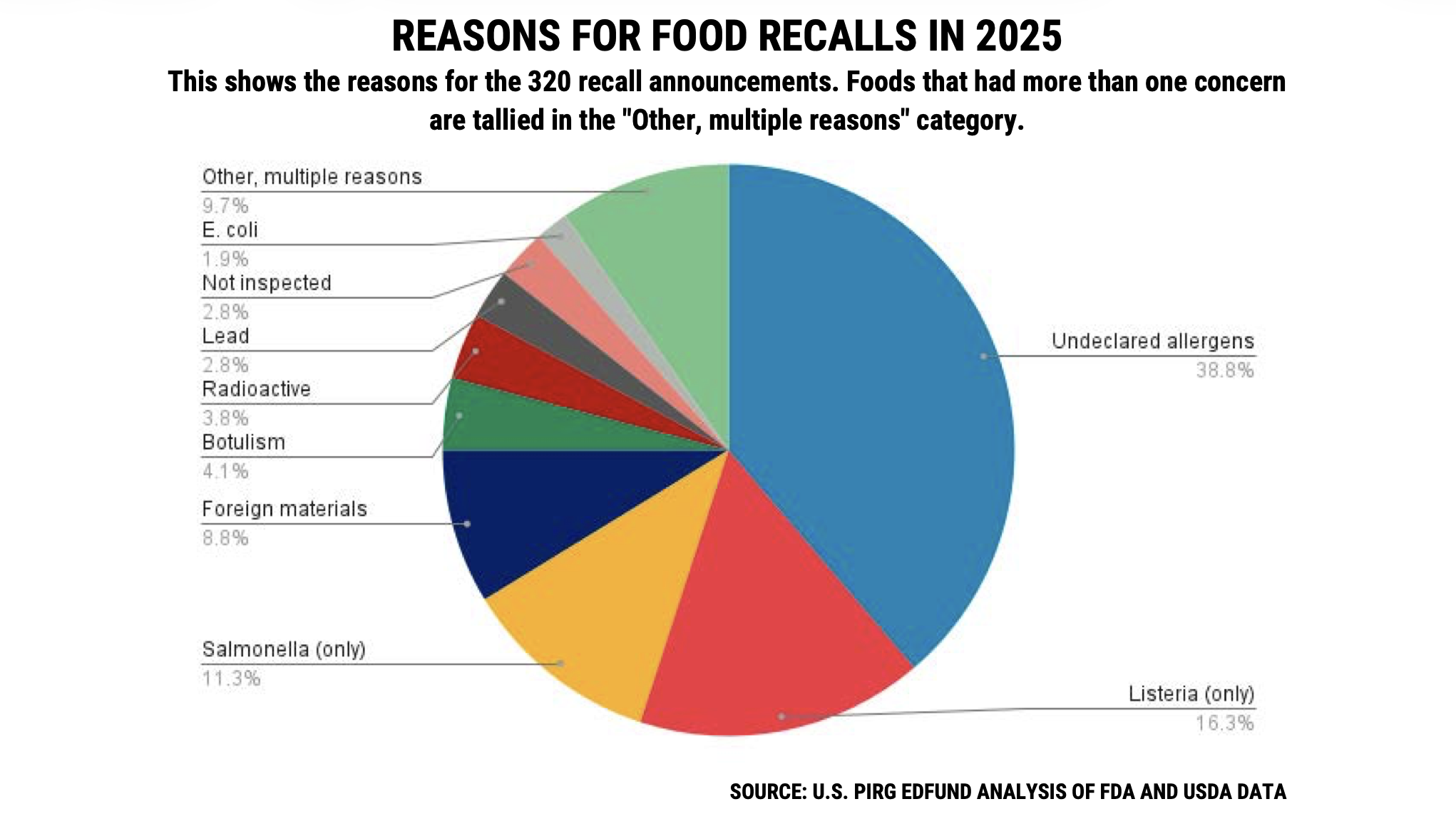
There were about 320 recalls announced in 2025, according to the PIRG report, with 48 percent related to allergens or foreign objects and 31 related to ingredients that had been previously recalled.
“Companies conducting a recall should be required to try to reach out to consumers directly, not just notify the FDA or USDA and issue a news release to alert their distributors,” PIRG says. “Many food manufacturers sure spend a lot of money to market their products to us. How about if they spend the same amount that was spent to sell us the product to inform us that it’s been recalled?”
The Food and Drug Administration’s delay of the Traceability Rule until July of 2028 is adding to the problem, PIRG contends. The plan to have the rule go into effect this year was altered by the Trump Administration. The implementation of the rule has been pushed to 2028.

Coral Beach
Managing Editor Coral Beach is a print journalist with more than 35 years experience as a reporter and editor for daily newspapers, trade publications and freelance clients including the Kansas City Star and Independence Examiner.

Cheese recalled because of Listeria
Auricchio brand Taleggio D.O.P. Cheese is being recalled in Canada because of contamination with Listeria monocytogenes.
This recall was triggered by the company, according to the Canadian Food

7-Eleven sandwiches, wraps recalled because of Listeria
7-Eleven brand sandwiches, subs and wraps are being recalled in Canada because of contamination with Listeria monocytogenes.
The products were distributed to 7-Eleven stores in Alberta, British Columbia and Saskatchewan.


Beef and pork jerky under recall in Canada
Soo brand Mala Spicy Flavoured Beef Jerky and Pork Jerky are being recalled in Canada because of mold on the products.
The recalled jerky was distributed in Alberta and British
Your Support Protects Public Health
Food Safety News is nonprofit and reader-funded. Your TAX-FREE gift ensures ongoing coverage of outbreaks, recalls, and regulations for everyone.
