

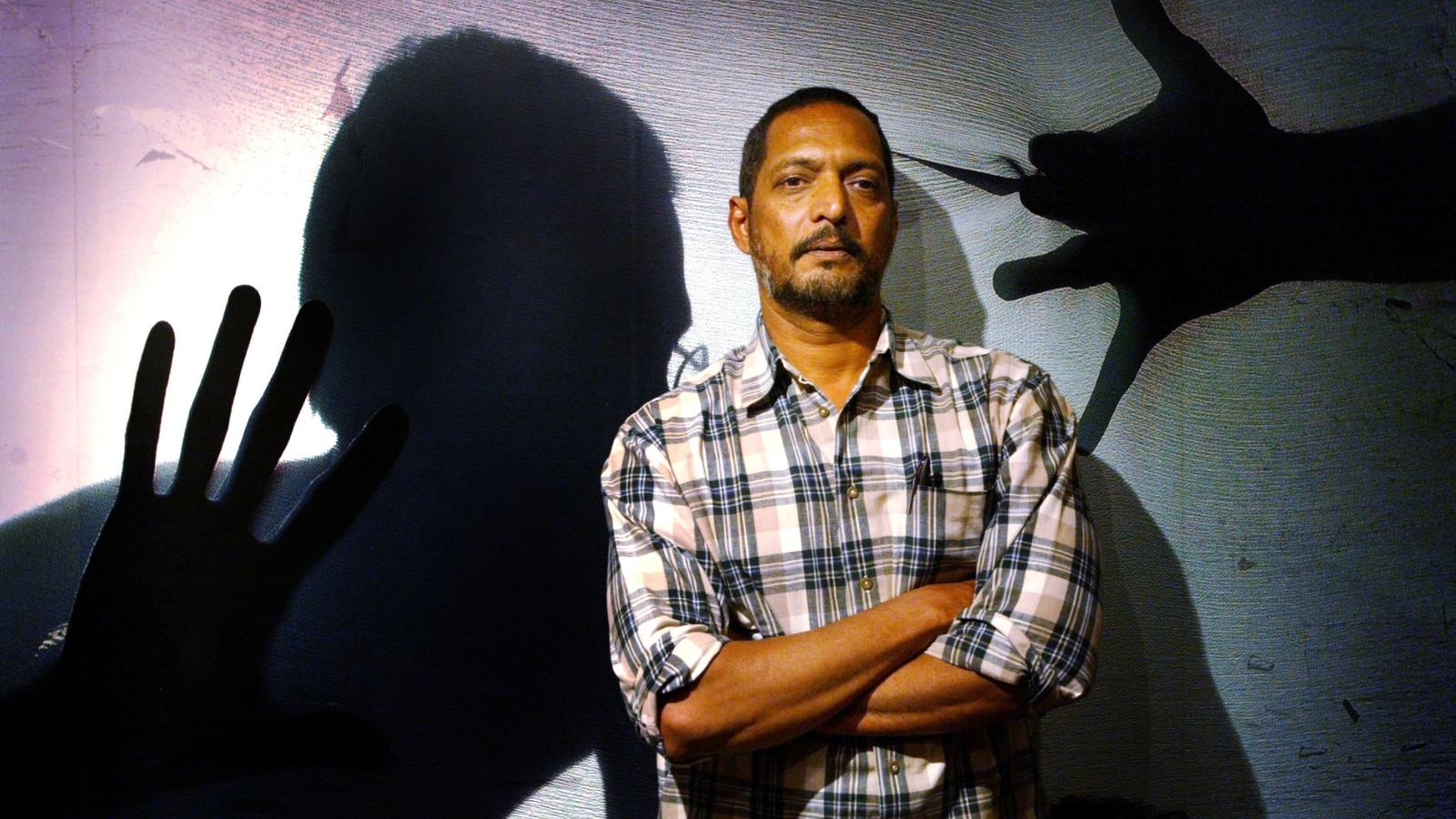
A short clip from a conversation between Anil Kapoor and Nana Patekar has resurfaced on YouTube after the latter passed away on Thursday, October 8. In it, true to his signature irreverence and abrasiveness, Patekar reprimands Kapoor for asking the director to cast another hero instead of him as the parallel lead for a film they did together decades ago.
“The role was initially offered to me. But you asked Vidhu Vinod Chopra to cast Jackie Shroff instead,” he rebukes Kapoor, still visibly hurt even after all these years. When Kapoor says both he and Chopra preferred Shroff for the role, Patekar replies instantaneously, “You were a big star. You could have convinced the director to cast me. But you did not.”
It’s a good thing he didn’t. For the film was Parinda (1990). Patekar’s blistering performance as its haunting villain Anna turned out to be his breakthrough, earning him his first National Film Award. The crammed and cobbled bylanes of the Mumbai film industry are rife with stories of Patekar’s mercurial temper, dead-pan humor, unpredictable, unfiltered behavior and a raw restlessness that underlined all his performances no matter how silly or serious.
In another recent interview, veteran filmmaker Amol Palekar discusses his reluctance to cast Patekar in his 1990 film Thodasa Roomani Ho Jaayen despite Patekar’s eager attempts to convince him. “The role had a softness, a poetic quality to it. Nana, meanwhile, was the complete opposite. When I told him that, he took it up as a challenge, came to my house everyday for 10 days, asking me to mould him the way I wanted. And true to his word, he was a totally different person by the end of it, so single-minded was his commitment to the craft,” Palekar says.
In an industry as image conscious as Bollywood, Patekar’s prolific acting career spanning nearly half a century shows the myriad fascinating things an actor can be when they accept themselves in their entirety—messiness, eccentricity, vulnerability, volatility et al—instead of trying to morph their identity into a commodity that can be manufactured, packaged, and sold. It is this decision to not mask the uncomfortable, hide away unpleasant that is at the root of Patekar’s trademark authenticity, which makes him so refreshing in an age of hyper-curated personas.
In his acting brilliance and political consciousness, he closely resembled Naseruddin Shah but unlike him, he carried the baggage of greatness lightly which he would shed without a hitch whenever. It was his superpower; it allowed him to comfortably inhabit films as disparate as Salaam Bombay! (1988), Krantiveer (1994), Khamoshi (1996), Raajneeti (2010), Welcome (2007), O’Romeo (2026) and Housefull 5 (2025).
In a country that still cannot have enough of the Three Khans in spite of over 35 years of more of the same, Patekar helped forge the roadmap for all those who, like him, wanted to tread the path of the middle-of-the-road cinema. Had there been no Nana Patekar, there probably wouldn’t have been any Irrfan Khan, Manoj Bajpayee or Rajkummar Rao. Patekar ran so they could walk in all directions and expand the realms of possibilities.
We live in an age when celebrities prioritize personal gains over public good and rarely join the frontlines without an agenda. At a twisted time like this, Patekar’s work to mitigate the water and agrarian crisis with The Naam Foundation which he co-founded in 2015 is a testament to how actors can (and should) extend their celebrity for social responsibility.
Patekar was arguably the last of the irascible, politically conscious mainstream Hindi film heavyweights but his legacy, like most, is hardly linear and not without complications. In 2008, actor Tanushree Dutta accused him of sexual misconduct and intimidation, opening up a Pandora’s box and triggering the #MeToo movement in India 10 years later. Patekar was eventually cleared of all charges by the court, citing lack of evidence. However, in a country where gender violence is endemic and law is readily manipulated, judgements ought to be read between the lines.
As the nation mourns his passing, Nana Patekar—true to the messy, menacing characters he played on screen—serves as a reminder of the need to acknowledge the vast multitudes and vicissitudes that make us all, the darkness that often lurks behind greatness, and what a folly it would be to reduce any being to binaries.
