

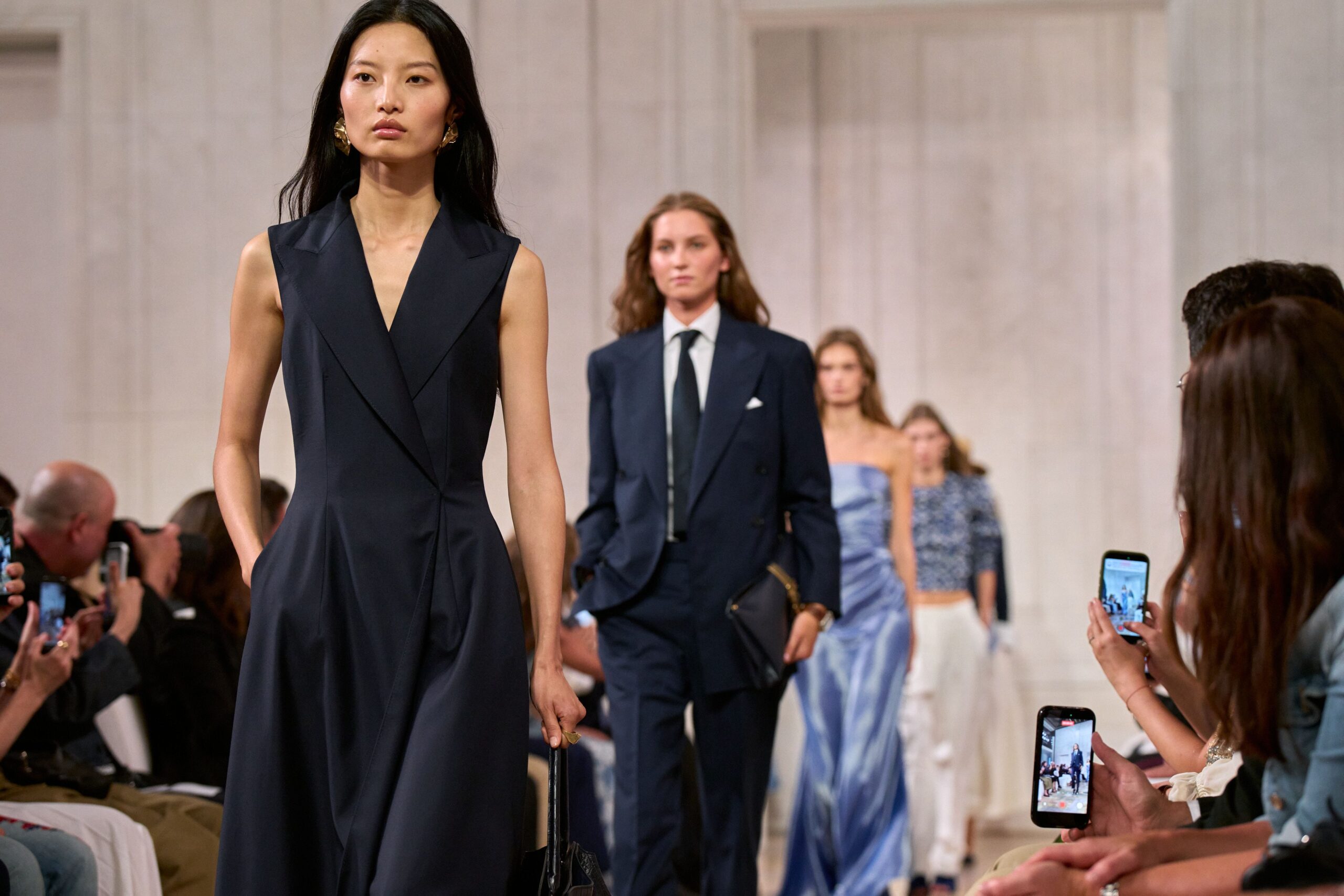
Earlier this year, Ralph Lauren released a monograph of his runway collections, part of the popular Catwalk series that has given the same treatment to designers like Vivienne Westwood and Miuccia Prada. It was an astute move given that the all-American sartorial icon is celebrating the 60th anniversary of his brand next year, and that his vernacular, the Ralph look, has been in the zeitgeist, with influencers appropriating his signature high-low styling: a colorful rain coat over a proper double-breasted suit, or a tuxedo jacket and cummerbund worn with blue jeans.
Celebrities have turned to Lauren’s oeuvre of late, too. Last December, Sabrina Carpenter wore a look from his spring-summer 2003 collection, a favorite by fashion netizens on Pinterest and X. At Lauren’s spring-summer 2027 show on Wednesday, which kicked off New York Fashion Week, it seemed like Carpenter’s patchwork mermaid gown, with its mix of denim and white lace and corsetry and golden bijoux, was at the center of Lauren’s mood board.
Viola Davis and Cynthia Erivo sat front row, whispering in each other’s ears; on the runway, Lauren delivered a monologue in the shape of a collection of his greatest hits.
“Spring 2027 is an irreverent take on romance that creates a new elegance,” Lauren said, “It’s about ways of dressing that celebrate ingenuity, originality, and character.” With blonde models sporting middle parts and Sting’s “Every Little Thing She Does Is Magic” reverberating in the background, there was a tinge of romance and optimism in the air, a welcome perspective on the eve of the 25th anniversary of 9/11 and following July’s lackluster semiquincentennial celebrations of the United States.
There was a terrific lamé dress in indigo blue, the kind one could easily imagine as a red carpet look on a pop star like Carpenter.. There were corsets in cotton lace and low-slung jeans and denim workwear trimmed with feathers or accessorized with lots of golden necklaces. It was all beautiful and romantic, less preppy than prim, and quintessentially American. And yet, it felt less like an ode to individuality than a celebration of Ralph Lauren. Which is fair enough—do we need Lauren to do and be more, to redraw the blueprint that he provided for contemporary American style?
The American way of dressing, sportswear and pragmatism, has also been trending on European runways, including Celine and Dior.
It seems to have inspired the next generation of designers to attempt to reclaim what’s theirs. Quoting Lord Tennyson via email, Jack Carlson, the new-ish designer behind J. Press, the prep outfitter founded not too far from Yale University over a century ago, illustrated this point: “Men may come and men may go, but I go on forever.”
“It may ebb and flow on runways and moodboards, but J. Press is and will always be ‘the real thing,’” he said, answering a question about American prep but applying it to his label.
At his show, also on Wednesday, Carlson iterated on the original spirit of prep with nods to that very Ralph men’s styling. Much of it worked because it felt instinctual, like a bright orange parka worn over a black suit—a New Yorker leaving work on a rainy day to attend a sort of black tie gala—but some of it felt more two-dimensional, like dressing for a TikTok. The soundtrack started with the sound of a classic American ballad, and transitioned abruptly into “Safe and Sound” by the Californian synth-pop duo Capital Cities, whose sound is representative of the Obama-era Millennial pop-timism of the 2010s. In a way, that is what Carlson is trying to do on the runway: mediate between American tradition and its present, even if with some too-sharp turns along the way.
Michael Kors and Tory Burch had similar ideas about what American style is today. The lattersaid after her show on Thursday evening that she was going for something that felt optimistic and joyful, ambiguously referring to the state of the world, as fashion designers of her stature often do. She also said that she wanted things to feel “a little off-kilter.” That description applied to her and Kors’s collections, both of which seemed intent on reexamining the great tradition of American sportswear.
Burch’s was a little kookier, and her emphasis on texture and material largely worked, though it looked as if the edge the collection was intended to have had been buffed out in favor of something more democratic—granny sweaters were beaded in pop colors and classic preppy boat shoes rendered as pointy heels. It wasn’t necessarily cool, but Burch is having fun, and it was delightful to spot Deeda Blair, one of the better dressed American women likely ever, sitting in the front row. For the rehearsals for her show, Burch outfitted her models with t-shirts that celebrated the late Gloria Steinem. One wishes that tee would’ve popped up on the runway under those sweaters or her a-line coats—Burch doesn’t need to be eccentric to speak to the women who aspire to be like Steinem, or like her.
Rosalía and Tate McRae arrived at Veronica Leoni’s Calvin Klein Collection show on Friday in what looked like two different brands: the first wore a clerical-looking black dress and the second some classic blue jeans. These ends of Leoni’s spectrum as a designer are currently in competition on her runways—on one hand, there’s the more conceptual, and on the other, her austere and sharp take on Klein’s minimalism. She made strides this season by, she said in an interview ahead of the show, choosing to focus on the “100% essential.”
There was more clarity at Eckhaus Latta, where designers Mike Eckhaus and Zoe Latta celebrated the launch of their partnership with J.Crew on their runway, which followed a spring collection that seemed to have a firmer grasp on what American—style is today: t-shirts were worn doubled up and cut to expose the biceps, skirts and dresses were cut in wispy fabrics and jeans wide at the legs but low-slung. Eckhaus and Latta have become the unofficial outfitters of NewYork City’s young millennial set, and that is because they have an understanding of what that pocket of people see as attractive: revealing just enough—the arms, the midriff, and even only the feet—while preserving a sense of mystery. Their runway customer is niche, but their ambitions are not. Eckhaus Latta has often been defined as a forever indie brand—an independent label that makes clothes for a singular niche. And yet with J. Crew, and another partnership with Mango earlier this year, Eckhaus and Latta have confirmed what many have always known: that their collection has mainstream appeal.
“This idea that your brand is about this, your brand is about that,” Eckhaus ruminated on this in an interview ahead of the show. “It’s an interesting tension to build, when part of it feels perhaps more austere, more serious, more centerd, or provocative, or sensual, or something that’s more playful or silly or lighthearted,” he continued. “Why should one have to choose?”
Their after-party, however, was most indicative of their understanding of the all-American vernacular: hosted at the National Arts Club, a Gramercy Park mansion, it was realized like a frat party with fashion editors playing beer pong, models eating pretzels and cheese balls, and singer Moses Sumney posing for photos on a basement pool table.
And yet it’s still an odd week for celebrations in New York.

Coach
Billy Farrell/BFA.com
With Troye Sivan and Elle Fanning on the front row, plus a disco ball and a tower of shrimp and seafood, Stuart Vevers celebrated 85 years of Coach, the quintessentially American leather goods house.
Vevers, who is British (and who I worked for early in my career, while I was still a fashion designer) has always been fascinated by the American youth. And yet, what he showed on the runway felt overly melancholic—there were great slips and leather tank tops, but his models look too young and at times too thin. When when the confetti dropped and his collection turned brighter and celebratory, there was a feeling that the party was over. Perhaps disillusion is a very American sentiment at the moment, but this country has always found a way to remain optimistic. In that, Lauren remains American fashion’s most trustworthy oracle.
-
From Prince George to Princess Leonor: Where Young Royals Will Attend School This Fall
-
The Pitt’s Patrick Ball on Shipping, Stardom, and Season 3
-
From Cowboys to Clean Girls: The State of American Style, in Pictures
