

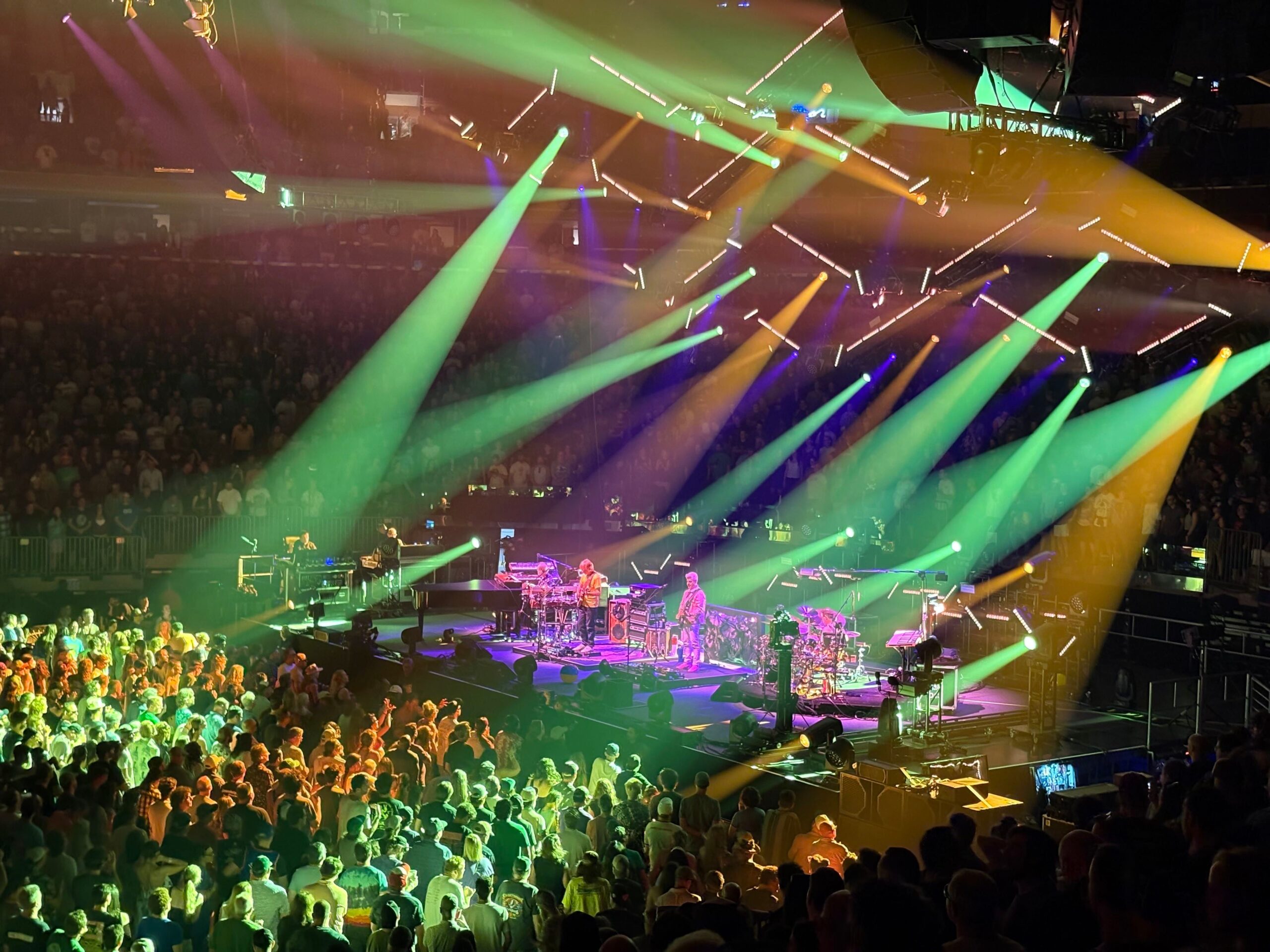
“What the fuuuuuuck, man?” the woman shouted up at a screen that read, “Biometric identifier information collected at this location.” She cheesed and mugged and danced her middle fingers up at the message. She was only here for a good time, not to be spied on, she told me, laughing slightly maniacally. Kirsten was her name; she drove down to New York City from New Hampshire, had sewed her own corduroy patchwork top but didn’t finish the halter in time so the straps were held on with salon clips featuring an alien on one side and a plastic sprig of berries on the other. Whatever works, man. She wore not a speck of makeup beyond a modest dusting of silver glitter on her cheeks, the adornment of choice for women at a Phish show. All 30 of us.
There aren’t very many women at Phish shows these days, which is why the line to get your bag searched is so short. That’s where I met Kirsten, as we marveled over Madison Square Garden’s data collection methods, part of a mind-blowing surveillance system that Noah Shachtman and Maddy Varner recently reported on for Wired. (The owners of Madison Square Garden have sued Wired for defamation in a case that is still pending. Wired stands by its reporting; Condé Nast owns both Vanity Fair and Wired.)
A security guard wanted to make explicitly sure he understood whether or not Kirsten was with the guy standing behind her, whose purple shorts featured a rambunctious cactus print. I couldn’t tell whether they were together or not, but the guard seemed to be saying, “I think I’m about to find contraband on one of you.” Kirsten looked like she’d been to a few shows, though she told me she didn’t keep count—it would not be chill to keep count, she suggested, or at least to tell me the number. And if you’ve been to a few shows, you probably have seen your fair share of fanny-pack pharma buffets. Your own fanny pack might even be filled right up. The guard let her and Cactus Pants skip off (definitely together) without even unzipping her Cotopaxi, but he dug into my tiny crossbody and scrounged around as effortfully as he could, suspiciously examining my vintage lipstick case. He wanted badly to have found a stash, but it was just my trusty Gucci 25 Goldie Red. I puckered up and kissed the air. “Your husband’s gonna get jealous,” he sneered as he tossed it back in and waved me through.

Candidates, listen up! The road to 2028 runs through a Phish show.
Courtesy Claire Howorth
Who even needs drugs when this is the scene? Madison Square Garden, home of the Knicks. Wedding altar of Taylor Swift. Cultural birth canal from which Tony Hinchcliffe slickly emerged as a household name. The place where Kalshi currently has the naming rights to an entire concourse. And now, for five nights in July, Phish, barrelling toward its 100th show here, second only to Billy Joel in MSG prolificacy.
Everywhere, there are middle-aged white men looking blissed out, in Ween and Waterwheel and Dead at the Sphere shirts. (Candidates, listen up! The path to 2028 runs through a Phish show!) Nowhere is there a person under 32. Somewhere, Jimmy Dolan is watching all of us.
Phish fans, crystallized in my mind by personal experience, used to be mostly in their 20s, college kids—they were my age. Now, it seems, they’re still my age. (The guys in the band—started in 1983 by Anastasio, bassist Mike Gordon, and drummer Jon Fishman, to be joined by pianist Page McConnell—somehow seem ageless, despite having been on the road for 40-plus years.)
Until Monday night, I had not been to a Phish show in almost 26 years, since before the band’s 2000 hiatus, which caused me to patch my college years with String Cheese Incident and Widespread Panic shows. (If you aren’t familiar with these bands, this will all sound like Dr. Seuss via ChatGPT.) Bill Clinton was the president and I didn’t own a cell phone. “Vibes” were a thing, but they hadn’t shifted in as many directions. Vibes were the reason I ever went to a Phish show in the first place, scrounging around like a security guard for a scene and a feeling and a vague cultural-political alignment that I suspected my mother got from the Grateful Dead and the 1970s. (“Why on earth do you care so much about a cover band?” she once asked me of Phish, a rhetorical bitch slap that still makes me laugh.) My prefrontal cortex, for better or worse, developed during my Phish era. But when college ended, so did my show days, and I never really looked back.
Then last year, Amanda Petrusich wrote the most perfect outsider-inside story about Phish for The New Yorker. She precisely captured the occasional cringe and the enduring appeal of the band: The lyrics can be impenetrable, but the members are profoundly talented rockers, and the fans can be kind of ridiculous but are duly genuine. More than anything, the music can seduce you. By this point, I was way outside the Phish realm, but the story pricked an urge to go to a show again.
Would the lot scene exist? Could I barter some glitter for a quesadilla? Would the scary girls with fairy wings still be hanging around a trust-fund junkie with a tank of nitrous? A friend told me the lot scenes now are as commercial and managed as anything else in the world. Probably for the best in the age of cyclospora not to eat too many tour burritos, but what about that guy who depended on selling you some rocks—not crack rocks, but the geological kind—to fund his tickets?
Unless it was hiding in Penn Station, the lot scene did not exist at MSG. What did exist was overflow Knicksmania, which Phish turned into its theme for this run of shows: Phish in 5, during which the band would revisit its ’90s music, applying a year to each night. Monday was dedicated to 1995, meaning every song the band played would be one it debuted or wrote that year. “Anastasio is vehemently uninterested in Phish becoming a nostalgia act,” Petrusich wrote last year. I’m not sure that holds true, certainly not for this latest MSG run. When Phish whipped out the ultrarare “Johnny B. Goode,” which they had not played since 1998, the crowd freaked out. But it doesn’t matter, the whole schtick was pretty perfect for me, seeing as it dovetailed exactly with my years of fandom.
Inside the warm cocoon of the stadium, despite MSG’s catalog of 17 prohibited items that includes “alcohol and illegal substances” (except the beer I consumed by the $24 cupful), it seemed perfectly fine to get lit, judging by the haze, fragrance, and relative lack of interference from any security other than those trying to corral wayward noodlers. NYPD had assumed a casual presence outside the arena. “Do any of you like Phish?” I had asked a group of 12 male officers loitering at the Seventh Avenue entrance. “No!” two of them practically shouted. The others didn’t answer me at all, but I don’t think they were hiding secret fandom.
It was safe inside. Cartoonishly so. Phish and its fans have a thing with balloons—people blow up giant ones and bounce them around the room. The visual is pleasant—a stadium-scale bubble bath—and the physical boop is not terrible either. At one point I felt a tap-tap on my shoulder. I turned around to the gentleman in the seat behind me. He looked to be in his early 60s, wearing a T-shirt for some bar on Long Island and a belt needlepointed with Jerry bears. He didn’t say anything, didn’t smile—we were mid “Theme From the Bottom,” serious business—he just pointed to a sunken balloon near my feet. He wanted me to launch it back into the smoky air where it belonged. I obliged.
To my right was my husband, who made it nearly 50 years without seeing Phish and says he will be processing Monday night for the next 50. To my left was a group of friends who had none of Kirsten’s real or fake chill and eagerly told me exactly how many shows they’d been to.
“Two hundred and ninety-eight,” said George, who was there from Annapolis, where he owns what he described as a “Phish-themed butcher and charcuterie shop.” It took me a few Googles later on to find The Ugly Pig, which must be the place; the song “Guyute” is about an “ugly pig / Who walked on me and danced a jig.” (Phish would appreciate this, I think; the band has more folklore and Easter eggs than Taylor Swift could possibly fathom.) George and his friends were planning to celebrate what would be his 300th show in a suite at Fenway, where Phish will play later this week.
If George paid around $150 on StubHub for each show—less for the many years when an average ticket was cheaper; more if he’s buying out boxes—he could easily have dropped $45,000 on tickets alone. Throw in some arena beers, merch, and travel, and you have a six-figure passion that does not come with a motor. “Phans” (I’m sorry, I cannot bear to do a bunch of ph-words throughout this story, but that’s what they’re called) like George keep the band’s gross haul steadily approaching $1 billion; they’re one of the most popular acts in the world, ranking above Paul McCartney and Toby Keith for tour popularity in this century, according to Pollstar. (Shout out to George—if I’m ever in Annapolis, I will support your pursuit by buying a meatstick.)

College roommates on our way to a show at Red Rocks, with the Flatirons behind us.
Courtesy of Claire Howorth
“A huge part of it is nostalgia,” Katy Tur told me. “Phish is irreverent and absurdist and never self-important. It’s joy in a stadium.” The MS NOW anchor and noted Phishhead went to two of these New York shows. “It takes me back to being a teenager, before life and the world got so complicated. For a few hours, you get to surrender back to that flow.”
Tur also acknowledged the “so many dudes” aspect (she says she’s been taking her girlfriends to shows to help the ratio). “But to be fair there is more variety among the dude phenotype than you would expect. There’s hippie dudes and Patagonia dudes but also corporate lawyer dudes looking for a night off. There are dudes that look like they’ve spent every night of their life on a bus and dudes that look like they own the bus company.”
“It’s sort of like their megachurch or their Kripalu. It’s a place to feel!” offers Michelle Ruiz, a friend and Vanity Fair writer who has written for Vogue about being a “Phish wife.”
“Phish is like a free space and a cosmic release for middle-aged males who were probably raised with a ‘boys don’t cry’ mentality,” she told me. “The shows are sort of tantric, trance-like, allowing these males to shed their societal skin.”
The last time I saw Phish until this week was September 27, 2000, at Fiddler’s Green near Denver. I was a freshman in college, with good friends from home. One of them would die a few years later, when he was only 28, before I turned 25. “Strange Design,” another relatively rare live song, had been one of Ryan’s favorites. It’s a wistful ballad, and more accessible than a lot of their other songs; it goes like this:
I’m feeling my heart’s not beating anymore
I’m feeling it’s all right, this happened once before
I’m fine, I’m fine ’cause I’m
Dripping in this strange design
None is yours and far less mine
Hold the wheel, read the sign
Keep the tires off the line
Just relax, you’re doing fine
Swimming in this real thing I call life
Can I bring a few companions on this ride?
The song debuted in 1995, at a Voters for Choice benefit concert hosted by Gloria Steinem, after an antiabortion extremist murdered two women at a Planned Parenthood and another family-planning clinic in Massachusetts. Phish played that concert with new material, including “Strange Design.” I didn’t learn this micro-history until this week, as I waded through the heaviness of my memories.
Phish didn’t play “Strange Design” that night in 2000, though I recall dreamcasting it on the setlist with my friends. But they did play other favorites—”Sample In a Jar” and “Limb By Limb” are two of mine—and we flailed around on the lawn of the amphitheater, very young and very alive. They closed that show with “Loving Cup,” a Rolling Stones song, but one that Phish has played so often it’s become a beloved appropriation. (That’s a cover band for you, Mom!)
On Monday night in 2026, at the end of the show, Phish played “Strange Design.” Then, they closed with “Loving Cup.” I was back at Fiddler’s Green, and reveling in the present. Nostalgia may not be Anastasio’s intent, but I can live with it as my own motivation. Next time I’d just rather be in an amphitheater.
-
The 10 Biggest Odyssey Updates From Homer’s Original Text to Christopher Nolan’s Latest Film
