







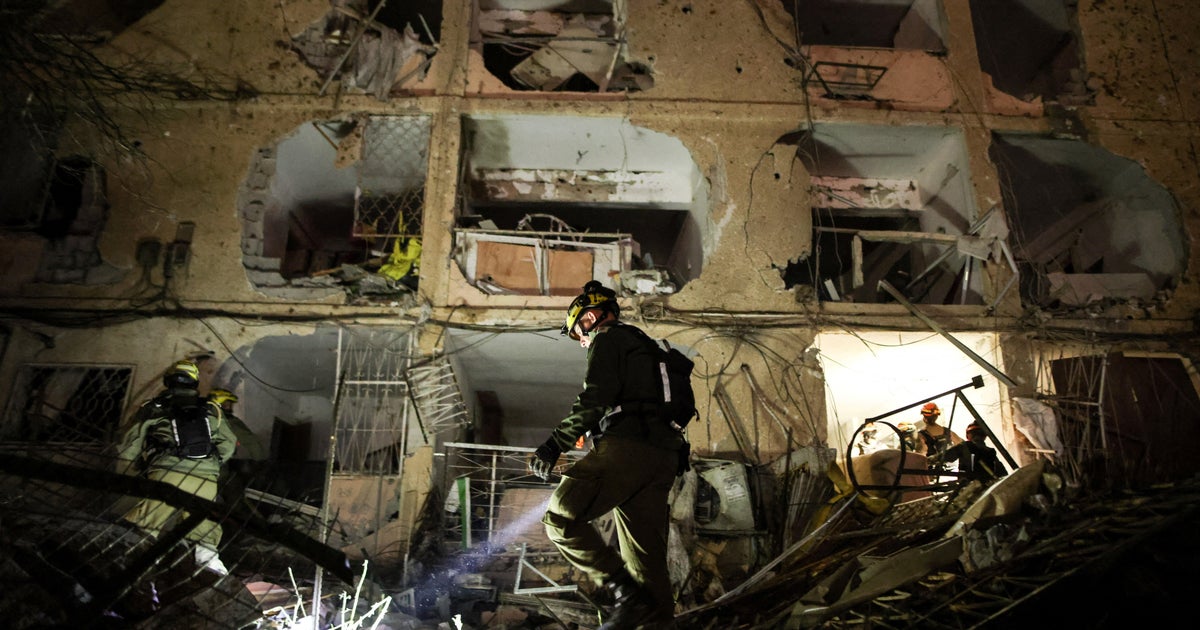
Iran releases detained Japanese national, Japan’s foreign minister says
Japan’s Foreign Minister Toshimitsu Motegi said Sunday local time that one of two Japanese nationals detained in Iran has been released and will be returning to Japan.
Motegi, speaking on a Fuji Television talk show, said the person had been detained since last year and was released on Wednesday. He said the person took a flight from Azerbaijan which was scheduled to arrive in Japan on Sunday.
Motegi said another Japanese national who was arrested earlier this year is still in custody.
Motegi said the release came after his repeated demands to Iranian Foreign Minister Abbas Araghchi, and that he is “working to win an early release” of the other detainee while communicating with his family and other concerned parties.
Motegi did not identify either of the people detained and said the released Japanese national was detained in 2025.
Injury toll rises to 64 in Iranian strike on southern Israeli town of Arad, officials say
Israel’s Magen David Adom emergency rescue agency says that at least 64 people have been injured in the Iranian strike on the southern Israeli town of Arad early Sunday morning local time.
Magen David Adom reported in a social media post that of the 64 people taken to area hospitals, seven were in serious condition, 15 were in moderate condition and 42 are in mild condition.
Magen David Adom teams are continuing to search the debris for more casualties, the agency said.
An Iranian strike hours earlier on the nearby town of Dimona had injured at least 40 people, Magen David Adom previously reported.
Dimona and Arad are located near Israel’s main nuclear research center. Iran said the strike on Dimona was in retaliation for an earlier strike Saturday on Natanz, Iran’s main nuclear enrichment facility.
Qatari military chopper crashes at sea due to “technical malfunction,” officials say
A Qatari military helicopter crashed early Sunday morning local time in the Persian Gulf.
Qatar’s defense ministry reported on social media that the chopper suffered a “technical malfunction” during a routine flight which caused it to crash off Qatar’s coast.
A search and rescue operation was underway. The defense ministry did not say how many people were aboard the chopper at the time of the crash.
Israel launches new wave of strikes on Tehran, IDF says
Hours after Iran struck two southern Israeli towns with missiles, wounding dozens of people, Israel’s military launched fresh strikes on Tehran.
Israel Defense Forces early Sunday morning local time said it had “just begun a wave of strikes targeting the infrastructure of the Iranian terror regime in Tehran.”
Iranian military says it will target energy, desalination infrastructure in Middle East if Trump carries out power plant threat
Iran’s military renewed threats against the region’s infrastructure after President Trump threatened to “obliterate” power plants in Iran if the Strait of Hormuz is not swiftly reopened.
“Following previous warnings, if Iran’s fuel and energy infrastructure is violated by the enemy, all energy, information technology and desalination infrastructure belonging to the US and the regime in the region will be targeted,” Iran’s military said in a statement carried by Fars news agency.
The statement comes after Mr. Trump Saturday night gave Iran a 48-hour deadline to open the vital route in the Gulf to shipping traffic.
Trump threatens to “obliterate” Iran’s power plants if Strait of Hormuz not reopened within 48 hours
President Trump Saturday night threatened to destroy Iran’s power plants if the Strait of Hormuz is not reopened within 48 hours.
“If Iran doesn’t FULLY OPEN, WITHOUT THREAT, the Strait of Hormuz, within 48 HOURS from this exact point in time, the United States of America will hit and obliterate their various POWER PLANTS, STARTING WITH THE BIGGEST ONE FIRST!” the president wrote in a Truth Social post.
Iran’s largest power plant is the Bushehr Nuclear Power Plant, located on the Persian Gulf in southwest Iran. It is Iran’s only commercial nuclear power plant.
The Strait of Hormuz has been effectively closed to most ship traffic by Iran’s military forces since the war began three weeks ago. The crucial waterway is responsible for the movement of approximately 20% of all global oil, and its shuttering has led to a spike in gas prices.
Mr. Trump’s statement comes after the Treasury Department Friday announced that it was lifting sanctions on Iranian oil at sea as it attempts to bring down those prices.
After Iranian missile attacks, Netanyahu says Israel will “continue to strike our enemies”
Following two Iranian missile strikes on southern Israel that officials said wounded at least 70 people, Israeli Prime Minister Benjamin Netanyahu vowed early Sunday morning local time that Israel’s military would continue in its war efforts in the Middle East.
“This is a very difficult evening in the campaign for our future,” Netanyahu said in a statement posted to social media, adding that he had spoken to the mayor of Arad, one of the two towns that was struck, and conveyed “our prayers for the peace of the injured.”
“We are determined to continue to strike our enemies on all fronts,” Netanyahu wrote.
At least 30 more wounded in Iranian missile strike on second Israeli town
Israeli firefighters said a “direct hit” by an Iranian missile on the southern Israeli town of Arad caused extensive damage, with medics reporting around 30 people wounded.
Israeli media showed badly damaged buildings in Arad, about 15 miles northeast of Dimona, a town struck hours earlier. Both towns are located near Israel’s main nuclear research center.
Lt. Col. Nadav Shosh, an Israel Defense Forces spokesperson, said that, in total, more than 70 people were injured in the two strikes.
“It is becoming increasingly clear that the Iranian regime is resorting to reckless attacks that only further expose its instability and disregard for human life while strategically targeting civilians,” Shosh said in a social media post.
“In both Dimona and Arad, interceptors were launched that failed to hit the threats, resulting in two direct hits by ballistic missiles with warheads weighing hundreds of kilograms,” firefighters said.
An Israeli soldier uses a torch to inspect the damage after an Iranian missile strike struck the town of Dimona in southern Israel on March 21, 2026. Ilan Assayag / REUTERS 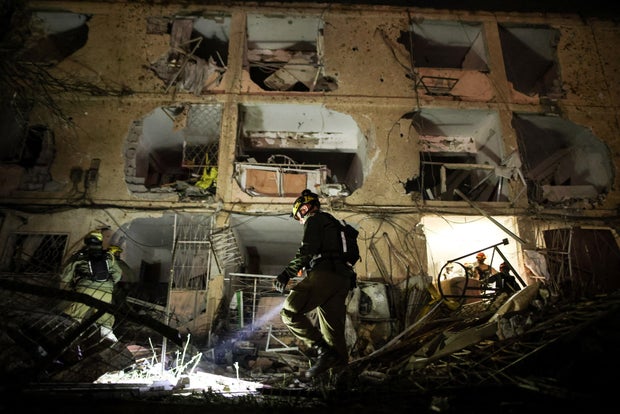

The local fire service said there was “extensive damage” from the Arad strike, with three buildings affected and a blaze sparked in one of them.
Magen David Adom first responders said they were taking 33 wounded people to hospital from the Arad strike, including four with serious injuries, 12 with moderate injuries, and 17 with minor injuries.
“This is a very severe scene,” emergency medical technician Yakir Talkar said in a statement, adding there were “many wounded with varying degrees of injury.”
The casualties in Arad came after an Iranian missile strike on Dimona left at least 30 people wounded.
Iranian state TV said the missile attack on Dimona in the Negev desert was a “response” to an earlier strike on its own nuclear site at Natanz.
CBS/AFP
Iran used two-stage intercontinental missile in failed strike on U.K-U.S. base in Indian Ocean, Israel says
U.K. officials did not give details on the unsuccessful Iranian strike Friday that targeted the Diego Garcia base. Britain’s Ministry of Defense described Iran as “lashing out across the region.”
Diego Garcia is a joint U.K.-U.S. base located on the island of the same name in the Indian Ocean, almost 2,500 miles away from Iran.
Iran targeted Diego Garcia Island with a two-stage intercontinental ballistic missile, Israel’s military said. This refers to a missile with at least two rocket engines, one allowing the missile to reach space, and the other propels it to its target.
“These missiles are not intended to strike Israel. Their range extends to the capitals of Europe — Berlin, Paris, and Rome are all within direct threat range,” Israel Chief of Staff Lt. Gen. Eyal Zamir said on Saturday evening.
Iran previously limited the range of its ballistic missile program to 1,240 miles, but U.S. officials have said Iran’s system for satellite launches could extend their range.
“Ballistic missiles are space rockets. They launch, they go really high up and they come down really fast,” said Steve Prest, a retired Royal Navy commodore. “If you’ve got a space program, you’ve got a ballistic missile program.”
Prest said the launches were likely a message of defiance, to say “look what we can do,” in response to President Trump’s claims that Iran’s military has been obliterated.
Britain has not participated in the U.S.-Israeli attacks but has allowed U.S. bombers to use its bases to attack Iran’s missile sites. On Friday, the U.K. government said bombers could use Diego Garcia to attack sites used to target ships in the Strait of Hormuz.
Iran says it is targeting Israel’s nuclear program, several injured in Dimona
Nearly two dozen people in the southern Israeli city of Dimona were injured following an Iranian missile strike on Israel’s main nuclear research center, according to the country’s rescue services.
The Israeli army told AFP there was a “direct missile hit on a building” in the town in the Negev desert. Magen David Adom first responders said a 10-year-old boy was among those with shrapnel wounds who were treated.
Dimona hosts a facility just outside the main town, widely believed to possess the Middle East’s sole nuclear arsenal, although Israel has never admitted possessing nuclear weapons.
Iran said it is targeting Dimona after the Natanz nuclear enrichment site was targeted earlier. Israel’s military said it was not responsible for striking Natanz.
CBS/AP
Iran claims there is no crude oil stranded at sea for the U.S. to lift sanctions on
Saman Ghodousi, Iran’s Oil Ministry spokesperson, told the country’s state media that the United States’ announcement that it will lift sanctions on Iranian crude stranded at sea is an attempt to manipulate the market because there is no such oil.
“At present, Iran essentially has no crude oil left in floating storage or any surplus available for supply to other international markets, and the U.S. Treasury Secretary’s remarks are solely intended to reassure buyers and manage the market psychologically,” he said late Friday.
On Friday, the U.S. Treasury authorized the purchase of Iranian oil that’s already at sea, exempting buyers from the tight sanctions that have restricted the country’s oil industry for years.
Treasury Secretary Scott Bessent said Friday the move could free up around 140 million barrels of oil that otherwise would’ve been “hoarded by China on the cheap,” referring to China’s status as the largest importer of Iranian oil.
CBS/AP
Mojtaba Khamenei, Iran’s new supreme leader, believed to be alive, U.S. officials say
Iran’s new supreme leader, Mojtaba Khamenei, is believed to be alive, but his condition is unknown, U.S. officials tell CBS News.
Khamenei, the son of Iranian Supreme Leader Ayatollah Ali Khamenei, who was killed in a strike on the first day of the war, did not appear in public on Friday for the Iranian New Year.
For the past three decades, the country’s supreme leaders have typically marked the occasion with a public address. However, this year, Iran’s state news agency, Tasnim, instead posted a statement from and a photo purportedly of the new leader.
Khamenei’s absence is notable, U.S. officials said, because a public address could offer a useful opportunity to push a message of unity during a time of conflict. Khameni was believed to have been injured in the strike that killed his father.
U.S. intelligence officials told CBS News that an effort is ongoing to determine the authenticity of the photo released by Tasnim and are assessing whether it was AI-generated.
Egypt and Saudi Arabia say Iran’s attacks on Gulf states endanger regional stability
Egypt’s president Abdel-Fattah el-Sissi and Saudi Crown Prince Mohammed bin Salman stressed Saturday that the Iranian escalation against Gulf states endangers the safety and stability of the region.
The state-run Saudi Press Agency reported that el-Sissi reiterated his country’s rejection of the Iranian attacks on the Gulf states, adding the Egyptian president expressed solidarity with the Kingdom against threats.
Also Saturday, Arab League chief Ahmed Aboul Gheit welcomed the visits of el-Sissi and his Jordanian counterpart King Abdullah II to multiple Gulf states over the past few days, saying that these visits “reflect full Arab solidarity.”
CENTCOM says U.S. military has “degraded” Iran’s ability to threaten Strait of Hormuz
The head of U.S. Central Command said Saturday that Iran’s ability to threaten the Strait of Hormuz has been “degraded” and that U.S. forces “remain on plan to eliminate Iran’s ability to project meaningful power outside its borders.”
Adm. Brad Cooper, in a video update posted on X, said the U.S. dropped multiple 5,000-pound bombs on an underground facility along Iran’s coastline that was used to store anti-ship cruise missiles, mobile missile launchers and other equipment “that presented a dangerous risk to international shipping.”
“We not only took out the facility but also destroyed intelligence support sites and missile radar relays that were used to monitor ship movements,” Cooper said in the video. “Iran’s ability to threaten freedom of navigation in and around the Strait of Hormuz is degraded as a result and we will not stop pursuing these targets.”
He also said that “we have built the most extensive air defense umbrella in the world over the Middle East right now,” adding that the U.S. has hit 8,000 targets and 130 Iranian vessels in the three-week war.
“My operational assessment continues to be Iran’s combat capability is on the steady decline,” he said.
The Strait of Hormuz is a waterway vital to international commerce, where 20% of the world’s gas and oil normally flow. Iran’s de facto blockade of the waterway and the numerous attacks on oil and gas infrastructure in the Middle East have sent energy prices soaring.
On Saturday, 22 countries condemned Iran’s attacks on commercial vessels, as well as oil and gas facilities in the region, and urged it to reopen the Strait.
“The effects of Iran’s actions will be felt by people in all parts of the world, especially the most vulnerable,” the nations said in a joint statement.
Britain condemns Iran’s “reckless attacks” after targeting U.S-U.K. Diego Garcia base
Britain condemned Iran’s “reckless attacks” after its military fired missiles at the U.S.-U.K. joint base on the island of Diego Garcia in the Indian Ocean on Friday.
U.K. officials have not given details on the attempted strike. It’s unclear how close the missiles came to the base, which is about 2,500 miles from Iran.
“Iran’s reckless attacks, lashing out across the region and holding hostage the Strait of Hormuz are a threat to British interests and British allies,” a Ministry of Defense spokesperson said in a statement.
The Wall Street Journal, which was the first to report on the attempted strike, said it was unsuccessful. Citing multiple U.S. officials, the WSJ reported Iran fired two intermediate-range ballistic missiles at Diego Garcia.
Britain has not participated in U.S.-Israeli attacks on Iran but has allowed American forces the use of British bases for “specific and limited defensive operations.”
On Friday, the British government said U.S. bombers can also use U.K. bases, including Diego Garcia, in operations to prevent Iran attacking ships in the Strait of Hormuz. Iran targeted the base before that U.K. statement.
Earlier this week, the U.K. warned Iran against “directly” targeting British bases, territory or interests. Meanwhile, Iran’s foreign minister told the U.K. that any use of British bases by the U.S. would be seen as “participation in aggression” against the Islamic Republic, AFP reported.
Nations’ leaders condemn Iran’s recent attacks on unarmed commercial vessels in the Gulf, closure of Strait of Hormuz
The leaders of 22 nations issued a joint statement on Saturday condemning “in the strongest terms” the recent attacks by Iran on unarmed commercial vessels and the “de facto closure” of the Strait of Hormuz.
The joint statement represented leaders from the United Arab Emirates, the United Kingdom, France, Germany, Italy, the Netherlands, Japan, Canada, the Republic of Korea, New Zealand, Denmark, Latvia, Slovenia, Estonia, Norway, Sweden, Finland, Czechia, Romania, Bahrain, Lithuania and Australia.
“We express our deep concern about the escalating conflict,” the statement said. “We call on Iran to cease immediately its threats, laying of mines, drone and missile attacks and other attempts to block the Strait to commercial shipping, and to comply with UN Security Council Resolution 2817.”
The leaders said freedom of navigation is a fundamental principle of international law and that the effects of Iran’s “will be felt by people in all parts of the world.” They also called for “an immediate comprehensive moratorium on attacks on civilian infrastructure, including oil and gas installations.”
“Maritime security and freedom of navigation benefit all countries,” the statement said. “We call on all states to respect international law and uphold the fundamental principles of international prosperity and security.”
Strikes on Iran will increase “significantly,” Israeli defense minister warns
Israeli Defense Minister Israel Katz warned that the United States and Israel would intensify their strikes on Iran in the coming week starting Sunday.
“This week, the intensity of the strikes to be carried out by the IDF and the U.S. military against the Iranian terror regime and the infrastructure on which it relies will rise significantly,” Katz said in a statement issued by the defense ministry on Saturday.
Iran says nuclear facility was hit by airstrike
Iran’s Natanz nuclear enrichment facility was hit in an airstrike on Saturday, the official Iranian news agency Mizan reported. There was no radiation leakage, it said, as the war in the Middle East entered its fourth week.
The International Atomic Energy Agency said on social media that it had been informed of the strike and that “no No increase in off-site radiation levels” had been reported.
Natanz, Iran’s main enrichment site, was also hit in the first week of the war and several buildings appeared damaged, according to satellite images. The United Nations’ nuclear watchdog had said that “no radiological consequence” was expected from that earlier strike.
The nuclear facility, located nearly 135 miles southeast of Tehran, had been targeted by Israeli airstrikes in the 12-day war between Iran and Israel in June 2025, and by the United States.
Iran ready to help Japanese ships sail through Strait of Hormuz, Iranian foreign minister says
Iran is willing to help Japanese ships sail through the Strait of Hormuz, Foreign Minister Abbas Araghchi told Kyodo News in an interview published on Saturday.
Japan depends on crude oil imports from the Middle East, most of which transit the Strait of Hormuz.
In a telephone interview with Kyodo News on Friday, Araghchi denied closing the passageway, insisting instead that countries attacking Iran face restrictions, while others were being offered assistance.
“We have not closed the strait. It is open,” he said, adding that Iran was prepared to ensure safe passage for Japan.
Japan, the world’s fourth-largest economy, is the fifth-biggest importer of oil, with 95% of it coming from the Middle East and 70% passing through the Strait of Hormuz.
On Monday, Tokyo said it was beginning the release of its strategic oil reserves — among the world’s largest. The country holds reserves equivalent to 254 days of domestic consumption.
Japanese Prime Minister Sanae Takaichi met with President Trump at the White House Thursday. The prime minister said she told Mr. Trump about Japan’s desire to establish a joint venture to stockpile crude oil procured from the U.S.
“Regarding the ongoing tense situation in Iran, we confirmed the importance of swiftly calming the situation and ensuring the safety of navigation in the Strait of Hormuz and the stable supply of energy,” Takaichi said in a social media post following the meeting.
CBS/AFP
Trump is strategizing means to seize Iran’s nuclear stockpiles, sources say
The Trump administration has been strategizing methods and options to secure or extract Iran’s nuclear materials, according to multiple people briefed on the discussions, as the U.S.-Israel led military campaign against Tehran enters a more uncertain phase.
The timing of any such an operation – if President Trump were to order it – remained unclear Friday night. One source said he has made no decision yet.
But planning has centered on the possible deployment of forces from the secretive Joint Special Operations Command, the elite military unit often tasked with the most sensitive counter-proliferation missions, two of the sources told CBS News.
Spokespeople for the White House and Pentagon didn’t immediately comment.
United Airlines preparing for oil prices to climb as high as $175 a barrel, CEO says
In a letter sent to employees on Friday, United Airlines CEO Scott Kirby said the carrier was preparing for the possibility that oil prices could climb as high as $175 a barrel.
“Our plans assume oil goes to $175/barrel and doesn’t get back down to $100/barrel until the end of 2027,” Kirby said in the letter.
Kirby noted that while he doesn’t necessarily expect the price of oil to reach that level, he still wants the airline to be prepared.
“Honestly, I think there’s a good chance it won’t be that bad,” but Kirby noted “there isn’t much downside for us to preparing for that outcome.”
As of Friday evening, Brent crude, the international benchmark, was selling for about $112 a barrel. Just prior to the start of the war, it was at around $70.
According to AAA, the average price for a gallon of regular in the U.S. was $3.91 a gallon Friday, up from $2.92 a month ago.
An analysis from Deutsche Bank found that if prices for jet fuel remain high for a sustained period of time it could pose an “existential threat” to the airline industry.
U.S. temporarily lifts sanctions on Iranian oil at sea amid surge in gas prices
The U.S. Treasury has authorized the purchase of Iranian oil that’s already at sea, exempting buyers from the tight sanctions that have restricted the country’s oil industry for years — a move aimed at stemming soaring prices amid the U.S.’s war with Iran.
The sanctions license allows oil from Iran to be purchased if it was loaded onto a ship by 12:01 a.m. ET on Friday. The authorization lasts until April 19.
The move marks a temporary break with President Trump’s strategy of “maximum pressure” against Iran, which dates back to his first term and consists of heavy sanctions that make it difficult to do business with wide swaths of the Iranian economy, including its energy industry.
Iran’s foreign minister says Starmer is “putting British lives in danger”
Iran’s foreign minister alleged Friday that British Prime Minister Keir Starmer is endangering British lives by allowing the U.S. military to use U.K. bases to launch strikes against Iran.
Iranian Foreign Minister Abbas Araghchi wrote on social media that the “vast majority of the British People do not want any part in the Israel-U.S. war.”
Araghchi added that Starmer “is putting British lives in danger by allowing UK bases to be used for aggression against Iran.”
Earlier Friday, Starmer’s office announced in a statement that the U.K. had given specific permission for the U.S. to use its bases to launch strikes on Iranian “missile sites and capabilities” that were being used to attack ships in the Strait of Hormuz.
Trump says U.S. considering “winding down” its war against Iran
President Trump on Friday evening said that the U.S. was considering “winding down” its military operations in its war against Iran.
“We are getting very close to meeting our objectives as we consider winding down our great Military efforts in the Middle East with respect to the Terrorist Regime of Iran,” Mr. Trump wrote on Truth Social.
The president listed a series of objectives, which he said included preventing Iran from getting “close to Nuclear Capability” and “completely degrading” Iran’s missile capabilities and launchers, as well as “eliminating” Iran’s navy and air force.
This comes, however, after multiple sources briefed on discussions told CBS News earlier Friday that Pentagon officials have made detailed preparations for the possibility of deploying U.S. ground forces into Iran.
Mr. Trump has been deliberating whether to position ground forces in the region, the sources said.
Is the Trump administration’s efforts to lower oil and gas prices working?
Although the Trump administration is pulling multiple levers to tame energy costs amid the widening Iran war, the average price of gasoline in the U.S. on Friday neared $4 a gallon, raising questions about whether those efforts are working.
The most effective measure for bringing down oil prices would be to reopen the Strait of Hormuz, the vital Persian Gulf waterway that handles some 20% of the world’s oil and natural gas supplies, according to experts. The strait remains virtually closed as violence in the region escalates, bringing shipping traffic to a near-halt.
In the meantime, the U.S. is turning to other options to counter rising oil prices, with Brent crude, the international benchmark, at about $108 a barrel, a 48% surge since the start of the war. The Trump administration’s strategies range from tapping the Strategic Petroleum Reserve to easing government regulations that boost the cost of petroleum products.
Former Iran detainees fear Americans held in Iranian prisons face heightened danger
Former Iran detainee Siamak Namazi says he’s worried about the handful of Americans known to be held inside Iranian prisons as the war continues.
“They are the easiest-to-grab punching bag right now in the hands of that rogue regime,” he said during a panel discussion with “Face the Nation with Margaret Brennan.”
“I think this is a dangerous time,” said Namazi. He added, “For a hostage or wrongfully detained citizen abroad, their biggest fear is to be forgotten, and this is a very dangerous time for them, with all that’s going on in Washington’s mind.”
232 U.S. service members injured since war started, Central Command says
A U.S. Central Command spokesperson told CBS News that 232 American service members have been injured since the war started.
The spokesperson said 207 service members have returned to duty and 10 are seriously wounded.
Trump says U.S. doesn’t need Strait of Hormuz
Asked about the Strait of Hormuz, President Trump said the U.S. doesn’t need the critical waterway that’s used to transport oil from the Persian Gulf.
“We don’t use the strait, the United States, we don’t need it,” he told reporters on the White House South Lawn.
“At a certain point, it’ll open itself,” he said of the strait.
The president has urged U.S. allies to get involved in defending the waterway.
U.S. can use U.K. bases to strike Iranian missile sites attacking ships, officials say
The U.S. military can use U.K. bases to launch strikes against Iranian missile sites attacking ships in the key Strait of Hormuz, the British government said Friday.
Prime Minister Keir Starmer’s office said in a statement that Iran’s attacks against shipping vessels “risked pushing the region further into crisis and worsening the economic impact being felt in the UK and around the world.”
U.K. officials agreed that the U.S. could use its bases “to degrade the missile sites and capabilities being used to attack ships in the Strait of Hormuz,” Starmer’s office said. Previously, the U.S. could only use the bases for the collective self-defense of the region.
The prime minister’s office also said that the U.K. remained committed to not being drawn into the wider war.
U.K. officials “underlined the need for urgent de-escalation and a swift resolution to the war,” the office said.
Trump administration undertakes heavy preparations for potential use of ground troops in Iran
Pentagon officials have made detailed preparations for deploying U.S. ground forces into Iran, multiple sources briefed on the discussions told CBS News.
Senior military commanders have submitted specific requests aimed at preparing for such an option as President Trump weighs moves in the U.S.-Israel-led conflict with Iran, the sources said.
Mr. Trump has been deliberating whether to position ground forces in the region, sources said on condition of anonymity because they were not authorized to speak publicly. It was unclear under what circumstances he would authorize the use of troops on the ground.
U.S. “can take out Kharg Island at any time,” White House says
A White House official told CBS News that the U.S. military “can take out” Iran’s Kharg Island “at any time,” and said President Trump “retains all options.”
The comment was made in response to an Axios report that the administration is considering plans to blockade or occupy Kharg Island to pressure Iran to reopen the Strait of Hormuz. The report cites four sources who have knowledge of the issue.
The statement from the White House official doesn’t deny or confirm the report, saying Mr. Trump “has no plans to send troops anywhere – but he wisely does not broadcast his military strategy to the media, and he retains all options as Commander-in-Chief.”
Kharg Island, roughly 20 miles off Iran’s northern Gulf coast, has served as the country’s main oil export terminal for decades. If its loading facilities were knocked out, Iran’s ability to export oil would collapse almost immediately.
Iran threatens to target recreational, tourist sites worldwide and says it’s still building missiles
Iran on Friday threatened to target recreational and tourist sites around the world. It also insisted that it was still building missiles.
Iran’s top military spokesman Gen. Abolfazl Shekarchi warned that “parks, recreational areas and tourist destinations” worldwide won’t be safe for enemies of Tehran, renewing concerns that it may revert to using militant attacks beyond the Middle East as a pressure tactic.
Meanwhile, Iran’s paramilitary Revolutionary Guard on Friday disputed Israeli Prime Minister Benjamin Netanyahu’s claim a day earlier that Iran’s navy was sunk and its air force is in tatters, and that Iran’s ability to produce ballistic missiles was taken out.
“We are producing missiles even during war conditions, which is amazing, and there is no particular problem in stockpiling,” spokesman Gen. Ali Mohammad Naeini was quoted in Iran’s state-run IRAN newspaper as saying.
Surging oil prices affecting every link in U.S. supply chain
Soaring oil prices don’t just mean pain at the pump for U.S. consumers. The impact is also likely to be felt by shoppers both in stores and online.
Global oil prices have jumped more than 40% since the conflict effectively closed the Strait of Hormuz, affecting every link in the U.S. supply chain.
From cargo ships crossing the ocean to the delivery van pulling up to your door, rising fuel and other energy prices are driving up the cost of transporting goods.
Diane Swonk, chief economist at KPMG, told CBS News that “all of those shifts are adding to costs, a portion of which will be passed along to consumers.”
“The costs that are not passed along show up as a squeeze in profit margins and employment,” she added.
By Maya Blackstone
Israel continues killing senior Iranian figures. Here’s how they do it.
Israel says operations that kill top Iranian leaders are carried out through intelligence-driven targeted strikes.
The intelligence that reveals targeted individuals’ locations falls into two different categories, according to Glen Segell, an academic and political analyst based in Israel with a background in operations and information security.
The first category is “where you actually have an informant on the ground who’s passing in information to say this is the person’s current location, and the second one is going to be some form of electronic tracking, whether it is through mobile phones or a regular phone or even satellite or drone surveillance,” Segell said. “If you look at the Iran situation, there are lots of people on the ground who are reporting on each other.”
Segell told CBS News that, in addition to informants, Israel gathers intelligence on Iran in collaboration with partners, “including Iran’s neighbors, including the United States and various NATO sources. You can also monitor other countries’ monitoring of Iran. For example, a communication between Russia and Iran. So it becomes a very, very big picture of what is going on.”
He said there is also “a multitude” of domestic resistance movements inside Iran that help provide information on the whereabouts of targeted people and equipment.
Iran’s supreme leader releases new statement
A second message attributed to Iran’s Supreme Leader Mojtaba Khamenei was released on Friday as the country marks Nowruz, Persian New Year.
A text statement was released by the government, with state media also broadcasting an audio version read by a radio presenter.
The message addressed the Iranian people, saying their vigilance and sacrifices delivered a “crippling blow” to “the enemy,” which had thought Iranians “would overthrow the Islamic system” after a day or two, calling it “a gross miscalculation.”
It said “the enemy” had a “false assumption” that the killing top military figures “would create fear and despair among the people and enable their domination over Iran and eventual partition.”
“The enemy, America and Israel, have been repeatedly trying to inflict harm on the Iranian nation, but your resilience and widespread efforts have confused and weakened them,” the message said.
Mojtaba Khamenei replaced his father, Ali Khamenei, as supreme leader after the ayatollah was killed at the start of the war. The younger Khamenei has not been seen publicly during the conflict and his health condition is unclear. Defense Secretary Pete Hegseth said last week he was “wounded and likely disfigured.”
NATO pulls advisory mission out of Iraq, relocates to Europe
NATO has pulled its advisory mission out of Iraq and relocated the mission’s personnel to Europe, with the last personnel leaving the country on Friday.
“I would like to thank the Republic of Iraq and all the Allies who assisted in the safe relocation of NATO personnel from Iraq,” said NATO’s top commander, Gen. Alexus Grynkewich, in a statement.
He also thanked the “dedicated men and women of NATO Mission Iraq, who continued their mission throughout this period,” calling them “true professionals.”
The non-combat mission was launched in 2018 to advise Iraq’s national security chief, ministries of defense and interior, and police on how to develop and build effective institutions and forces. It has worked mostly around Baghdad, and will now be run from NATO’s headquarters in Naples, Italy.
The move came after a series of Iranian attacks on other troops at British, French and Italian bases in northern Iraq.
Trump: Iran had Russian and Chinese equipment but it was “useless” against U.S.
President Trump said Friday that Iran had good “Russian equipment, Chinese equipment,” and “plenty of money.”
But the equipment “was useless against us,” he said at a U.S. Navy Midshipmen football team event at the White House.
Trump says the U.S. is trying to contact Iranian leadership but there’s “nobody to talk to”
President Trump said Friday, during a White House event honoring the U.S. Navy Midshipmen football team, that the U.S. is trying to speak with Iranian leadership, but there’s “nobody to talk to” left.
“Their leaders are all gone,” he said. “The next set of leaders are all gone. And the next set of leaders are mostly gone. And now, nobody wants to be a leader over there anymore. We’re having a hard time, we want to talk to them and there’s nobody to talk to. We have nobody to talk to. And you know what, we like it that way.”
The president also said Defense Secretary Pete Hegseth and Joint Chiefs of Staff Chair Gen. Dan Caine are doing a great job.
Trump says “we’re doing extremely well in Iran”
At a White House event honoring the U.S. Navy Midshipmen football team, President Trump began his remarks by praising the U.S. operation destroying Iranian naval vessels.
“I want to begin by just saying we’re doing extremely well in Iran,” he said. “The difference between them and us is they had a navy two weeks ago. They have no navy anymore. It’s all at the bottom of the sea.”
“We’re not going to let them have nuclear weapons,” he added. “Because if they had them, they’d use them, and we’re not going to let that happen.”
About 2,200 Marines, 3 warships headed toward Middle East, sources say
A second Marine expeditionary unit of about 2,200 U.S. Marines and three warships is headed toward the Middle East after departing California earlier this week, two U.S. officials told CBS News.
This is the second such unit the Pentagon has sent toward the Middle East since the start of the Iran war. The first one coming from the Pacific is still making its way into the region. This second one could take a few weeks to be in place.
U.K. warns Iran against “directly” targeting British territory or bases
The U.K. warned Iran on Thursday against “directly” targeting British bases, territory or interests, according to a spokesperson for the U.K.’s Foreign and Commonwealth Development Office.
Britain’s Foreign Minister Yvette Cooper, in a conversation with Iranian Foreign Minister Abbas Araghchi, “condemned Iran’s reckless attacks – including on Gulf partners and critical energy infrastructure – and Iran’s disruption and closure of the Strait of Hormuz. She called for the immediate restoration of freedom of navigation.”
“The Foreign Secretary made clear to the Foreign Minister that the defensive UK operations in the region were a response to the Iranian aggression against Gulf partners countries who had not attacked Iran and she called on Iran to immediately stop these reckless strikes against its neighbours,” the spokesperson said in a statement.
Earlier, Iran’s foreign ministry said in a statement that Araghchi told Cooper that any use of British bases by the U.S. would be seen as “participation in aggression” against the Islamic Republic, AFP reported.
Israeli military told to hit Syrian regime infrastructure in southern Syria
Israel’s Minister of Defense Israel Katz said he and Prime Minister Benjamin Netanyahu have instructed Israel’s military to strike Syrian regime infrastructure in southern Syria.
The directive for the IDF to hit targets in the As-Suwayda area comes in response “to harm inflicted on the Druze population in southern Syria,” Katz said Friday.
“We will not allow the Syrian regime to exploit our war against Iran and Hezbollah to harm the Druze,” he said. “If necessary, we will strike with even greater force.”
Trump slams NATO allies as “COWARDS” for not sending troops to open Strait of Hormuz
President Trump lambasted America’s closest allies again on Friday, dismissing the seven decade-old NATO alliance as “A PAPER TIGER” without the U.S. military, and calling its other members “COWARDS” for not meeting his demands to send forces to help reopen the Strait of Hormuz.
Declaring the U.S.-Israeli war on Iran “Militarily WON,” Mr. Trump said in his post on Truth Social that there was now “very little danger for them” in the region, despite ongoing Iranian missile and drone attacks.
“They complain about the high oil prices they are forced to pay, but don’t want to help open the Strait of Hormuz,” Mr. Trump said, claiming it would be “a simple military maneuver” to do so and calling the shipping lane’s closure “the single reason for the high oil prices.”
“So easy for them to do, with so little risk,” said the president. “COWARDS, and we will REMEMBER!”
Six major U.S. allies on Thursday voiced their “readiness to contribute to appropriate efforts to ensure safe passage through” the Strait of Hormuz, in a joint statement.
The leaders of the U.K., France, Germany, Italy, the Netherlands and Japan provided no specifics, but some have indicated they would be willing to take part in an international mission to secure shipping through the strait once hostilities in the region end.
Police in Scotland arrest Iranian man and a woman trying to enter base home to U.K.’s nuclear-armed submarines
A man and a woman were arrested after trying to enter the naval base in Scotland that is home to Britain’s nuclear-armed submarines, police said Friday. CBS News’ partner network BBC News, and the U.K.’s Press Association news agency, said the man is an Iranian national. The woman’s nationality was not immediately clear.
Police Scotland said the pair attempted to enter HM Naval Base Clyde at about 5 p.m. local time on Thursday. The force said “a 34-year-old man and 31-year-old woman have been arrested in connection and enquiries are ongoing.”
The Royal Navy confirmed the arrests but said that “as the matter is subject to an ongoing investigation, we will not comment further.”
The base, also known as Faslane, is home to the core of the U.K.’s submarine fleet, including the subs that carry nuclear weapons.
Britain has been a nuclear power since the 1950s. Since the 1990s, its nuclear deterrent has consisted of four Royal Navy submarines armed with Trident missiles.
HMS Artful, an Astute-class nuclear-powered fleet submarine, maneuvers at His Majesty’s Naval Base Clyde, March 4, 2025, in Faslane, Scotland. Jeff J Mitchell/Getty 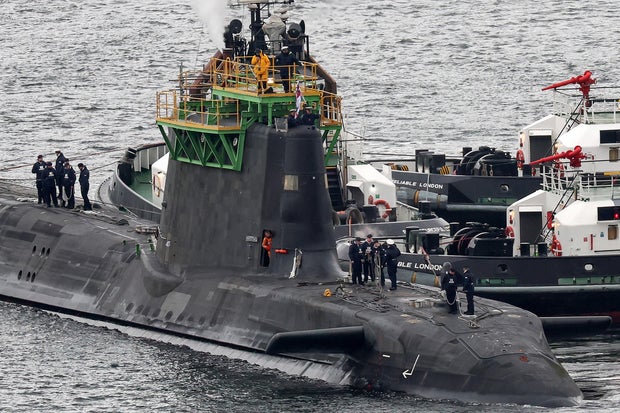

The arrests come two weeks after London police arrested four men on suspicion of aiding Iran by spying on the Jewish community around the British capital.
In a statement, the police said the suspects — one Iranian and three dual British-Iranian nationals — were taken into custody on suspicion of assisting a foreign intelligence service.
UAE says 4 Iranian missiles, 26 drones intercepted today
The United Arab Emirates Ministry of Defense said the country’s air defenses had intercepted four Iranian ballistic missiles and 26 drones on Friday.
“Since the start of blatant Iranian attacks, UAE air defenses have dealt with 338 ballistic missiles, 15 cruise missiles, and 1,740 drones,” the ministry said, adding that the strikes had killed eight people, including two Emirati military service members.
Debris rains down on Israel as Iran unleashes round after round of missile attacks
People across Israel were subjected to round after round of Iranian missile launches on Friday, with alarms blaring and cell phones alerting people in virtually every corner of the country to enter shelters as air defenses swung into action.
At least a dozen salvos from Iran were reported Friday, despite the U.S. and Israel saying for days that the Islamic Republic’s offensive capacities have been all but sapped by almost three weeks of joint strikes in Iran.
Debris from missile interceptions rained down on a number of communities, including in Rehovot, just south of Tel Aviv, where images showed a home on fire. The national Magen David Adom rescue agency said it was transporting a man and a woman, both about 70 years old, “in mild condition with suspected blast injuries,” to a local hospital after that impact.
An image shared by Israel’s national Magen David Adom emergency rescue agency shows a first responder running to the scene of a fire in a residential area in Petah Tiqva, east of Tel Aviv, March 20, 2026, caused by from an Iranian missile. Handout/Magen David Adom 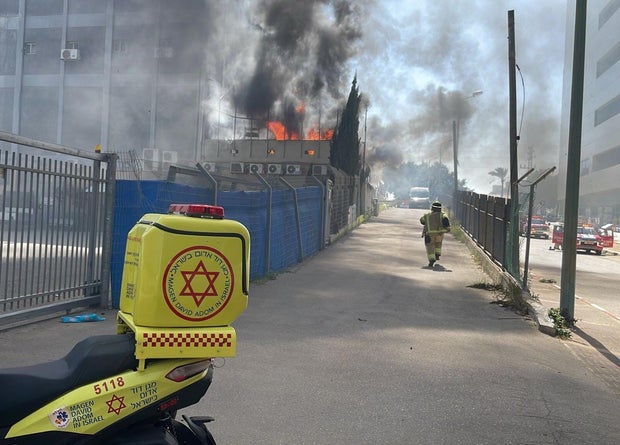

The MDA shared an image of first responders running to the scene of a fire in a residential area in Petah Tiqva, east of Tel Aviv, too.
A CBS News producer in Tel Aviv said there were “almost non-stop missiles from Iran towards all districts” on Friday, as well as new drone launches by Iranian-backed Hezbollah in Lebanon.
Israeli reservist with Iron Dome defense unit arrested on suspicion of spying for Iran
Israeli police and intelligence agencies said Friday that a reservist serving with a unit of the country’s Iron Dome missile defense system was arrested on suspicion of selling “sensitive security information” to contacts he knew worked for Iran.
“Raz Cohen, a 26-year-old resident of Jerusalem who served in the reserves of the Iron Dome system, was recently arrested,” the Israeli national police and Shin Bet intelligence agency said in a joint statement. “He is suspected of committing security offenses involving contact with Iranian intelligence agents to carry out security missions under their direction.”
The statement said Cohen had been in contact with Iranian intelligence officials for months, and “under their guidance, he was asked to perform various security-related tasks, including transferring sensitive security information he was exposed to during his service,” for which it said he “received monetary payments.”
Russia summons Israeli envoy over Lebanon strike near news crew, condemns U.S.-Israeli “unprovoked aggression”
Russia on Friday summoned Israel’s ambassador in Moscow for a reprimand after a reporter and photographer for the pro-Kremlin RT news outlet were injured in a purported Israeli missile strike in Lebanon.
Israeli Ambassador Oded Yosef spent about 30 minutes at the Foreign Ministry in Moscow on Friday, and then declined to speak with reporters as he left, Russia’s state-run TASS news agency said, adding that Russian diplomats had conveyed their “strong condemnation, describing Israel’s actions as a gross violation of international law.”
According to TASS, Suini reported that no warnings were given prior to the strike, and that it appeared to have targeted his RT team, who were reporting from an area Israel had warned would be targeted.
Separately, Russia’s Foreign Ministry issued a statement Friday saying Moscow was “gravely concerned about the continued armed confrontation in the Persian Gulf and the risks of further escalation.”
“The scale of damage to energy and other critical infrastructure in Iran and neighboring Arab states is increasing. We call for an immediate cessation of hostilities, which are the result of unprovoked aggression by the United States and Israel against Iran,” the ministry said, more than four years into Russia’s unprovoked, ongoing full-scale invasion of neighboring Ukraine.
Israeli military says it killed spokesperson for Iran’s Islamic Revolutionary Guard Corps
The Israel Defense Forces announced another targeted killing of an Iranian official on Friday, saying an intelligence-guided airstrike “eliminated Ali Mohammad Naini, the Spokesperson and Head of the Public Relations” for Iran’s powerful Islamic Revolutionary Guard Corps.
“For the past two years, he served as the IRGC’s main propagandist as part of the Iranian terror regime,” the IDF said, accusing Naini of spreading Iranian propaganda “to its proxies across the Middle East in order to influence and advance terror attacks against the State of Israel from the different fronts.”
“Naini’s elimination joins a series of eliminations of dozens of senior figures of the Iranian regime during the operation,” the IDF said, adding that it would “continue to operate with determination against the commanders and senior officials of the Iranian terror regime.”
The IDF announced the killing earlier this week of Iranian Supreme National Security Council leader Ali Larijani, who was in charge of the IRGC and other security forces, in a similar targeted assassination earlier this week.
Sri Lanka denied U.S. military planes access for Iran war, “steadfastly maintaining our position of neutrality”
Sri Lanka refused permission to the United States to station two of its warplanes at a civilian airport in the island’s south in early March, President Anura Kumara Dissanayake said Friday.
Washington wanted to relocate two of its missile-armed aircraft from a base in Djibouti to Sri Lanka’s civilian Mattala International Airport, Dissanayake told parliament.
The request, made on Feb. 26, two days before the U.S.-Israeli assault on Iran began, was turned down to maintain Colombo’s neutrality and ensure its territory was not used for any military purpose that could help or hinder either side, he said.
Sri Lanka was drawn into the consequences of the war when a U.S. submarine torpedoed an Iranian frigate, the IRIS Dena, just off its coast in March.
“They wanted to bring two warplanes armed with eight anti-ship missiles to Mattala International Airport from March 4 to 8, and we said ‘no’,” Dissanayake said.
He did not say whether the U.S. request was to use Sri Lanka as a base for the aircraft to carry out offensive actions against Iran.
Dissanayake said Iran, too, had requested port calls for three of its warships, returning from India after a naval exercise, on the same day the U.S. requested permission to station their two aircraft.
“We were still considering the Iranian request to bring the three ships to Colombo from March 9 to 13. Had we said ‘yes’ to Iran, we would have had to say ‘yes’ to the U.S. too,” he said. “But we didn’t. We are steadfastly maintaining our position of neutrality.”
Israeli oil refinery likely out of commission for several days after Iranian strike, Reuters reports
An oil refinery in the Israeli port city of Haifa was hit by an Iranian attack on Thursday, with images showing black smoke rising from the complex.
The Reuters news agency quoted officials with the company that owns the facility as saying Friday that the impact had damaged external infrastructure belonging to a third party, but which is essential to the refinery’s operations.
The sources told Reuters operations at the refinery would likely remain offline for several days.
Smoke rises from an oil refinery damaged by an Iranian attack, amid the U.S.-Israeli war with Iran, in Haifa, Israel, March 19, 2026. REUTERS/Sharon Sztrozenberg 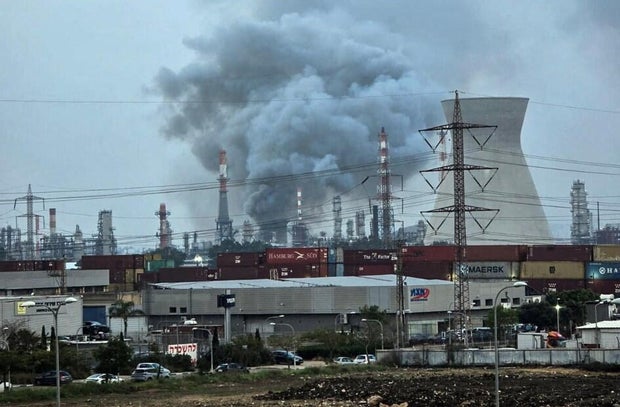

U.S. pilot in stable condition after F-35 makes emergency landing after possible Iranian attack
One of America’s most advanced fighter jets was forced to make an emergency landing after flying a combat mission over Iran, the U.S. military’s Central Command said Thursday.
U.S. military officials told CBS News on Friday that the F-35 made an emergency landing in an undisclosed U.S. air base in the Middle East and that the pilot was in stable condition.
A U.S. Air Force Lockheed Martin F-35 Lightning II fighter jet is seen during a flight demonstration at the Paris Air Show 2023. Nicolas Economou/NurPhoto/Getty 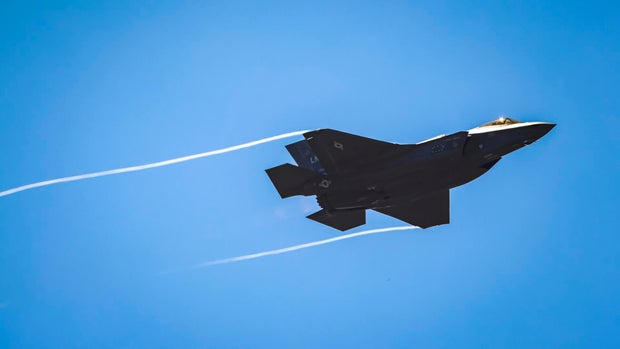

CNN first reported on the incident and said the jet was believed to have been hit by Iranian fire. If it was, it would be the first successful Iranian attack on a U.S. aircraft since the war started, and it would have come as President Trump said Iran no longer had such a capability.
“Their air force is gone, their anti-aircraft equipment is gone. We’re flying wherever we want,” Mr. Trump said Thursday in the Oval Office. “We have nobody even shooting at us.”
Explosions over Dubai, Bahrain and Saudi Arabia as more Iranian weapons intercepted
Heavy explosions shook Dubai as air defenses intercepted early incoming fire over the city, where people were observing Eid al-Fitr, the end of the holy Muslim fasting month of Ramadan, and mosques made the day’s first call to prayers.
Bahrain’s Interior Ministry said a fire broke out after shrapnel from an intercepted projectile landed on a warehouse, and Saudi Arabia reported shooting down multiple drones targeting its oil-rich Eastern Province.
The renewed attacks came after an intense day that saw Iran hit energy infrastructure around the region and launch more than a dozen missile salvos at Israel following the attack on South Pars.
South Pars, the Iranian part of the world’s largest gas field, is located offshore in the Persian Gulf and owned jointly with Qatar. With some 80% of power generated in Iran coming from natural gas, the attack posed a direct threat to the country’s electricity supplies.
Iran launches missile and drone attack on Kuwait, local officials say
The Kuwaiti military said early Friday local time that Iran had launched missile and drone strikes on the country.
In a social media post, the Kuwait Armed Forces said that if explosions were heard, “they are the result of air defense systems intercepting the hostile attacks.”
An earlier drone strike on Kuwait’s state-owned Mina Al-Ahmadi refinery sparked a fire but caused no injuries, the state-run KUNA news agency reported Thursday.
The Kuwaiti military previously reported that it was targeted with 18 Iranian drones over a period of 24 hours on Wednesday into Thursday, 13 of which were intercepted and destroyed. Two of the drones struck the refinery, the military said.
Israeli military hits Tehran with “wave of strikes,” IDF says
Israel pounded Tehran with airstrikes Friday morning local time as Iranians marked Nowruz, or the Persian New Year.
Activists reported hearing strikes around Iran’s capital. The attacks came a day after Israel pledged to refrain from more strikes on a key Iranian gas field and Iran intensified attacks on oil and natural gas facilities around the Gulf.
Israel Defense Forces wrote on social media that it had “begun a wave of strikes targeting infrastructure of the Iranian terror regime in the heart of Tehran.”
Iran kept up its own retaliatory attacks on Israel that have sent millions of people to shelters, with sirens sounding across a wide swath of the north, from Haifa to the Galilee to the border with Lebanon.
It also continued its strikes on Gulf neighbors. Heavy explosions shook Dubai early Friday as air defenses intercepted incoming fire over the city, where people were observing Eid al-Fitr, the end of the holy Muslim fasting month of Ramadan, and mosques made the day’s first call to prayers.
CBS/AP
Netanyahu says Iran’s current leadership structure is “not clear” after targeted killings
Israeli Prime Minister Benjamin Netanyahu said Iran’s current leadership structure is “not clear” after a series of targeted missile strikes killed several prominent clerics and leaders during the war.
Top Iranian security official Ali Larijani and other senior leaders were killed in strikes earlier this week, dwindling the number of top officials in the regime still alive.
Ayatollah Mojtaba Khamenei, the new supreme leader and son of the late Supreme Leader Ali Khamenei, is believed to have been injured in the strike that killed his father at the beginning of the war.
“Mojtaba, the replacement ayatollah, has not shown his face,” Netanyahu told reporters during a news conference Thursday night. “Have you seen him? We haven’t, and we can’t vouch exactly what is happening there. There is a cloud here that’s not clear.”
Netanyahu also speculated that the new supreme leader would not have the same influence as his father.
“I think the authority and the hold that Khamenei has had is not going to be translated to anyone,” Netanyahu said. “Not to Mojtaba, if he’s there, and not to anyone else.”
Netanyahu says Israel’s holding off on more attacks on key Iranian gas field
Israeli Prime Minister Benjamin Netanyahu said Thursday that his country’s military would hold off on additional attacks against a key Iranian gas field.
Netanyahu also said Israel acted alone in attacking Iran’s South Pars gas field.
“President Trump asked us to hold off on future attacks, and we’re holding,” the prime minister said during a news conference Thursday night.


