







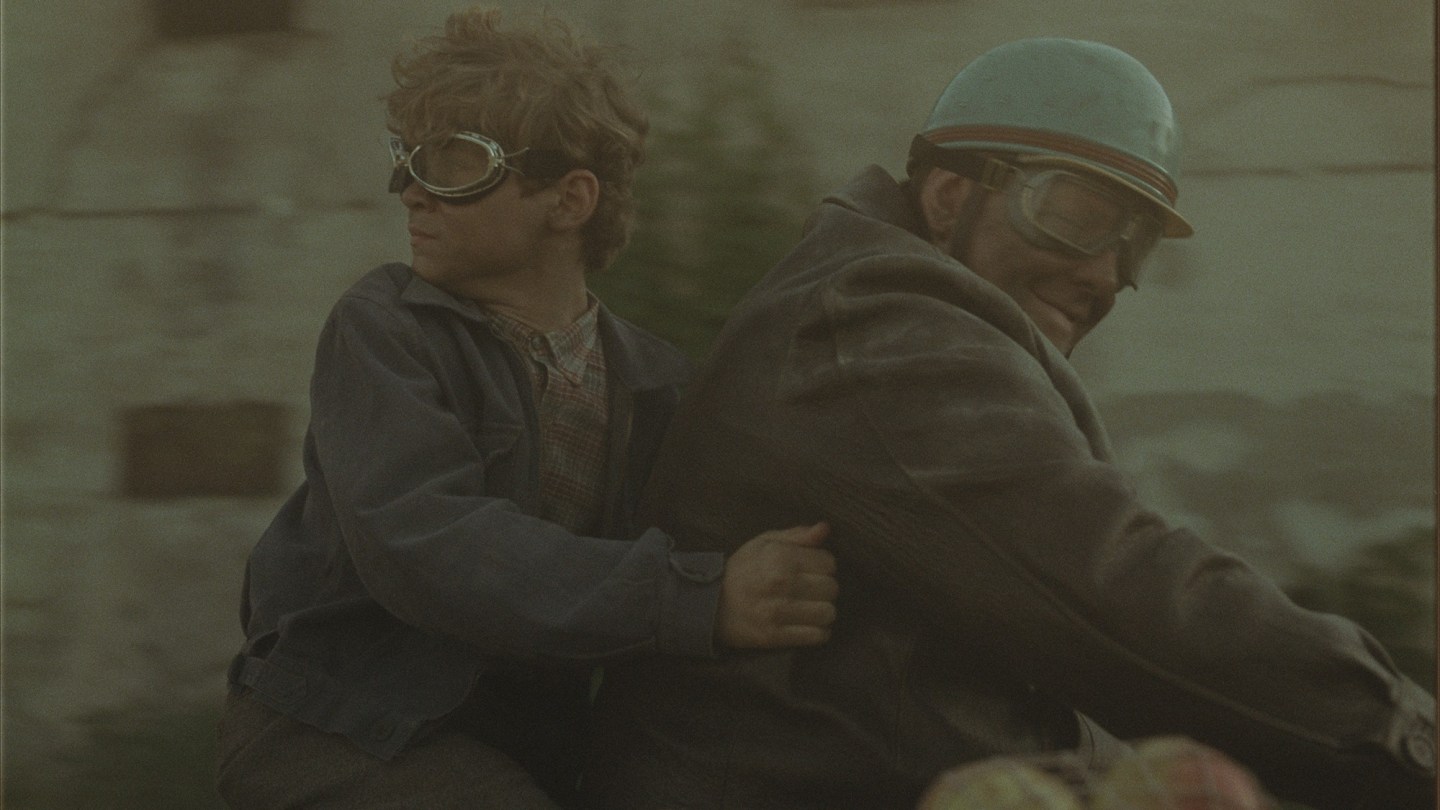
Hungarian director László Nemes returns to Venice with post-World War II family drama Orphan, the arthouse sensation’s third feature and his most personal one.
His first feature, the searing Holocaust drama Son of Saul (2015), not only won the Grand Prix at Cannes, but also the best international feature film Oscar. In Sunset (2018), he explored civilization on the brink of catastrophe one year before World War I.
Orphan, which Nemes wrote with Clara Royer, is set in 1957 Budapest, after an uprising against the Communist regime. “A young Jewish boy, Andor – raised by his mother with idealised tales of his deceased father – has his world turned upside down when a brutish man appears, claiming to be his true father,” reads a synopsis.
The film, featuring cinematography by Mátyás Erdély, stars Bojtorján Barábas, Andrea Waskovics, Grégory Gadebois, Elíz Szabó, Sándor Soma, and Marcin Czarnik. World sales are being handled by New Europe Film Sales and Charades.
“Orphan is the chronicle of a child’s coming to terms with his own family history and his own self, both reflective of the turmoils of the 20th century in the heart of Europe,” Nemes says in a director’s statement. “These stories have shaped our present and continue to haunt us, even questioning our future as a civilisation. My own family’s story served as a canvas for Orphan, spanning the ravages of the Holocaust and the tyranny of the communist regime.”
He concludes: “Ultimately, the film explores a question of inner darkness: will Andor, the young hero of Orphan, accept the stuff that he is made of?”
Ahead of the world premiere of Orphan in the Venice competition program on Thursday, Aug. 28, Nemes talked to THR about the film, the personal, true story behind it, and confronting the traumas of European history.
I understand that Orphan is based on your family’s experience. Can you share a little bit about that family connection?
This is indeed a story grounded in family history, my family history, and it has haunted me. Since my birth, I started realizing what the story was, and it is the story that I replicate, in a way, in this movie. A 12-year-old boy in 1957, who was born during the last month of the Second World War and who is waiting for his dad to return from the camps, makes up this kind of fantasy father figure. He meets a brutish man from the countryside, who claims to be his real father. I don’t want to give away too much, but this is the beginning of the movie, and this pre-adolescent boy has to cope with the reality of the past and of his existence.
It has reverberated so much in my own existence. Also, before making this movie, I realized that it is a sort of archetypal story of an usurping father, the ghost of the real one, and what our hero has to do with it. It’s almost like a Hamlet story.
It sounds like a very personal, but at the same time universal story…
It has echoes further into the collective unconscious. Also, in a way, it’s the history of Europe in the 20th century that calls back to our very reality and very present. It says something about how the traumas of the 20th century were layered and how the European individual had to navigate through this labyrinth. And even today, we see with all these conflicts that we have not come to terms with all this past.
I think [it is universal]. It’s my own father’s story, but I find it a sort of mythical story as well. It’s said that stories can all be categorized as archetypal stories. I’m interested in how to give today’s audiences a new retelling of the same archetypal stories. I think it’s the job of the filmmaker to do it, and fewer and fewer filmmakers do it in a way. They are interested in something else, or, I don’t know, I think maybe there is also pressure from executives, but I think it is important to tell these stories.


‘Orphan’
Courtesy of Pioneer Pictures/Good Chaos
As a filmmaker, how did you deal with confronting this emotion and trauma, and does making a movie provide any catharsis?
Making films is not some kind of bourgeois fantasy. It is the retelling of the archetypal stories that are so important for us as a species. If we don’t tell – and tell again – the basic stories, the foundations of our civilization are questioned. So that’s why I think cinema and whether it disappears or not is not a mere question of going into something else. If we stop telling stories that are important and that are, in a way, difficult, then we stop our human journey.
That’s why I’m always interested in going to the heart of the human question. In this case, I am going back to the story of my father. And because I recognize it as a very strong archetypal story, I think it can give so much to audiences in the world. Obviously, it’s a European story, but so much of Europe has disseminated into the world. So, I think people can relate to this to understand European history, but also the European present. And because it’s archetypal, I think it can cross the borders of Europe into different cultures.
The synopsis signals a lot of inner darkness in the film, but also historical darkness, from the horrors of the Holocaust to the horrible things under the Communist regime. Is there hope and lightness in the film, and how did you approach that?
I think there is. I try to maintain a layer of light amid all this darkness. There are moments of relief, and I think there are even quite funny moments. It is a tragedy, but with comedic aspects, as all tragedies also have some comedic aspects and vice versa. These things are inseparable from each other. I definitely think that this film, although it deals with the darkest times of repression and the darkest times of trauma, still carries some form of hope. In my pessimism, there’s always a big light of optimism, and I always try to see both.
Europe and Western civilization decided at some point that if we don’t deal with our own darkness, then it’s going to disappear. I don’t think it’s true. The most despicable side of human actions is still there, and we can recreate the worst place in the world in a second, even in the heart of civilization. And that’s what the 20th century taught us. The journey into the darkness is not a journey into a useless reveling in pessimism. So, obviously, you have to give some light in the story. Otherwise, everything is just dark. There is some contrast to be found. And I think there is still time, and cinema can still do this. That’s how I see my mission.
How did you go about casting such a personal story?
I’m always very thorough in my casting process. I knew that for a 12-year-old boy, and we also have a girl [Elíz Szabó] of the same age, we couldn’t just try agencies in Hungary. We had to go and find these youngsters among regular people, and that’s what we did. So, we had a pretty wide open call, and we watched thousands of self-tapes, and at some point, those who became the main actors of the movie were discovered. It became obvious pretty soon for both of them, especially for the boy [played by Bojtorján Barábas], because he is the lead of the movie. He was a sort of natural-born talent.
Then I had to recreate the family, and I had a harder time finding this brutish man from the countryside. I just couldn’t find him, because I didn’t want this guy to be played by someone who is just one-dimensional. I wanted someone who also has other layers, and who we can believe can love his son. That. So for this guy, I had to go to France to find our actor [Grégory Gadebois]. And for the mother, there’s an actress [Andrea Waskovics] who I think is a brilliant young actress from Hungary. She became the third part of this triangle
Was there any scene where it was particularly difficult and emotional for you to be confronted with your family’s history?
I had to take the burden of my father and create a vision for it. And it was a difficult process, but a very interesting one, and a journey for me. There is one scene that was really intense. I mean, most of the scenes were intense as we shot them. But there is one scene when this rather abusive, violent butcher, who is the father of the boy, or claims to be, becomes very angry and starts breaking everything in the apartment where they live. We did most of [the scene] in one take. And the way it unfolded the first time he did it, there was such a silence on the set. Everybody was very, very affected by this sheer explosion of violence. It was almost as if everybody went back to their childhood, whether they experienced [u like this] or not. But at least they found themselves in the shoes of a kid having to experience that. And I think that’s what the film does. It gives you the opportunity to go back to a very fragile state in childhood and experience it firsthand.


László Nemes
Courtesy of Másolat
Is there anything that you would like the audience to go away with after watching Orphan?
There’s a new tendency [to have] shock value in movies, but no real journey. What I want the audience to experience is a journey, and the film to be personal. If you give enough space for the audience, then it can become a subjective, individual experience. If you close it and you don’t leave any kind of space to the audience because you say, “I am, as a filmmaker, going to control you,” but actually give you also the entire control, at least the appearance of control, there’s nothing left untold or unsaid or unexpressed, there’s no more secret. I think [that] also ruins the echoes of a movie. It cannot really become a subjective experience. It’s an outside experience.
So for me, it’s very important, first and foremost, to respect the audience and leave them enough space in the movie so that it can become their own. And I think cinema, in its essence, is an art in which there’s not just one manifesto that you read aloud as a filmmaker. No, it should be a constant dialogue. And the way you achieve that is to leave enough space for the audience. That’s what I want to achieve.
I’m always interested in exploring historical events, but in ways that are surprising. I’m not interested in just recreating a postcard book, but something that can become very personal, and that other people from other places can relate to.
So, you still believe in the power of cinema…
I do. It does put into a very central light the importance of filmmaking as a retelling of the human story. It’s not just some kind of fancy kind of entertainment for ourselves. No, it is very central to the human experience.
People have sort of an anti-intellectual attitude. But for me, it’s not about being an academic or anything like that, but really to have deep conversations that are really honest and open-minded. It’s funny that the internet seems to have promised us all kinds of good things, but actually gave us so many fragmented and closed-down and rigid ways of thinking and operating. It seems almost like we’re bringing ourselves new forms of censorship and new forms of self-punishment. I think it’s important to open up the discussions again. When I look into the 20th century and the ’20s and ’30s and how much discussion there was going on, there’s an impoverishment of the collective discourse and communication. It’s an internet that really doesn’t do us as the human species any kind of justice.
Is there anything you did in this film that might surprise fans of your work?
I use effects, but I think in a way that’s very organic. It doesn’t attract attention. With our excellent VFX supervisor, we managed to open new dimensions on Budapest in 1957 using period footage and period pictures. And I think that really adds something to the movie. This is an entirely different movie from what I’ve done before, so I used a lot of other tools at my disposal that might surprise people who know my work.
Did you know from the beginning that Orphan would be the title of this film?
Yeah. It’s about someone who’s an orphan, but not really an orphan. And I feel the same. I’m not an orphan, but I feel like an orphan. And the 20th century made me an orphan, in a way. I think the world is fragmenting humanity more and more. The way we are going about our businesses becomes very lonely. And the orphan is someone who is, for me, a very touching figure.
How nice is it to premiere Orphan at Venice, where Sunset also had its debut?
My first short film [With a Little Patience] was actually also in Venice. That was my first major film festival, and I’m very glad to be there. I feel that I am welcomed with open arms. And it’s very much about the movies themselves, and much less about everything else.
I feel that Cannes nowadays is so much about everything else, like the stars. And for me, the movies should speak for themselves. And that’s what I feel in Venice. There’s no other agenda. I really find it very liberating.


