It’s difficult to say there’s another contemporary automaker that has better mastered the art of paying homage to its own considerable and historical road and racetrack bona fides than Porsche. At least, not when it comes to doing so by way of big-money, low-production special editions barely anyone will ever see in real life. Cynics will say cars like the track-only new 935 that was limited to 77 examples and priced at $800,000-plus and the 911 GT3 R Rennsport—also limited to 77 copies and priced at $1,046,000—are irrelevant to anyone but the handful of owner-collectors who get their hands on them. But that’s beside the point for car fans and dreamers who appreciate the mere existence of such near-vaporware creations.
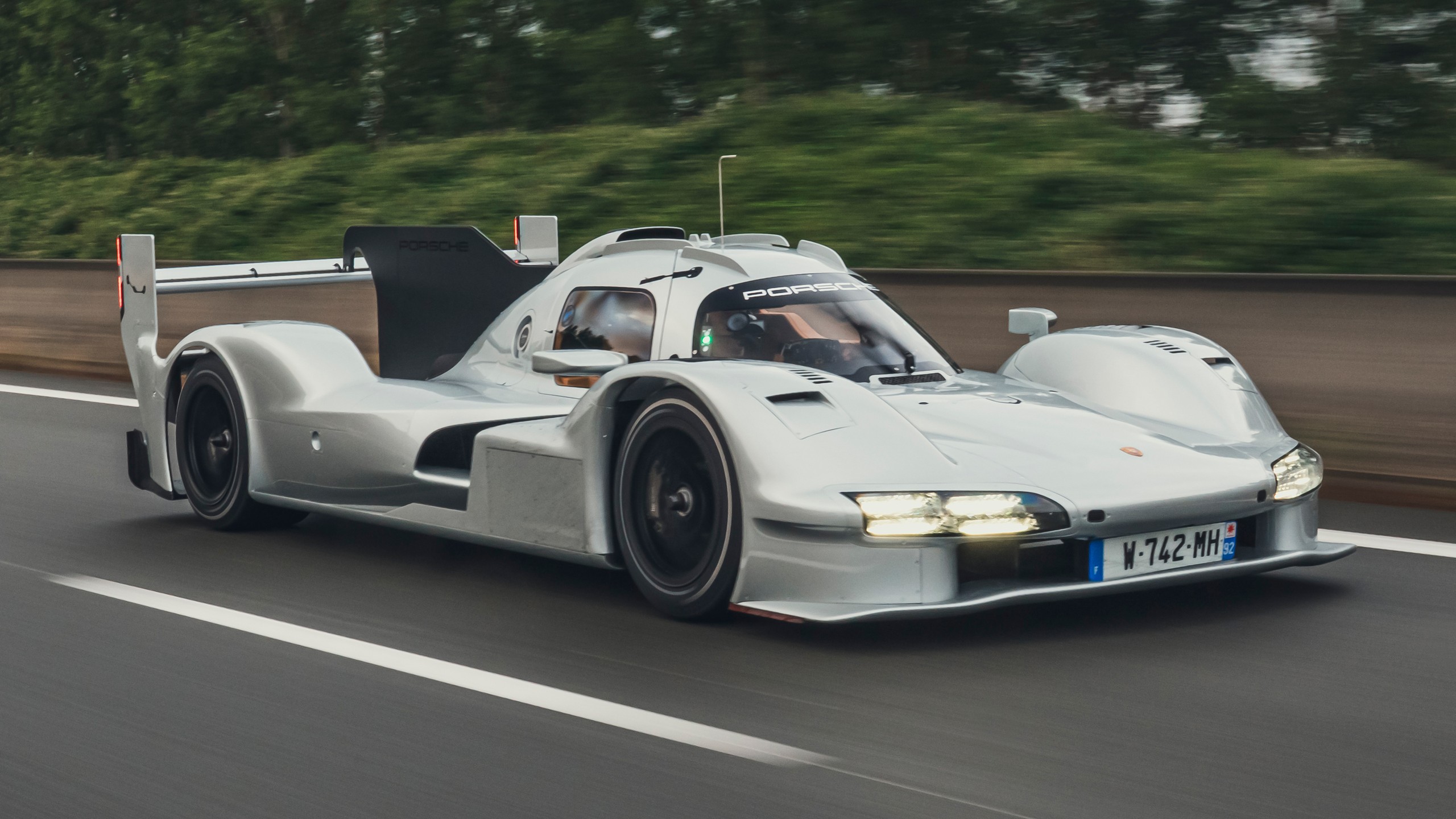
Whichever camp you fall into, Porsche’s latest and even more limited, more expensive salvo will have tongues wagging this summer. Say hello to the Porsche 963 RSP, a one-off road-oriented build of the company’s top-level endurance race car that competes in the Hypercar class at Le Mans and in the FIA World Endurance Championship, and in the GTP class in America’s IMSA WeatherTech Sportscar Championship.
If you are unfamiliar with its bond fides, here’s the car’s resume in a nutshell since its 2023 debut in international racing competition: 10 wins and five championship titles (spread between drivers’ and constructors’ crowns), including wins at the prestigious Rolex 24 at Daytona and the 12 Hours of Sebring.
Only One?
Yes, this is the one and only 963 RSP Porsche will build, and those three letters tailing the car’s name identify its owner as Roger Searle Penske, the automotive-industry stalwart and eponymous owner of multiple championship-winning racing teams, the NTT IndyCar Series, the Indianapolis Motor Speedway, and most relevant in this context, the co-namesake of the Porsche Penske Motorsport operation that fields 963s in international sports-car competition.
Revealed in full today in France a week before this year’s 24 Hours of Le Mans, the 963 RSP drew some inspiration from a similar project 50 years ago, 917 chassis No. 30 that’s seen here as well. The latter car, following its racing career, was commissioned into roadgoing-spec byTeofilo Guiscardo Rossi di Montelera, aka Count Rossi.
According to the manufacturer, the new 963 RSP was dreamed up by Porsche Cars North America President and CEO Timo Resch. Resch then met with Thomas Laudenbach, vice president of Porsche Motorsport, and Urs Kuratle, head of Porsche’s factory 963 program, with the trio eventually taking the idea to Penske.
Almost the Same as the Race Car
Obvious differences to the full-on racing version include Martini Silver paint over the carbon-fiber and Kevlar bodywork, and the interior trimmed in tan leather and Alcantara (the same colors as Rossi’s 917). Look a bit closer at some of the bodywork and you’ll see differences to the racing version, such as new fender-top vents where the standard 963 features wide-open cutouts. Carbon-fiber rear-wing blanking plates, required for racing, are deleted, and the RSP boasts an enamel Porsche badge on its nose in place of the racing version’s weight-saving and airflow-improving “sticker” badge. Peer into the cockpit and it’s amusing to spot a 3D-printed cupholder alongside the leather-trimmed racing-spec steering wheel, and likewise the vintage 1970s-style Michelin logos adorning the tire sidewalls in a nod to the 917 project.
Porsche, no surprise, says the car features places to install front and rear license plates, headlights and taillights programmed for road use, turn signals, a horn, lifted ride height, and the softest suspension setting available from the Multimatic DSSV racing dampers, and that it rolls on Michelin’s treaded wet-weather racing rubber rather than dry-weather slicks that aren’t allowed on open roads.
Dressed-Up Interior
Look inside a bit more and there are several other notable details, including a place to store the provided driver’s headset and the steering wheel when removed from its column, as well as one for resting the laptop computer needed to start the car. Porsche points out little touches like HVAC system end plates “which mimic the styling of the fan on top of the 917’s flat-12 engine.”
However, it’s not accurate to call this a street-legal 963, as the car hasn’t been truly homologated for road use like a series-production car, skipping costly and time-consuming endeavors like crash testing. This means Penske likely won’t be able to drive it on public streets whenever he wants, instead requiring special dispensation from local authorities to demonstrate it at specific times and places. If the Captain, as he is well known, takes the car to his metro-Detroit home, for instance, showing it off during an event like the annual Woodward Dream Cruise might be on the cards—but don’t expect to spot it in a Kroger parking lot.
That doesn’t mean enthusiasts won’t be able to cast their eyes on the 963 RSP before Penske takes delivery of it during August’s Monterey Car Week. Porsche plans to display it throughout the 24 Hours of Le Mans at the Circuit de la Sarthe and will subsequently move it to the company’s official museum in Stuttgart, Germany, before sending if off to July’s Goodwood Festival of Speed.
What About the Engine, Etc.?
As for performance, the Porsche 963 RSP retains the racer’s hybrid twin-turbo 4.6-liter V-8 power unit (itself derived from the engine used first in the RS Spyder race car of the mid-2000s before being adapted for road use in the 918 Spyder street car), and while the company says it is not detuned or modified from the modern race car’s, it did revise the hybrid system’s motor generator unit (MGU) mapping to deliver smoother operation on the street than is needed for racing. Oh, and the whole thing is now able to run on fuel from the nearest gas station rather than strictly racing-grade petrol.
Porsche cites a peak output of about 680 horsepower, funneled to the wheels through seven-speed Xtrac sequential transmission.That might not sound like much relative to the output of many of today’s hypercars and EVs, but keep in mind this car weighs approximately just 2,300–2,400 pounds. For comparison, the new 911 Carrera GTS T-Hybrid we tested recently weighs 3,598 pounds and accelerated from 0–60 mph in 2.6 seconds and covered the quarter mile in 10.7 seconds at 129.7 mph. Its peak horsepower? 532.
In terms of the overall 800-volt hybrid tech, Porsche says the 1.35-KWh battery can provide between 30–50 kilowatts in short blasts at the push of a button that “does not change the overall output of the powertrain. When the thrust of the MGU kicks in, the power of the combustion engine, which can reach over 8,000 rpm … automatically decreases.” This is a function of the “balance of performance rules” governing sports car racing.
How Much?
As a one-off creation, Porsche hasn’t supplied a price or value for the 963 RSP, but since the raw racing version starts at about $2.9 million, it’s not a stretch to imagine all the work that went into this car easily puts it at the $3.5 million mark, or more. That’s certainly beside the point, though, at least to the dreamers among us. But if you’re listening, Porsche, and speaking of the least you could do: How about putting the 963 RSP into a racing video game/simulation so the rest of us can have a chance to experience it in some capacity beyond staring at it in a museum or on a car show lawn?