



On The Ultimatum: Queer Love, no one knows. Here’s why that’s a good thing.

Sign up for the Slatest to get the most insightful analysis, criticism, and advice out there, delivered to your inbox daily.
No one was expecting the second season of The Ultimatum: Queer Love to delve deep into the wilds of sexual semiotics. The silly Netflix reality show is mainly a way to manufacture feelings of jealousy and betrayal by pairing people up with new lovers while their existing partners look on with gritted teeth.
But in the final “reunion” episode of the season, which dropped earlier this month and was taped one year after initial filming wrapped, several of the 12 queers on the show got caught up in a debate over what, exactly, constitutes sex. Definitions clashed, leading to a revelation that one participant had misled her partner about what she’d done with another woman on the show.
It ended up offering a riveting look at how queer women can diverge on their conceptions of sex, even within the same relationship. I thought the global queer consensus, given infinite possible variations of bodies, preferences, and pairings, was that we should take an expansive view of sex. Apparently not! Lesbians who weren’t even alive when Bill Clinton denied having “sexual relations” with Monica Lewinsky—it was only fellatio, people!—are out here trying to classify some sex acts as sex and others as not sex.
To explain how foolish this is, I need you to understand The Ultimatum. If you haven’t seen it, here’s a primer: In each of the six couples on the show, one partner is ready for marriage, while the other isn’t so sure. (Hence the titular demand: If we don’t get engaged, we’re over.) After all spending a couple of days together, the participants embark on an experiment that offers no obvious relevance to the project of marriage but plenty of opportunities for insecurity and heartbreak. The couples break up, choose new partners from the assembled group, and live in “trial marriages” with these pretend spouses for three weeks. Then, the original couples reconvene for their own three-week test runs. At the end, they must decide whether to propose marriage, end the relationship and leave single, or maybe pursue a future with their trial spouse.
Ostensibly, the point of the couple-swapping is to give each participant an opportunity to learn about themself, grow as a partner, and see if a break from their loved one offers them any clarity about marriage. But the main question on every viewer’s mind is: Are the trial spouses gonna do it?
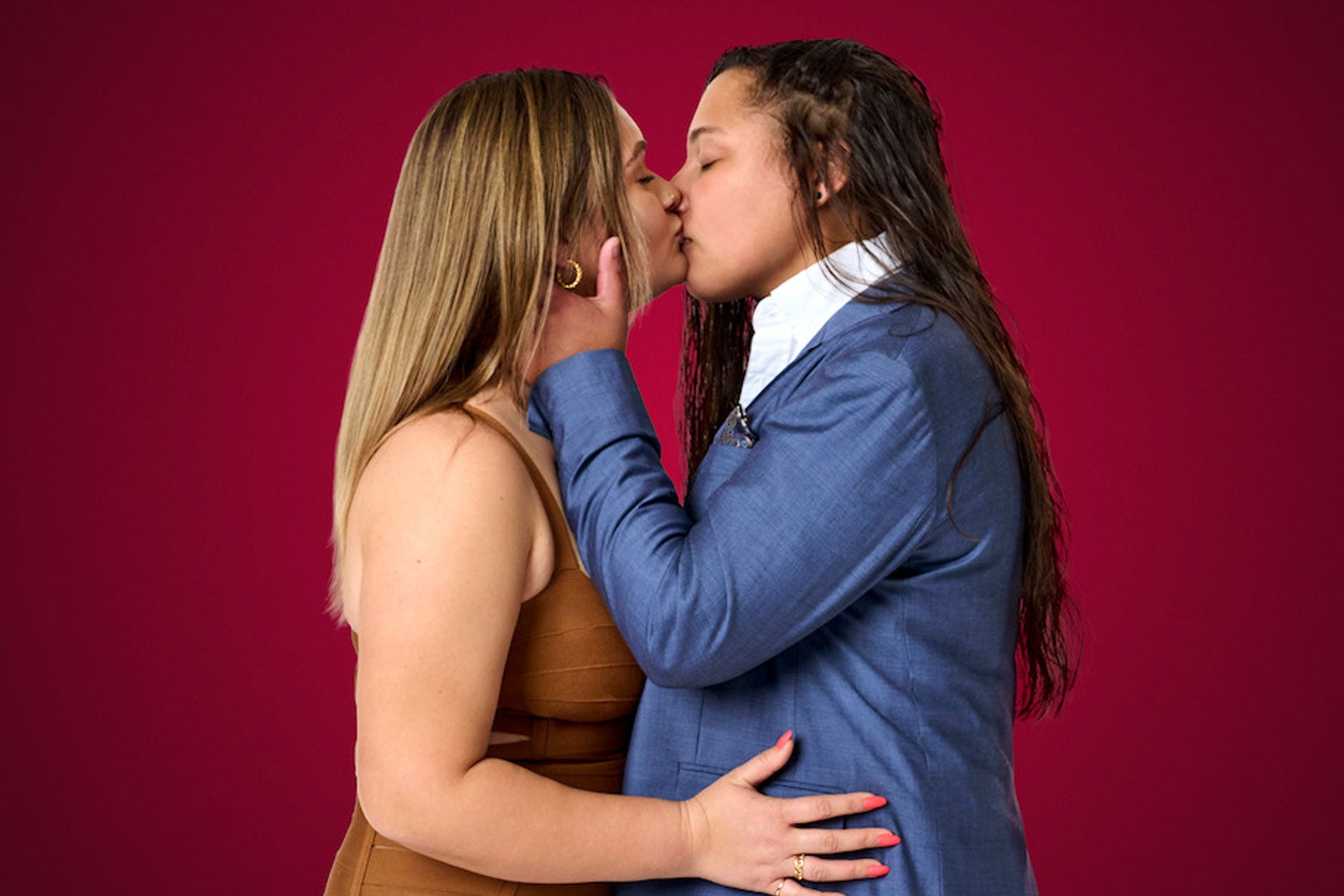
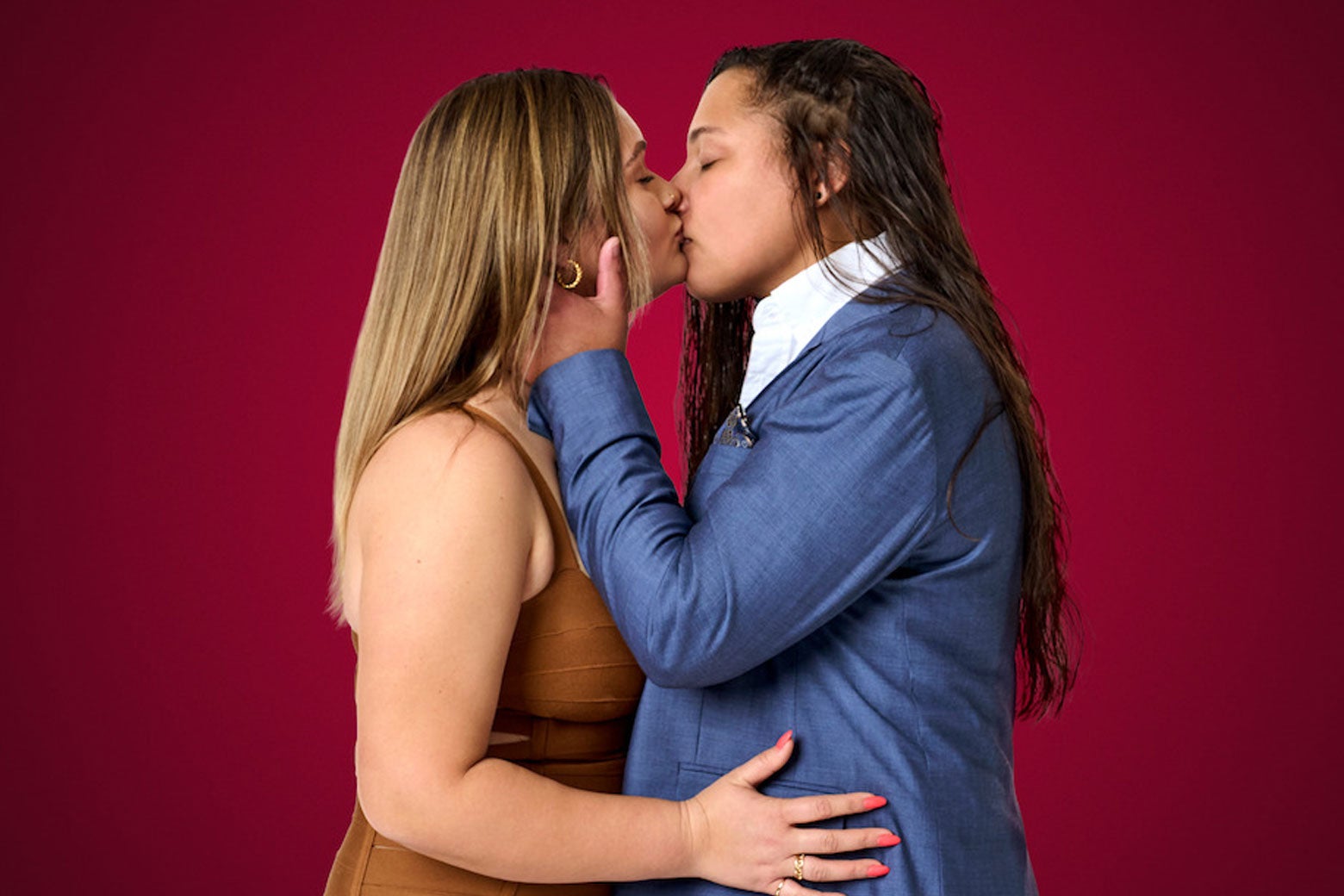
In this season, to the certain delight of the Ultimatum producers, two of the temporary pairings hooked up. Haley, a sweet-seeming redhead, got with Magan, a personal trainer with a topknot and a tendency to weep. They both spoke openly to the cameras about having sex together. Meanwhile, Magan’s original partner, Dayna—a volatile flirt with fake nails and filler—repeatedly made out in front of the cameras with her trial spouse, Mel, a marriage-averse long-haired butch who owned a food truck with her original partner, Marie. Dayna and Mel were also recorded moaning from behind a closed bedroom door, though neither told the cameras what (or who) went down in there.
When Mel and Marie reunited after their trial marriages ended, Mel denied having sex with Dayna. Marie, understandably, took that to mean they hadn’t hooked up at all. She and Mel ended up getting engaged. But when Marie watched the episodes after they aired, she saw and heard what the rest of us did. (Ecstatic moaning doesn’t usually accompany a getting-ready-for-bed routine.) The couple broke up. And on the reunion episode, Marie took Mel to task for her stretching of the truth.
To underline the possibility that two people could conceive of sex differently, The Ultimatum then aired a montage of interviews with the participants about their own definitions, including the least sexy descriptions of sex you’ve ever heard. “If you twiddle her pussy, that might be sex to one group,” one participant offered. Another said “penetration of any sort.” The wet washcloth of the bunch, Kyle, submitted “sexual cuddling,” which, what? Mel pointedly opined that “you have to use your mouth; you have to use your fingers. It has to be every part that you can use.” Every part?
Dayna said that sex to her is “oral pleasure,” and clarified that she and Mel didn’t have sex together “in that way.” Neither did they “finger each other” or “do anything like that.” Which leaves open the tantalizing mystery of the moaning. Did they use a toy? Did they dry hump? Did they touch each other over their clothes? And, to make a matryoshka doll of the situation, what does finger mean to Dayna? Does it necessitate penetration, or doesn’t it?
The absurd exercise drove home the futility of narrow, circumscribed definitions of sex. If the same sexual act can be sex for one person and not sex for another, and that difference means something in terms of how upset one should be that one’s partner did it with another person, the whole notion of sex as some distinctive category with inherent meaning comes tumbling down.
There are sex acts that feel more intimate or vulnerable to some people. There are sex acts that carry a higher risk of STI transmission or pregnancy. There are sex acts that couples might agree to keep for themselves while doing other things with other partners, to have something special just for the two of them. But as long as there’s some combination of nudity, touching of genitals, and deliberate movement toward pleasure (uh, I’m now having more sympathy for the unsexy phrasings of the Ultimatum gang), there’s no objective measure by which some sex acts are more sexual than others.
Nor should there be. Without a definitive hierarchy of sex acts, people get to decide for themselves, in conversation with their partners, what feels good, what feels meaningful, and what counts as cheating. There’s less pressure to do things that might not bring the most pleasure and more room for exploration of whatever does. Sex can be a bespoke concept, evolving alongside whoever’s having it. The idea of sex as a semisacred category with clear borderlines is a vestigial holdover from straight life and purity culture that we would be wise to release.
If Mel and Marie had done so, there would have been no room for misunderstanding or subterfuge. Without the squishy term of sex to hide behind, Mel might have been forced to come clean to Marie about what exactly elicited all that moaning—or refused to, prompting Marie to break it off while the cameras were running. Instead, all that drama went down after production wrapped.
In other words, if queers reject the heterosexual outlook that demands a firm definition of sex, we may see juicier drama on our reality shows. As a bonus, with the sex debate put to rest, we’ll never have to hear the phrase “twiddle her pussy” again.
Get the best of news and politics
Sign up for Slate’s evening newsletter.


