







HomeEntertainment NewsO’ Romeo movie review: A heady cocktail of love, violence and vendetta
Vishal Bhardwaj’s O’ Romeo, based on a real Mumbai gangster’s life, follows a hitman who falls for a widow seeking revenge. Set in the violence-scarred 1990s, the film stars Shahid Kapoor and Triptii Dimri.
3 Min Read
A fever dream, O’ Romeo is Vishal Bhardwaj once again trying to make sense of the two warring, messy forces that his entire cinematic oeuvre explores—love and revenge.
At three hours, it is a river in spate—chaotic, frothing and just as glorious. Based on Hussain Zaidi’s story of Hussain Ustara, a real-life Mumbai gangster, the film uses the violence-ridden Mumbai of the mid-1990s to tell the sprawling saga of a local mafia henchman falling hopelessly in love and risking everything for it.
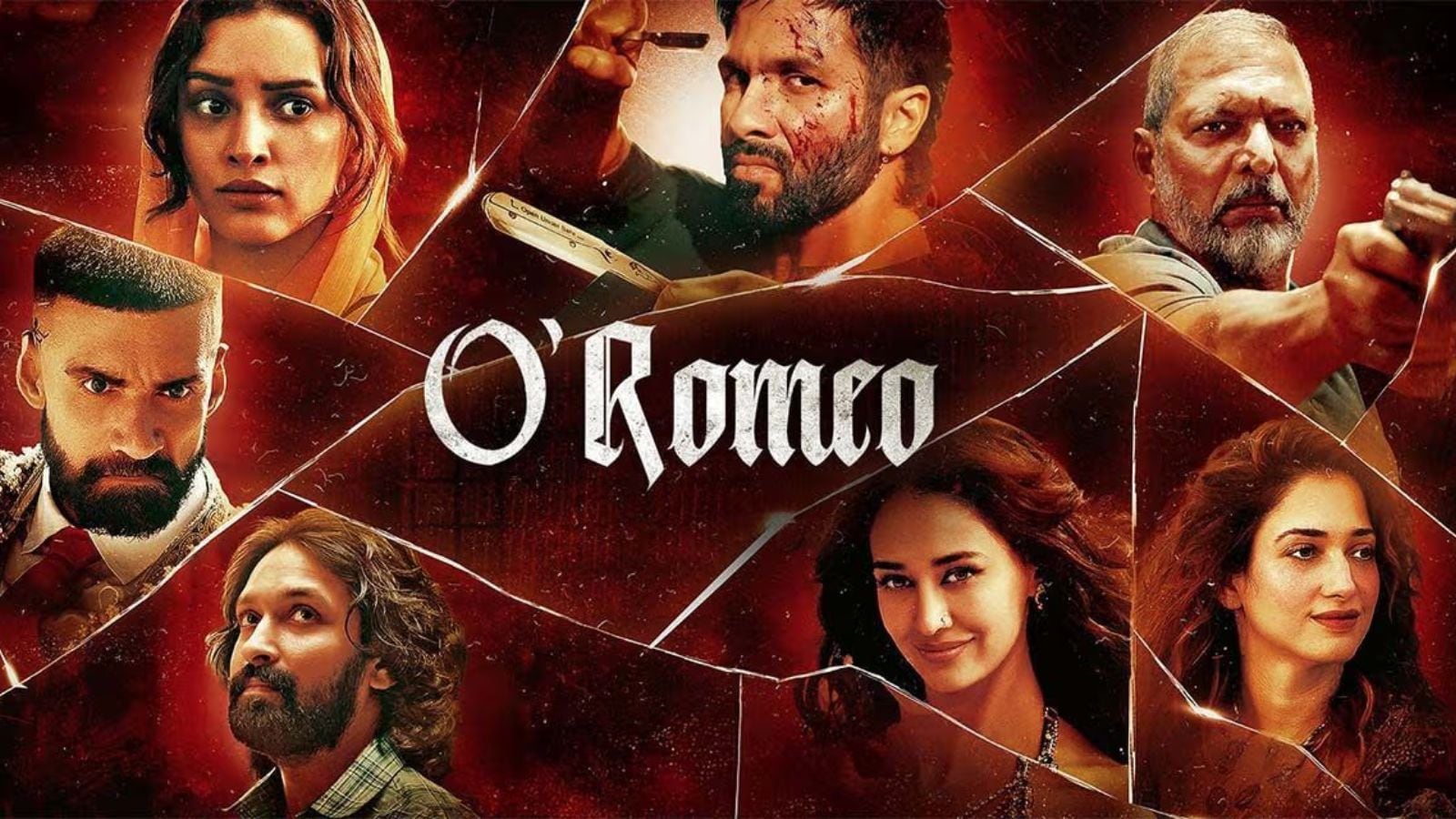
Ustara (Shahid Kapoor) is a tattooed, guitar-strumming, paan-chewing hitman, popular both for his skill with the blade and his raging libido. He goes about slashing throats and spilling guts until his machismo-fuelled world comes to a halt upon meeting Afsha (Triptii Dimri), a young widow seeking vendetta for the brutal murder of her husband (Vikrant Massey).
She wants to hire him to kill four men. At the apex is Jalal (Avinash Tiwary), a feral drug lord who lives in Spain, loves bullfighting and shares a complicated history with Ustara.
What follows is a grim, grainy, hyper-stylised fare with a constant undercurrent of melancholy that is strongly reminiscent of Sanjay Leela Bhansali’s cinema. The Vishal Bhardwaj flourishes on display in O’ Romeo are closer to Rangoon and Matru Ki Bijli Ka Mandola than to Omkara or Haider.
Ustara’s inexplicable, self-destructive obsession with Afsha is eerily similar to that of the protagonist in the short story “An Independent Organ” from Haruki Murakami’s Men Without Women. It is the kind of all-consuming, unrequited love that takes over everything else.
Along with cinematographer Ben Bernhard, Bhardwaj builds a gorgeous world so detailed, textured and inviting that it makes you want to linger and see what passion, when mired in violence, results in. His music and Gulzar’s lyrics do the teleporting instantly, transporting you to the Mumbai of 1995, when the underworld and brothels ruled the teeming metropolis.
The best of Shahid Kapoor is often found in Vishal Bhardwaj’s films, and O’ Romeo is no exception. Despite the bloodshed and Ustara’s obvious edginess, Kapoor grounds him in softness and restraint. He moonwalks and kills with equal finesse and credibility.
Triptii Dimri is excellent too as the suffering Afsha, who weaponises her femininity and fragility in a milieu overrun with guns and blades. It is fascinating to see and decipher the many vivid colours that Bhardwaj often paints and bathes his women in.
Whether it be Maqbool’s Nimmi, Omkara’s Dolly, Haider’s Ghazala or O’ Romeo’s Afsha, women in Vishal Bhardwaj films are never just one thing and are therefore always a joy to experience.
If only the director had given Avinash Tiwary more to do. After Laila Majnu and Bulbbul, it is Tiwary and Dimri’s third film together, but Bhardwaj is uninterested in mining their rich subtext to the film’s advantage. So taken is he with showing off Tiwary’s matador skills to accentuate his villainy that he allows him little else.
Whether it is the killing spree at a cinema, retrofitted to a popular 1990s song for dramatic effect in the opening act, or the final man-to-man combat, the influence of Sandeep Reddy Vanga’s Animal is unmistakable here too, as it has been in other recent Hindi films.
It is the new norm—deal with it how you will. But there is good stuff too. Watch out for Nana Patekar, Farida Jalal, Tamannaah Bhatia and the playfulness that runs through the film. Let all of it delight you.
(Edited by : Vivek Dubey)


