

Even slow EVs feel quick, but making a fast electric car feel exciting is a different challenge. Without an engine revving toward redline or a transmission banging through gears, automakers have increasingly turned to simulated shifts and synthetic sounds to give performance EVs some of the drama enthusiasts expect.
The 2025 Hyundai Ioniq 5 N is one of the best examples yet. Its N e-Shift system manipulates the electric motors’ torque to mimic the shifts, rev limiter, and even the jolt of an eight-speed dual-clutch transmission. Pair it with N Active Sound+, which can pump simulated engine noises or even fighter-jet-inspired sounds through the speakers, and the otherwise single-speed EV suddenly feels much more alive.
Now BMW M is entering the game, but it doesn’t simply want its first electric M car to pretend it has an internal-combustion powertrain.
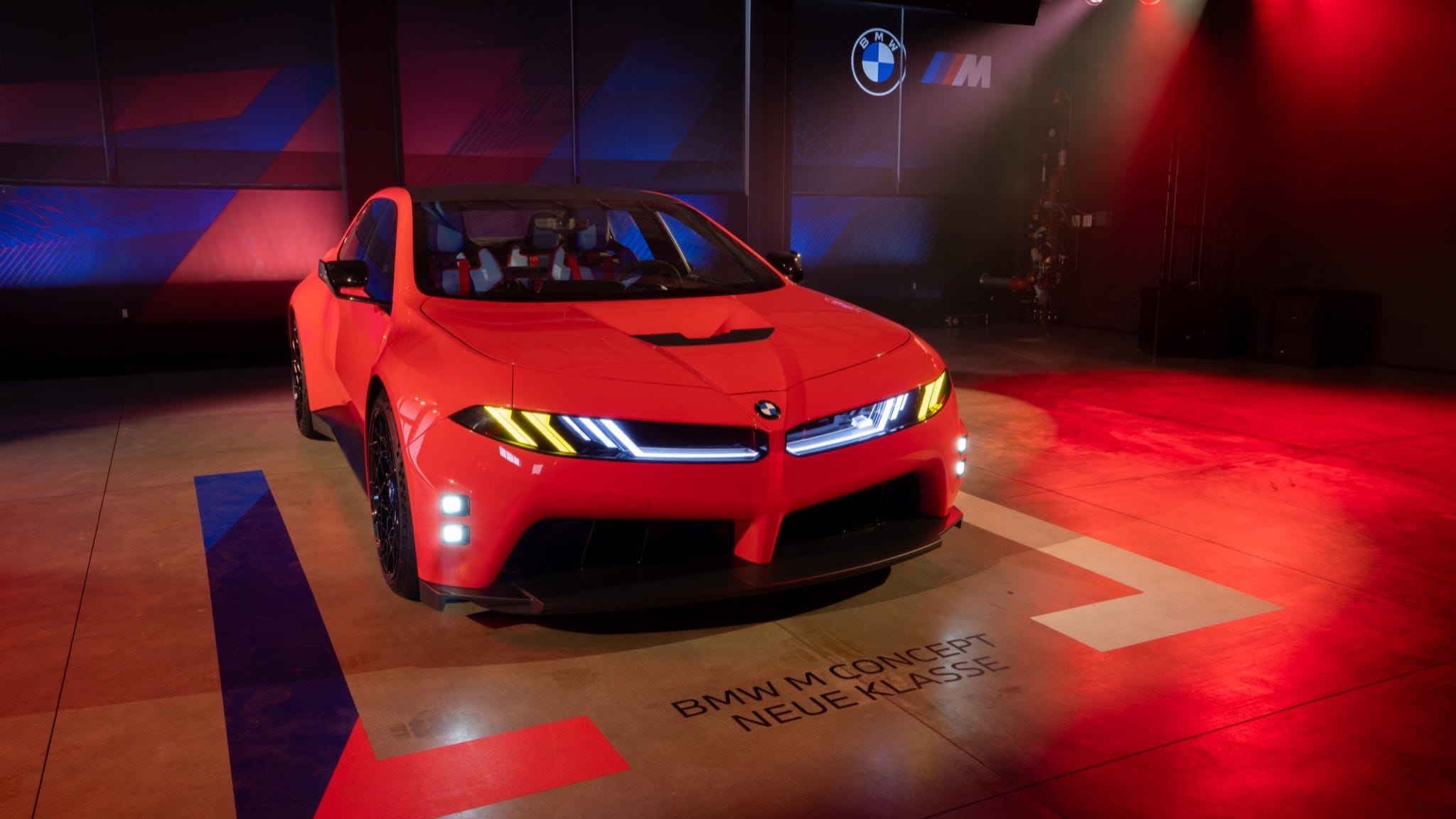
Based on BMW’s Neue Klasse architecture, the upcoming electric M model will use four electric motors, and we expect it to become one of the quickest M cars ever. More important for enthusiasts, BMW is putting a lot of thought into how all that performance will feel from behind the wheel.
We sat down with Frank van Meel, head of BMW M, ahead of the M Concept Neue Klasse’s North American debut. Van Meel confirmed the production car will use what he calls “different stages” to give drivers some of the feedback traditionally provided by gears, but BMW isn’t interested in simply copying the behavior of an automatic transmission.
“If you copy a gearbox into an electric car, you also copy all the disadvantages,” van Meel said, referring to the brief interruption in power that happens during a conventional gear change. “What you want is to have that feeling in different ‘stages’ while you drive.”
The BMW M Concept has paddle shifters and van Meel confirmed those will make it to the production version of the EV.
Van Meel wouldn’t reveal exactly how those stages will work, but he explained why BMW thinks they matter. In an internal-combustion car, engine speed, throttle response, sound, and the selected gear all give the driver an intuitive sense of how fast the car is going and how hard the powertrain is working. BMW wants to preserve those cues in an EV without artificially recreating the drawbacks of a conventional gearbox.
The same philosophy applies to sound. “Every M car has its own sound, and if you drive each and every one of those, it feels like it belongs to the car, and you feel at home,” van Meel said. “That’s the biggest challenge for sound: to make it feel natural, engaging, emotional, like it belongs to the car.”
Again, he stopped short of telling us exactly what the electric M will sound like. He did say its soundtrack should be tied to the character of an electric motor, perhaps with something resembling a turbine, rather than simply piping the sound of an old M engine through the speakers.
BMW has experimented with that during development, recording everything from four- and six-cylinder M engines to V-8s and the screaming V-10 from the E60 M5. But van Meel said simply transplanting one of those sounds into an EV wouldn’t feel right. The goal is to create something recognizably M without making the car sound, in his words, like you’re “flying the U.S.S. Enterprise.”
Why BMW Went Back to Smaller Kidney Grilles
The powertrain isn’t the only part of BMW M undergoing a rethink. Oliver Heilmer, head of design at BMW M, said the Neue Klasse era gave designers an opportunity to move away from the huge vertical kidney grilles that defined the current M3 and M4.
“For us, it was a change in mindset where we said, from a design-language perspective, we are heading toward a world where we need to reduce again. We need to focus on what’s necessary,” Heilmer said.
The M Concept Neue Klasse takes that approach literally. Its kidneys are much slimmer and more integrated into the nose, with illumination helping define their familiar shape. Most of the cooling air enters lower in the front fascia, while the kidneys function primarily as one of BMW’s most recognizable visual signatures.
Heilmer said the inspiration goes back much further than the current M3, pointing to cars such as the BMW 1500 and 507 and their simpler, more horizontal front-end treatments.
Despite looking radically different from today’s M3, Heilmer insists the next generation should still be immediately recognizable as an M car. And if you’re worried the M Concept Neue Klasse looks a little too futuristic, Heilmer sees it differently. “Since every element that we did is based on aerodynamics or functional specifications, I think the elements are more timeless than futuristic,” he said.
We’ll have to wait until 2027 to see exactly how much of the M Concept Neue Klasse survives the trip to production. But the concept is nevertheless starting to spill secrets about what the first generation of electric M cars will be like.
