




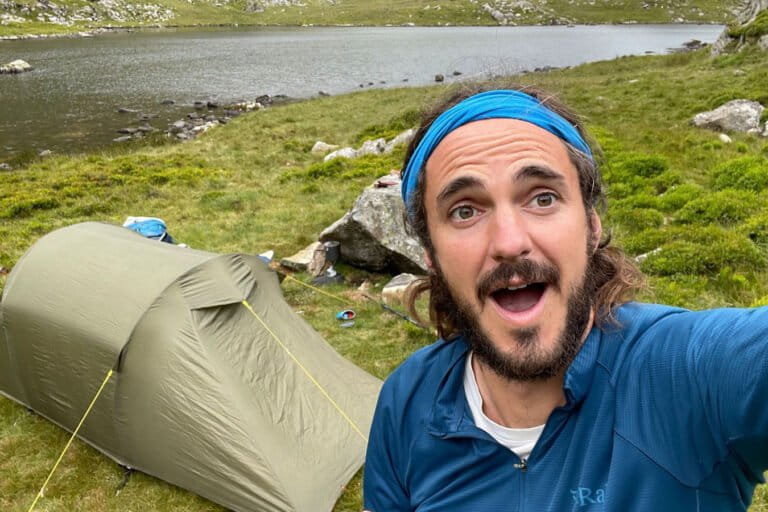
- Thomas Crowther’s Nature’s Echo argues that feedback loops shape everything from ecosystems and climate systems to human psychology and social change.
- Drawing on ecology, cosmology, and restoration science, the book reframes conservation as the cultivation of self-reinforcing systems rather than isolated interventions.
- Crowther suggests that optimism, behavior, and narrative are not peripheral to environmental outcomes, but part of the forces that influence them.
- In an interview with Mongabay’s founder and CEO, Crowther discusses how these ideas inform his thinking on restoration, regenerative movements, ecological resilience, and the role individuals play in larger systems of change.
Thomas Crowther’s career has been shaped by large claims about small things. A seed, a patch of soil, a soundscape, a moment of fear, a local restoration project: each, in his telling, can become part of a larger system of cause and effect. His new book, Nature’s Echo, is built around that idea. Feedback loops, he argues, are not just a feature of ecology. They are among the forces that formed stars, spread life across Earth, drive climate change, and may yet help repair damaged ecosystems.
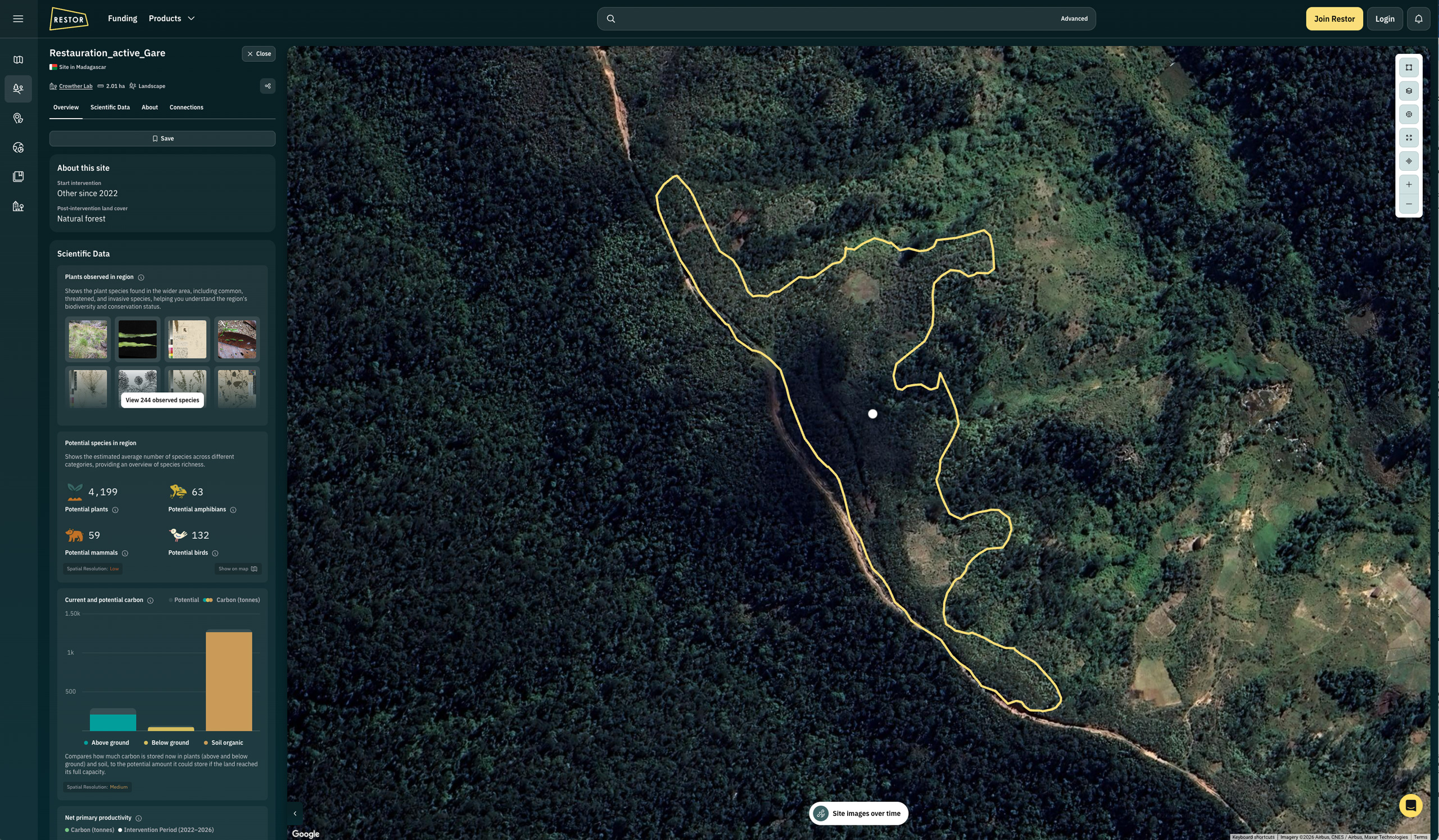
Crowther, a British ecologist, became one of the best-known figures in global ecology while at ETH Zurich, where he founded the Crowther Lab and built a large interdisciplinary research group. His work helped popularize the idea that ecosystem restoration could play a major role in addressing climate change, especially after a 2019 Science paper on the potential for additional tree cover drew worldwide attention, as well as criticism from scientists who warned against simplistic tree-planting narratives. His work also helped give rise to the World Economic Forum’s Trillion Trees initiative, and he has served as co-chair of the advisory board to the U.N. Decade on Ecosystem Restoration. He is also the founder of Restor, an open-data platform that connects conservation and restoration initiatives around the world.
That public profile has made Crowther both influential and contested. In 2024 he was also at the center of a dispute over his departure from ETH Zurich. The university said its decision followed an internal review that raised concerns about professional boundaries, compliance procedures and conflicts of interest. ETH did not reach definitive conclusions on some interpersonal allegations. Crowther has denied personal misconduct, said any procedural failures were unintentional, and acknowledged that he “sometimes blurred the lines between friendship and leadership.” Some former employees welcomed ETH’s findings, while many current and former members of his lab publicly contested the process, describing the investigation as flawed and defending the lab as supportive and inclusive.
The interview that follows is not about that episode. It is about the ideas in Nature’s Echo, and about how Crowther now thinks science, restoration and social change fit together. Still, the controversy gives some of the book’s themes a sharper edge. His book is concerned with how narratives form, how perceptions shape responses, and how systems can move rapidly from one state to another. Those are ecological questions. They are also human ones.

Crowther says his own interest in nature began before he had any sense that he might become a scientist. As a child on holiday in France, he recalls ignoring the other children and watching lizards basking on a wall. When an adult wondered aloud what was wrong with him, his father defended him: “He just loves nature. There is nothing wrong with that.” Crowther says the moment reinforced an obsession. In the book and in conversation, that childhood fascination has become a way of reading the living world as a system of relationships, signals and consequences.
“Feedback loops are pretty magical patterns,” he says. “They happen when a process causes something that reinforces that inciting process.” The definition is simple, and it carries much of the book’s argument. Crowther sees such loops in the formation of stars, the spread of life, the destabilization of the climate, and the recovery of landscapes. Once a loop begins, it can gather force. That force can be destructive, as with warming that accelerates further warming. It can also be regenerative, if the incentives, benefits and emotions point in another direction.
This gives his account of conservation a different emphasis from many restoration narratives. He does not argue that restoration is simply a matter of planting trees or fencing land. “You cannot just stick trees in the ground in places where local people don’t want them,” he says. Recovery, in his view, becomes durable when nature improves people’s lives and those improvements create a reason to protect more nature. A restored forest may support crops, health or local income. Those benefits can then create the conditions for further recovery.
He applies the same logic to positive tipping points. Renewable energy, electric vehicles, regenerative farming, plant-based diets and upcycled clothing matter to him not only as technologies or consumer choices, but as signs of systems beginning to reinforce themselves. Once an option becomes cheaper, easier, more effective or more enjoyable, he argues, growth no longer depends only on exhortation. It starts to draw strength from adoption itself.
Crowther is also interested in less visible signals of ecological change. Bioacoustics, he says, offers a way to measure the complexity of an ecosystem by listening to its frequencies of life, from birds and insects to wind and rain. Sound, for him, is not only data. It also opens the imagination. Healthy ecosystems, he argues, have soundscapes that people instinctively recognize and prefer.

The most personal parts of Nature’s Echo move from ecology into psychology. Crowther opens the book with a story about being bitten by a snake in a rainforest and wrongly believing it was venomous. Fear made his arm go numb, which made the danger feel more real. The loop fed itself until the mistake was corrected. For Crowther, the episode became a way of thinking about environmental fear. Panic, he argues, can narrow agency. Optimism, when grounded in real possibilities, can do the opposite.
That is the central thread of the conversation: humans are not outside nature’s feedback loops. They are part of them. Crowther’s answer to ecological despair is not reassurance, and it is not denial. It is attention to the places where restoration is already becoming self-reinforcing, and to the choices that help such loops gather strength. As he puts it, “Feedback loops do not care about scale.” Small actions, if they connect to the right dynamics, may not remain small for long.

An interview with Thomas Crowther
Rhett Ayers Butler for Mongabay: What first drew you into this field? Was there a moment when you realized you wanted to understand nature at this systems level?
Thomas Crowther: I never really wanted anything else. From as long as I remember, I had always longed to work with wildlife. But I didn’t think that I would be able to get involved in the scientific process, although I knew that I would take any chance that I could.
If you need a specific day, there was one moment that stands out. When I was young, our family used to go to stay with another family in France for our holidays. While all of the other children from both families used to play in the garden, I used to spend most of my time sitting alone and staring at a wall where lizards liked basking in the sun. One day, I remember the grandmother of the other family asking, ‘What do you think is wrong with him?’ I vividly remember my dad saying, “What do you mean? Nothing is wrong with him! He just loves nature. There is nothing wrong with that! We should all be reminded of how incredible nature is.” I remember feeling quite emotional. And I think it reinforced my obsession.
Mongabay: Your book frames the world through feedback loops—ecological, social, even psychological. What led you to see these patterns as the central lens for understanding nature?
Thomas Crowther: Feedback loops are pretty magical patterns. They happen when a process causes something that reinforces that inciting process. I used to just find them fascinating, because they help to explain the intricate patterns that we see in the natural world. But as I started writing the book, I began to realize that they were actually responsible for all of the most powerful forces that the universe has ever seen. After the Big Bang, they allowed stars to form, they allowed life to spread across the planet, and they are driving climate change. And they also hold all of the potential to regenerate our planet if we allow them to.
When you start noticing them, you can’t stop seeing them everywhere. They are why it gets harder to sleep the more anxiously you need to sleep, or why exercising makes it easier to do more exercise. When you start following these lines of causality, they seem to make sense of everything that came before, and they also help you to imagine how things might change in the future. And when you realize their power to shape the future, they bring with them an incredible sense of agency, as you realize that your actions have an astonishing potential to build a regenerative world.
Mongabay: You open with a personal story about perception and the body’s response to belief. How did that experience shape the way you think about cause and effect in complex systems?
Thomas Crowther: Yes, I was bitten by a snake in a rainforest. And the misguided fear that it was venomous made my arm go numb, which reinforced my belief that it was venomous. My panic also caused those around me to panic, driving a hectic series of events that started to get out of control. It really viscerally showed the power of feedback loops to shape our physical future.

As a society, if we face our environmental future with fear and anxiety, then our reactions run the risk of exacerbating the problem. As defensiveness and antagonism increase, military spending goes through the roof, which only justifies the need for more fear. Instead, if we can find a way to react from a place of optimism for a brighter future, then those are the qualities that will be amplified through feedback loops. And there are so many ways to engage. If we can face our uncertain future with enthusiasm for the environmental opportunities that can improve our health, wealth, fun, or fashion choices, then we will find the intrinsic motivation to do them more. And the more we enjoy them, the more we will engage, which should only enhance the enjoyment. Feedback loops like this help us to see how we can collectively manifest a different future.
Mongabay: Much of environmental science focuses on collapse. You emphasize “snowball effects” and tipping points—both negative and positive. Where do you see the most realistic opportunities for positive tipping points today?
Thomas Crowther: Positive feedback loops are universal forces that can build out of anything. Of course, we tend to focus on the loops that are building in destructive directions because they are overwhelming at the moment. It is natural that we do this, because our sympathetic nervous system is designed to focus on threats rather than opportunities. But around the world, positive feedback loops are also building in incredibly positive directions, and once they start building, they only grow with runaway momentum.
The classic examples are the growth of electric vehicles and renewable energy, which is becoming cheaper and more effective than the alternatives. When solar energy becomes cheaper than fossil fuel energy, then it is inevitable that more people start using it, which only lowers costs more, driving more uptake. Once a feedback loop like this builds momentum, it can tip entire industries into new states. But we are also beginning to see similar patterns in regenerative farming, where the introduction of biodiversity is improving farmers’ yields. And even things like upcycled clothes and plant-based diets are becoming more fashionable and desirable than the alternatives. Whenever the regenerative solution becomes easier, cheaper, better, more effective, or enjoyable than the alternatives, then its continued growth is not only possible — it is inevitable.
Mongabay: The book suggests that stability in ecosystems comes from a balance between reinforcing and stabilizing forces. How should that idea change the way we approach conservation or restoration?
Thomas Crowther: Positive feedback loops are the agents of growth and momentum. If we want to drive change, we can only achieve success if you can tangibly see that positive feedback is possible. If you want to restore a forest, you cannot just stick trees in the ground in places where local people don’t want them. However, if there is intrinsic motivation to restore vegetation because it brings tangible local benefits — like improved vitality of crops, health, or economic stability — then recovery will happen under its own steam. Wherever nature improves the livelihoods of local people, then there is more incentive to protect more nature, which supports even more livelihoods. When this loop starts building momentum, you cannot stop nature from recovering across landscapes under its own self-reinforcing momentum.
At the same time, if we want a system to stay stable, this cannot happen without negative feedback loops. In nature, the balance of the system cannot happen without the classic negative feedback loops of predation, parasitism, and competition. For an ecological system to remain in balance, you often need to make sure the top predators are present, because these are the organisms that regulate the species below them in the food chain, keeping the entire system in balance. We have seen it over and over again, where the restoration of a few predators can transform entire landscapes, reviving resilience that can last in the long term.
Mongabay: There’s a growing use of bioacoustics to understand ecosystems. In a world defined by feedback loops, what does “listening” to nature reveal that we might otherwise miss?
Thomas Crowther: One of the biggest challenges in nature protection is the task of measuring the full complexity of an ecosystem. Sound is an incredible way to characterize ecological complexity, because it allows us to characterize all the frequencies of life, but also those of the abiotic characteristics like wind and rain. All of these things will vary between a healthy ecosystem and an unhealthy one, so sound recording provides an incredible depth of information.
But for me, the most exciting thing about bioacoustics is that it also serves to open up our imagination. When you hear the soundscapes of ecological health, it taps into something deeper within all of us. We all share an innate preference for the soundscapes of healthy nature over the sounds of degradation. It is no surprise that meditation and relaxation soundtracks always sound like beautiful bird sounds. These are the complex ecosystems that allowed us to survive for thousands of years. And so our preferences for these beautiful soundscapes are baked into our genetic makeup.
Mongabay: You’ve moved from ETH Zurich to the Branch Institute. It’s early, but how is that transition progressing so far? And does it reflect a change in how you want to engage with science and impact?
Thomas Crowther: The start of the Branch Institute has been a whirlwind. The lab in ETH Zurich was one of the best times of my life because we were all close friends, having fun and working together toward a shared mission. But we were an enormous group, all crammed within one lab, and we could not do some of the more applied conservation work. However, since evolving into the Branch Institute, we have been able to continue working together, and we have been able to expand and grow naturally. Now our research group actually reflects the scope of our research topic.
Mongabay: The book moves from physical systems to human belief and perception. Why is it important to include psychology and narrative when talking about ecology?
Thomas Crowther: So much of the discussion around climate change is about the physical threats or how insurmountable they are. These feedback loops are overwhelming planetary forces. They can lead to a loss of agency, as we believe we are passive bystanders to inevitable collapse.
But this belief itself is also the subject of feedback loops that shape our perception of reality. And it has the potential to shape our physical future through self-fulfilling prophecies. If we convince ourselves that we are doomed to a bleak future, then growing levels of fear, anxiety, defensiveness, and antagonism will only continue to limit progress. However, if we can allow our attention to nourish the incredible regenerative opportunities that can improve our lives, livelihoods, and emotional well-being, then we have the agency to build incredible momentum in a different direction.
Mongabay: You describe how small actions can scale through feedback loops. For readers, what are examples of “small decisions” that genuinely have system-level consequences?
Thomas Crowther: A feedback loop is a process that drives inevitable momentum without effort because everything builds on all that came before it. Subtle asymmetries in the early universe can build momentum to form stars, and slight genetic fluctuations can give rise to the creation of entire species. And exactly the same forces are able to build from our authentic joy and appreciation for regenerative solutions.

You may enjoy running to work or eating vegan for the taste benefits. You may enjoy ecotourism holidays for the feeling of freedom, or upcycling your clothes to impress your Instagram followers. Each of these actions has a small benefit. But the enjoyment you gain from them is the most important thing because it will be the fuel for feedback loops that can grow with unstoppable power. Because the more you enjoy them, the more you will do them, which only makes it easier to enjoy them more and so on. And when others around you see the joy you are taking from those actions, they are more likely to get involved. That is how movements are slowly building with unstoppable momentum.
Mongabay: What gives you hope right now—not in an abstract sense, but based on patterns or trends you’re seeing in real systems?
Thomas Crowther: We are all aware of the threats that our planet is facing. But I am lucky enough to work with a platform called restor.eco, which connects millions of regenerative nature projects around the world. When you see farmers and indigenous populations getting improved livelihoods as a result of nature recovery, you can see how feedback loops can grow. When nature revival improves the lives of people, then you cannot stop it from growing across entire landscapes. This regenerative movement now spreads across 170 million hectares of land, as people and nature are beginning to thrive together.
Thomas Crowther: When you see feedback loops like that gaining steady momentum, you start to realize how the smallest actions can grow into planetary-scale forces. Every one of us can engage in regeneration with the tiniest of actions, and if we can nourish them with our joy and attention, then they too can grow into immense forces of positive change.
Mongabay: For people hoping to work in conservation or ecological research, what mindset or skill set matters most in a world shaped by complex systems rather than linear cause and effect?
Thomas Crowther: I think my answer would be the same as for any field of work: if you can tap into authentic joy and enthusiasm for what you do, then you can achieve amazing things. If you love nature, then it will be easy to find the intrinsic motivation to fight for its protection. The environmental movement needs every kind of skill set. Whether you are good at writing, fieldwork, campaigning, statistics, storytelling, or any other task, you are desperately needed in this movement. The key challenge is to find your enjoyment of the process and dive in with everything you have got.
Mongabay: If readers take away one idea from Nature’s Echo, what would you want it to change about how they see their own role within these feedback loops?
Thomas Crowther: If there’s one thing I hope readers take from Nature’s Echo, it’s that we are not outside nature: we are a fundamental part of nature’s feedback loops, shaping them whether we intend to or not.

Our tiniest actions can cascade into planetary changes, rebuilding landscapes and strengthening the conditions for further recovery. Feedback loops do not care about scale. They amplify the qualities of whatever we put into them. If we face the future with panic, that is what will be amplified. But if we can face the future with joy and enthusiasm, then those are the qualities of what will emanate.
That’s why optimism isn’t naïve. It is a tangible prerequisite to environmental success. Once you see these reinforcing loops, you realize that we are not passive witnesses to planetary collapse. We can become active participants in the greatest regenerative opportunity our species has witnessed.