







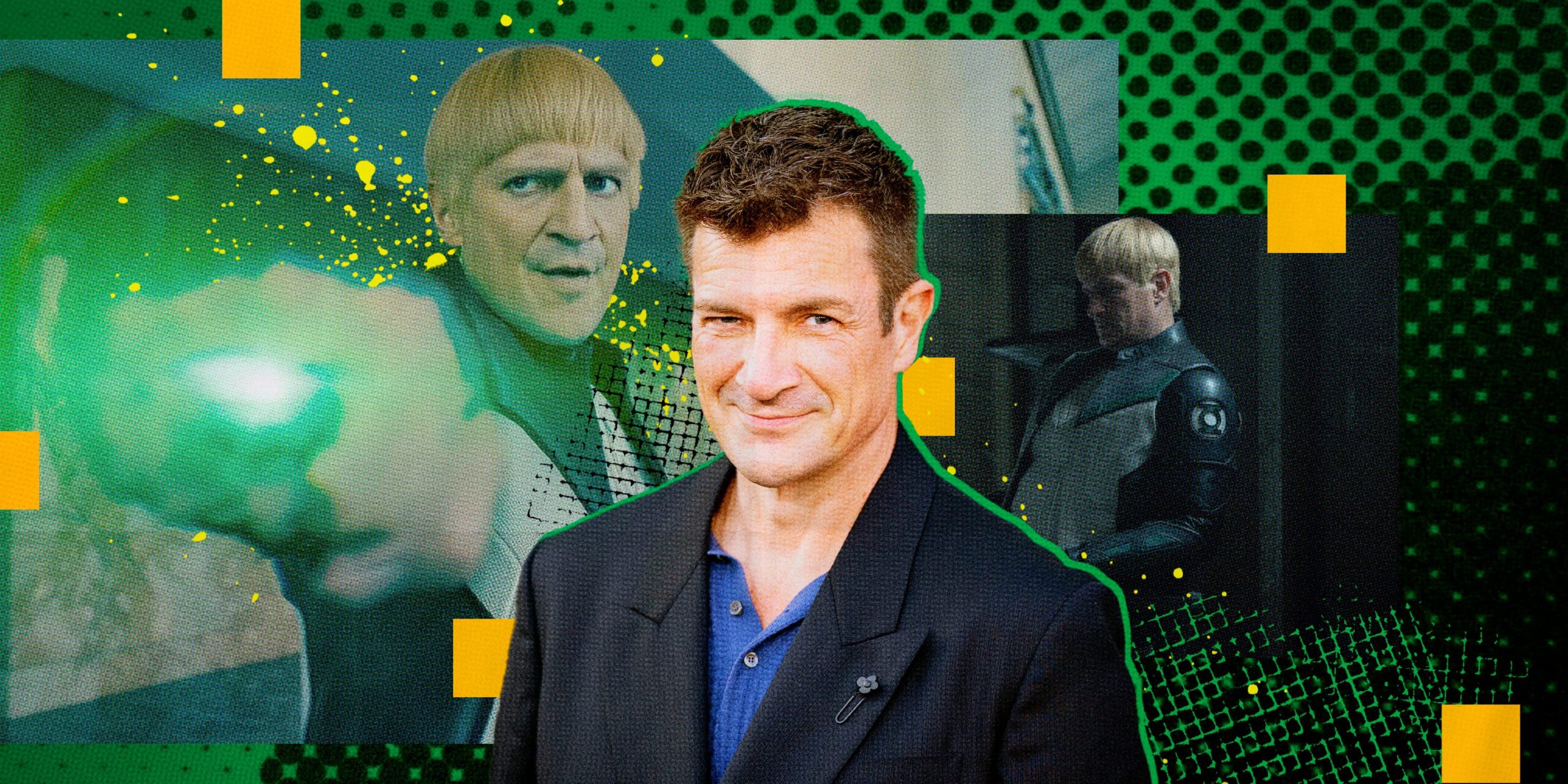
The following story contains spoilers for Lanterns through episode 6.
AT THE CLIMAX of 2025’s Superman, a little boy begs the Man of Steel to come and save his countrymen from the forces of an invading military. The boy gets saved, but not by the Last Son of Krypton. Instead, an emerald bubble surrounds him, courtesy of Guy Gardner, a member of the intergalactic peacekeeping force, the Green Lantern Corps. “Sorry, kid,” says the smirking Gardner. “Superman couldn’t make it. So you got an upgrade.”
That one scene captured the essence of Guy Gardner, who first appeared as a relatively bland backup for main Lantern Hal Jordan in 1968’s Green Lantern #59, by John Broome and Gil Kane, but was reinvented in Green Lantern #190 (1985), by Steve Englehart and Joe Staton, as an arrogant jerk in a bowl cut. Since then, Guy Gardner has been antagonizing good guys and bad guys alike, doing the right thing for all the wrong reasons, yet still maintaining a rabid fan base.
Which is why Nathan Fillion is the ideal actor to bring Guy Gardner to live-action. Since his breakout role as the misbehaving space cowboy Malcolm Reynolds in the cult sci-fi hit Firefly, Fillion has made his name playing charming rogues. Whether it’s the brash mystery author Richard Castle of the crime series Castle or construction-worker-turned-beat-cop John Nolan on The Rookie, Fillion knows how to aggravate audiences with a smirk and then win them back with a wink.
Those qualities have served Fillion well in his two previous appearances as Guy Gardner, first getting taught about the nature of heroism in Superman and then denying John Cena’s buffoonish musclehead admission into the Justice Gang on Peacemaker. But the HBO series Lanterns poses a unique challenge to Fillion’s take on Gardner.


A mystery in the vein of True Detective, with a sci-fi twist, Lanterns stars Kyle Chandler as veteran Green Lantern Hal Jordan, who is forced to take on young trainee John Stewart (Aaron Pierre). The two butt heads while investigating an alien invasion in Rushville, Nebraska, being manipulated at every turn: by the supervillain Sinestro (Ulrich Thomsen), by the incognito Manhunter (Poorna Jagannathan), and by one of the Guardians of the Universe (Laura Linney), the Green Lantern Corps’s otherworldly bosses.
The tension came to a head in episode 5 of Lanterns, when John and Hal fail to prevent the battle between the Manhunter and the alien warriors coming to kill her, leading to the destruction of Rushville and both Hal and John’s expulsion from the Corps. Episode 6, “Bad Optics,” jumps ahead years in the future, when Hal’s imprisonment (and eventual death) means that Guy Gardner has to step in and succeed where his fellow Corps members failed—a job he’s happy to take on.
Men’s Health sat down with Fillion to find out how he pulled off Guy Gardner’s return, learned about the psychology of the DCU’s most insecure superhero, and how he’s like one of the Golden Girls.
MEN’S HEALTH: Lanterns marks now the third time you’ve played Guy Gardner, after Superman and Peacemaker. What’s Guy all about?
NATHAN FILLION: Guy’s all about Guy. It’s always Guy first, because he has something to prove. He really wants to be the biggest ring in the room.
MH: Who does Guy see as his biggest threat? Is it Superman? Or is it the other Green Lanterns, Hal Jordan and John Stewart?
NF: Just from what we’ve seen, Guy clearly thinks he can take on Superman. He was ready to put up the dukes, as they used to say.
Being in the Green Lantern Corps means you get a ring, this incredibly powerful weapon. You have to be fearless to use that ring, so it follows that Guy would be fearless even facing somebody like Superman.
But among Green Lanterns, when he’s up against Hal Jordan or John Stewart, Guy would be… I’m not going to say afraid, but he’s certainly less comfortable.
MH: So would Guy feel like he had to prove himself if he was ever in a room with Hal, alive and fully charged-up?
NF: Always. Yeah, that’s his guiding light. It’s the fire that burns inside of him—this pathological need to prove himself.
MH: Hal’s dead by the time Guy shows up, but we do see Guy interacting with John Stewart. How does Guy feel about John?
NF: Guy, John, and Hal are all part of the same secret club, and that fires Guy up. He’s looking at them, and he’s always thinking, “You think you’re better than me? You’re not better than me.” Because, for all his abilities and advantages, Guy is limited. He’s a flawed character because he’s limited in his compassion.
I think he comes around, eventually. He came around in Superman. But, man… it took a minute.
MH: Is it compassion that makes Guy agree to John’s request to get Hal’s uniform and ring for the funeral?
NF: At that point, Guy’s being manipulated. When John Stewart asks if he’s scared and can’t do it, Guy immediately says, “Don’t you tell me I can’t do it.” He’s a child. And John’s a strategist. John’s military and precise, while Guy’s a blunt object. He’s all baseball bats and hammers.
MH: John’s certainly not alone in that, because there’s a lot of manipulation going on in Lanterns, especially from the Guardians of the Universe. How does Guy feel about the Guardians? Does he trust them more than Hal and John seem to do?
NF: Yeah, I think so. That’s part of his limitation, too. From Guy’s perspective, if the Guardians were smart enough to pick him, then clearly they’ve got their heads on straight.
“From Guy’s perspective, if the Guardians were smart enough to pick him, then clearly they’ve got their heads on straight.”
MH: It’s that kind of attitude that makes Guy Gardner my favorite character in comic book history.
NF: Thank you! Can I share something with you? I loved comic books when I was a young man, and I was aware of Guy Gardner. But I didn’t particularly like him, and I thought that was the idea—that we weren’t supposed to like him.
So, I had no idea how well-liked he was. I’ve met children who think he’s adorable, and people who say that he’s their favorite superhero. People like him for some sincere reasons, and goofy reasons, and brilliant reasons. But I’ve been surprised, in a good way, by how people feel about him.
I just thought he would be fun to play because he’s a flawed character. It’s rewarding and challenging to play a flawed character, because you have to tap into those flaws without standing in judgment.
MH: Guy isn’t the first Green Lantern you’ve played, because you also voiced Hal Jordan in some animated films. What similarities and differences do you see between Hal and Guy?
NF: The Hal Jordan in the comic books was the prototypical hero. He has an exciting job, he’s handsome, all the ladies like him. And, guess what, he has superpowers as well. That type of hero of yesteryear made sense to us, because that’s what we expected.
But if we mix in more reality, we get what Kyle Chandler is giving us as Hal, which is brilliant and beautiful, and just makes a lot of sense.
MH: Did you try to bring some of that reality to Hal when you were voicing him?
NF: No, we never got that deep into him. The version I was working with was a little more advanced than the guy from old comic books or the Super Friends cartoon show, you know: [Adopts an over-the-top narrator voice] “Meanwhile!”
But it just didn’t hold a candle to Lanterns and what Kyle Chandler and Aaron Pierre are doing. That show is precise and layered. It’s so satisfying to watch.
MH: Given your experiences voicing Hal and then playing Guy in Superman and Peacemaker, what were your expectations for Lanterns? Did you know what kind of grounded mystery show it would be?
NF: Yes, because that was the concept that was sold to us. And I’ve been excited to see how it unfolds, because, you know, I just pop in for a couple of scenes. I wasn’t there to watch the show being built and to truly understand how they established the tone.
I have my scenes and this character that I’ve already established. My hope is that he just fits inside that world. I think the only way to fit into a world as grounded as Lanterns is to maintain sincerity. And that’s just basic Actor 101 stuff: Who is this person? What’s he about? What does he care about?
MH: But it’s not just that Guy’s not battling a kaiju or auditioning members of the Justice Gang. He’s here for a funeral in a city that hates every Green Lantern. There’s a different level of gravity here in Lanterns.
NF: Here’s how I approached it: If I were to visit Metropolis for one weekend, and then visit Gotham the next weekend, I would be the same person. But I would be in two very different environments. It’s all about the consistency, which was built into the writing on Lanterns.
There’s something really clever in Lanterns, which made it different from the other projects. In Superman, Guy is a superhero among superheroes. But in Lanterns, he’s a god among men. He’s the only superhuman there. Everyone else is just normal. For a cocky person who likes being the biggest ring in the room, that’s great. There’s no arguing against him.
MH: How does the fact that he’s sort of cleaning up the mess made by Hal and John play into that feeling?
NF: Guy cares a lot about the brand. He knows social media, he knows how to do TikTok trends. He’s got his face out there and his brand is important to him, so he’s just capitalizing on everything. It’s all part of what he thinks he deserves.
MH: How far has Guy come along to being a more pure, altruistic superhero after his experiences in Superman?
NF: As an actor, you really have to avoid treating a scene like it’s the biggest deal in that character’s life. You have to treat every scene like it’s just part of that person’s day.
When Guy Gardner visits the Lanterns portion of the DC Universe, he’s not on a mission. It’s just part of his afternoon. He’s got bigger things to worry about, because he’s part of the Justice Gang and he has LordTech meetings. He’s only there for five minutes. It’s tertiary at best.
He’s more concerned with promoting his brand and making sure his face is out there. Guy wants to be recognizable.
MH: You certainly know something about being recognizable and dealing with social media and fan expectations. Between Firefly, Castle, The Rookie, and now Guy Gardner, you’ve had your share of the internet weighing in on what you do. Did any of that go into your understanding of Guy and his approach to branding?
NF: No, I didn’t really pull from things the internet has said about me, but I do relate to Guy’s approach to branding in another way.
I try to find a fun way to commemorate every project I do. This time, I had a friend concoct for me little Zippo lighters with a Green Lantern logo on it. Across the top, it says, “From Guy.” And when you flip it open and press the button, a little translucent green middle finger pops out.
“I loved comic books when I was a young man, and I was aware of Guy Gardner. But I didn’t particularly like him, and I thought that was the idea—that we weren’t supposed to like him.”
MH: That’s an interesting choice, because it speaks to the physicality of playing a Green Lantern. How do you get into portraying someone who doesn’t just fly or shoot laser beams, but also brings to life whatever he can imagine?
NF: In my bedroom, I have a multicolored wax crayon device and a full-length mirror. To get started with Guy, I stood in front of the mirror and drew a Green Lantern logo where my chest would be. And then I started writing on the mirror all the things that occurred to me about the character. So then, every time I looked in the mirror and saw that logo, I would also think about who Guy was.
That included thinking about how to float through space and how Guy carries himself through the world. And as you’re thinking about what type of person Guy is while you’re actually looking at yourself, you can’t help but start to take on a type of physicality.
With Guy, it’s this sort of self-importance, like he’s trying to show us that he doesn’t care what anyone thinks about him, even though he’s constantly thinking about his posture or how he looks in that jacket. It all starts to transform your physicality.
MH: What were some of the things about Guy that you wrote on that mirror?
NF: At some point in Guy’s history, he was essentially overlooked, more than once. And he’s sore about it. Even after he became a Green Lantern, he still has this open, raw wound. And it feels like there’s this lemon-coated stick constantly poking him.
He’s happy to be a Green Lantern, but there’s an anger to his happiness. He just can’t be grateful. There’s always an edge.
MH: That matches his comic book origins, where he was a pretty normal person when he was chosen to be Hal’s backup, but then all sorts of things happen to him. His Lantern explodes…
NF: He gets hit by a bus, yeah, and put into a coma. I thought about that too, and I played into it, because it helped me understand how someone could be so heartless and awful.
It reminded me of Estelle Getty’s character on The Golden Girls. She had a stroke and that short-circuited the part of her brain that had a filter. So I just put that into Guy, where the accident and the coma that followed just removed his filter. So, now, all the personality flaws that most people would tamp down, Guy lets out.
MH: Despite all that, do you still think Guy is a hero?
NF: Yeah, I do. I just don’t think he’s an altruistic man. I’ve said this before, but if you need a Green Lantern, then things have gotten pretty bad. And if they send a Green Lantern, you’d say, “Oh, thank God.” And if they send Guy Gardner, you’d say, “Oh… Is there anyone else? Maybe that squirrel?”
This interview has been edited for length and clarity.


