








Sandhya J, Group CFO of Narayana Health, said the hospital chain expects continued organic growth in India, supported by operational efficiencies, higher-value bed configurations and expansion in integrated care and insurance businesses.
While no major capacity additions are planned immediately, the company expects its India business to continue delivering stable growth momentum.
Narayana Health sees significant room for margin improvement in its newly acquired UK business. The company plans to increase private-pay patients while retaining its large NHS-linked revenue base.
Sandhya J said UK operations currently run at EBITDA margins of around 10-10.5%, compared with competitors operating in “high teens,” indicating substantial upside over time.
The hospital chain reported consolidated revenue of ₹2,594 crore in the January-March quarter of 2026 (Q4FY26), marking a jump of nearly 76% year-on-year (YoY) and more than 20% sequentially. Net profit rose over 16% YoY to ₹228 crore, while earnings before interest, taxes, depreciation and amortisation (EBITDA) increased more than 40% to ₹539 crore.
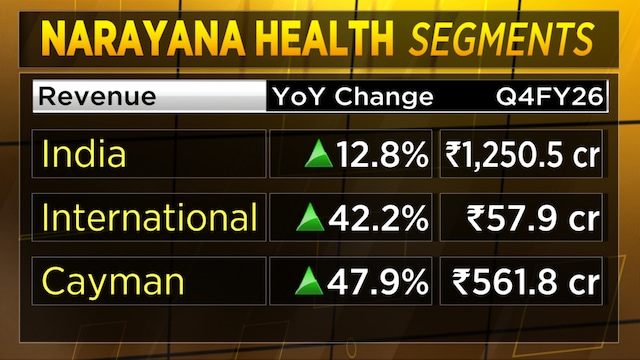

For the full year, revenue climbed 42% to ₹7,806 crore, while profit rose marginally to ₹810.5 crore from ₹790 crore in 2024-25 (FY25). However, annual EBITDA margins moderated to 22% from 25% a year earlier, reflecting the impact of investments in newer businesses and the lower-margin UK operations.
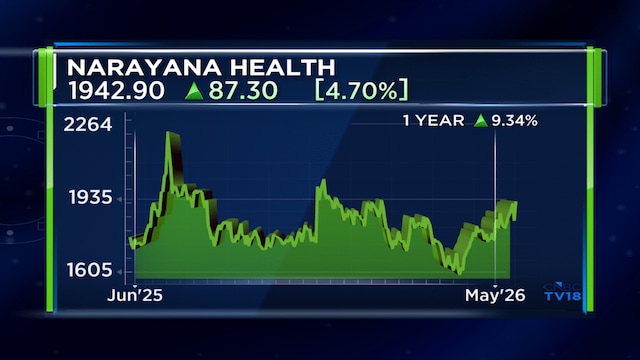
Shares of Narayana Health have gained nearly 10% over the past year, giving the Bengaluru-based hospital chain a market capitalisation of around ₹39,624.54 crore.
This is an edited transcript of the interview.Q: Let me begin with your margins. While margins expanded quarter-on-quarter, they are still lower year-on-year post the acquisition of the UK Practice Group. What led to the pressure? Was it the UK business, clinics, insurance business in India, or new bed additions?
A: If you look at the hospital segment, we have seen the positive impact of all the transformation initiatives we have undertaken, where patients have opted for higher-configuration beds. We have consistently spoken about improving our bed configurations.
We have also benefited from operational efficiencies driven by our technology and throughput improvement initiatives. Indian hospitals have seen substantial growth in margins.
Also Read | Narayana Health focuses on GCC, insurance and UK turnaround for next growth phase
The dilution in India is coming from investments we are making in the integrated care business, which includes clinics and insurance. In Cayman, the hospital business has come back to earlier levels, but the insurance business has caused some dilution. The UK is a lower-margin business, so the acquisition also dilutes overall margins. All of this together is resulting in blended margins being lower than before.
Q: Particularly on the UK business, what is the margin profile, and how should investors think about the margin trajectory over the next two to three years?
A: The UK is not a high-margin business like India or Cayman. Having said that, it is a very stable and high cash-flow business, which is why it was attractive for us.
The UK business currently operates at around 10-10.5% EBITDA margins. We believe we have the ability to improve this toward peer levels in the UK market.
The right way to look at the UK business is through the steady cash flow it generates and the predictability of revenue because a large part of the business comes from the National Health Service (NHS), the government payer. It is also a leveraged acquisition, making it accretive from a return ratios perspective.
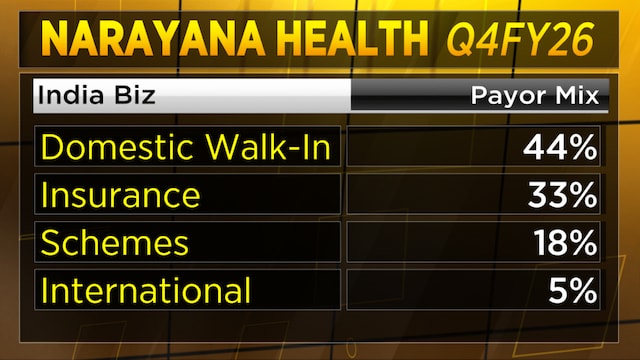
A: We cannot guide specific numbers, but directionally, India will continue to see growth. We are not adding significant capacity in India apart from one hospital going live next month, so most growth will be organic.
Integrated care and insurance businesses in India are growing well. The insurance business did quite well in the second half of the year and will continue consolidating those gains.
Cayman saw significant growth last year because of new capacity additions and momentum in insurance. This year’s growth will be more balanced because there is no inorganic element.
Also Read | Apollo Hospitals to add 850 more beds as expansion pipeline strengthens: MD Suneeta Reddy
In the UK, we are confident about growth because the business was already growing reasonably well even before the acquisition, but we are still assessing the long-term trajectory.
Q: What proportion of the UK business comes from the NHS?
A: Currently, 90% comes from the NHS.
Q: For margins to improve meaningfully, the private patient share has to increase. What will that trajectory look like?
A: We would like to retain our NHS business while increasing private-pay patients. Competition in the market operates with significantly higher private-pay volumes, so we believe it is achievable.
Even in Waterford, we are seeing encouraging signs in private patient growth. From next quarter onwards, we will start reporting more granular data so investors can track the direction.
A: Yes, competitors operate at high-teens margins, while we are still around 10%, so there is room for improvement.
Q: On the insurance side, does scaling up require more capital commitment?
A: For the year, we generated a gross written premium of around ₹44 crore against an almost zero base last year, so growth has been significant.
We have invested ₹117 crore into the insurance business so far. Some additional capital infusion will be required as premiums grow because regulations require that, but it will not be significant since the initial investment already supports a large part of the planned expansion.
As far as hospital capex is concerned, we have already announced our plans and will provide updates as projects materialise.
Watch the full conversation here

Q: Have you launched all the products you planned for the insurance business?
A: We currently have multiple plans — some limited to Narayana Health hospitals, some including partner hospitals, and others offering access to the broader healthcare ecosystem.
We will continue launching more insurance products, especially for the “missing middle” segment, where affordability remains a challenge. Insurance penetration is still low because affordability is an issue, and we are working on products that can address that gap.
Catch all the latest updates from the stock market here


