

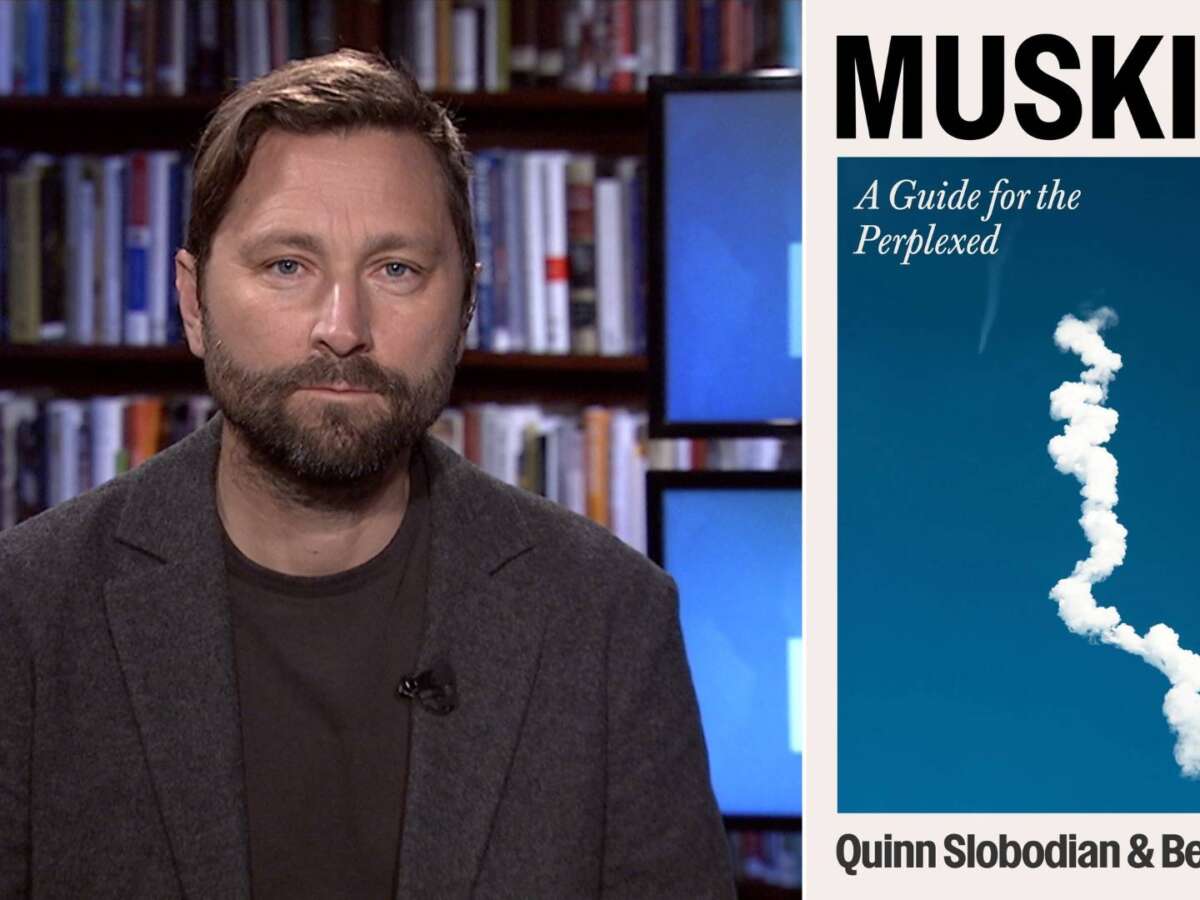
In the new book, Muskism: A Guide for the Perplexed, authors Quinn Slobodian and Ben Tarnoff look at the worldview that shaped Elon Musk and the ideology that has coalesced around him. They call Muskism “an operating system for the 21st century.”
Musk runs rocket company SpaceX, AI startup xAI, electric car maker Tesla and the social media platform X, formerly Twitter. Musk’s political influence extends from his use of X to advance controversial ideas, to his political donations, to the role he played leading the so-called Department of Government Efficiency. “He’s not just building a rocket company or a satellite company — but what we see is a vertically integrated ideological stack where he can kind of build an echo chamber from low Earth orbit all the way back to Earth and create a kind of closed loop for the ideology that he wants to push out,” says Slobodian, professor of international history at Boston University.
TRANSCRIPT
This is a rush transcript. Copy may not be in its final form.
AMY GOODMAN: We end today’s show with a look at the ideology and influence of Elon Musk, the richest person in the world, with a fortune estimated by Forbes at $800 billion. Musk runs rock company SpaceX, AI startup xAI, electric car maker Tesla and the social media platform X, formerly Twitter. His political influence extends from using his massive platform to advance controversial ideas, his political donations, as well as his role leading the so-called Department of Government Efficiency, or DOGE, a quasi-governmental agency that oversaw chaotic layoffs and cutbacks across government agencies.
In the new book Muskism: A Guide for the Perplexed, authors Quinn Slobodian and Ben Tarnoff look at the worldview that shaped Musk and the ideology that’s coalesced around him. They call it “Muskism,” “an operating system for the 21st century.” In a review of the book, prominent science fiction writer and journalist Cory Doctorow wrote in a review, quote, “Muskism doesn’t seek to exit the state, it seeks to colonize and control it.”
For more, we’re joined in New York by Quinn Slobodian, professor of international history at Boston University, co-author with Ben Tarnoff of Muskism.
Thank you so much for being with us. If you can talk about the latest news right now and the empire that Musk has acquired? There’s been a lot of news about space in the last few weeks. And particularly start off by talking about SpaceX and what he’s doing.
QUINN SLOBODIAN: Yeah, SpaceX is kind of a — you know, a tough wake-up call for people who have this impression that Musk had disappeared from the news, had had some kind of feud with Trump, and everything had now passed into the rearview mirror. In fact, we’re gearing up for what is going to be likely the largest IPO in history with SpaceX, likely in June, projected to be somewhere between $1.5 trillion and $2 trillion valuation, which will put it immediately as one of the top 10 biggest companies in the United States, potentially more valuable than Meta.
And that’s interesting, because SpaceX itself has now become a kind of a merger of many of Musk’s ventures. xAI, the AI company that was mentioned, is now part of SpaceX. X.com itself is now part of SpaceX itself, too. So he’s not just building a kind of a rocket company or a satellite company — but what we see is a vertically integrated ideological stack where he can kind of build an echo chamber from low Earth orbit all the way back to Earth and create a kind of closed loop for the ideology that he wants to push out.
JUAN GONZÁLEZ: And, Quinn Slobodian, could you talk some about his — about Musk’s childhood, his being raised in South Africa, and the deep commitment that he has to racial hierarchy, industrial self-reliance and what you call fortress futurism?
QUINN SLOBODIAN: Yeah, so, what we try to work out in the book is where he gets this idea of the state as a kind of technologically enabled fortress that needs to be constantly reinforced and buttressed against external enemies and internal enemies. It turns out that late apartheid South Africa is kind of a perfect prototype for this version of organizing society and economic forces.
In late apartheid South Africa, we think of it naturally as a very backward place, politically explicitly engineered to reinforce racial hierarchies. But they were also a very high-tech country. They were importing nuclear technology from the United States and Israel. They built out their own bomb. They were using IBM mainframes to actually sort out populations and conduct the very practice of apartheid. They built out their own auto industry inside of South Africa. So it became a kind of enclosed enclave economy, which was nevertheless still plugged in to a global economic marketplace.
And this is what Musk has been able to sell, too, a vision of a kind of civil a civilizationally hierarchical, technologically enabled enclave approach to the world in which states, and then households, too, are sold products to protect them in a time of civilizational breakdown. And Musk then ideologically is incentivized to push more and more fears and anxieties out there to, therefore, produce more of a demand for the products he will sell to you to harden yourself against the coming unrest, the coming storm, that he predicts is around the corner.
JUAN GONZÁLEZ: And yet you have this contradiction that, on the one hand, Musk’s companies depend so much on government support or subsidies, and yet he is trying to deconstruct government at the same time?
QUINN SLOBODIAN: Yeah, I mean, this was really the incentive for us to write the book, is we feel like we needed a kind of a new narrative for this new era that had been entered into with Big Tech and digital capitalism. For a while now we’ve been talking about libertarianism, and even cyberlibertarianism, as if this is the main way to understand Silicon Valley, that it’s about Ayn Rand, it’s about visions of colonizing Mars. But, in fact, at least since the rollout of ChatGPT in 2022, the Big Tech companies now realize they need a much closer relationship to the state than they had before. If you’re going to build out the kind of data centers that they are building out, if you’re going to have to have federal land opened up to new construction, enormous sources of water, new sources of energy, you can’t just do the kind of asset-lite version of social media-style platform capitalism that they did for many years in the time of Web 2.0. You need to fuse with the state. And someone like Peter Thiel pioneered this when he made his alliance with Trump in 2016 already. But now, as we know, the rest of the Silicon Valley leadership class has followed behind, literally standing and sitting behind Trump at the inauguration. So, any vision that this is libertarian, I think, is now not helpful.
It’s a period of what we call state symbiosis, a period of selling sovereignty as a service. And as we know most recently by the Palantir manifesto and the fast-tracking of Project Maven into the military software and technology of war fighting in the United States, it’s a time when the fates of the state and the fates of these companies is now extremely wound up with one another. And we need to sort of understand that dependency that’s been produced, because SpaceX, too, will be fast-tracked into the indexes, so that people’s pension funds, college retirement funds, all of these sort of things are now going to be part and parcel of often the quite vicious and xenophobic visions of the founder CEOs, like Elon Musk.
AMY GOODMAN: This is Elon Musk talking about an imagined future built on AI and robotics, in which there’s no money and everyone could get a free trip to Saturn.
ELON MUSK: It’s really the only path to amazing abundance, is AI and — AI and robotics. … Now, wouldn’t it be amazing if you could buy a trip to Saturn, or, frankly, if you just have a trip to Saturn? I think things will just be free in the future. It sounds nuts, but, you know, if you’ve got an AI-robotics economy that is anywhere close to a million times the size of the current Earth economy, literally any need you possibly want can be met. If you could think of it, you can have it. So, I think Iain Banks, in his Culture books, has it pretty much right, where there actually isn’t money in the future and there’s abundance for everyone. If you can think of it, you can have it.
AMY GOODMAN: So, in your final comments, Professor Slobodian, if you can talk about what he’s saying and the changing goals of SpaceX, from colonizing Mars to orbital AI data centers?
QUINN SLOBODIAN: Yeah, I mean, it almost has to make you laugh to hear these kind of low-energy efforts he makes that seem to be just sort of free-associating what he hopes will be enough of a distraction that people won’t actually look, A, what his empire is being built on, and, B, what, day to day, he pushes out on his platform X, which has now really become a megaphone for a far-right international. I mean, he’s talking there about endless abundance and travel to Saturn, but what he talks about from day to day on X is the need for remigration, the dangers of racialized immigration, the dangers of falling white birth rates. Palantir’s manifesto talks about cultural hierarchies.
So, one has to look more at the day-to-day production of what they’re doing, but, more importantly, as you suggest, what the products are that they’re actually building. So, SpaceX now, its valuation is based on this idea that he’s going to be able to put AI data centers in space — totally untested technology — but also that he’ll be able to ramp up something called Starlink Mobile, so that he’ll be able to provide direct-to-device and direct-to-laptop internet and connectivity for perhaps the entire planet, at which point he’s able to kind of keep the legacy media, as he calls it, keep independent media sources, like Democracy Now!, out of the conversation and produce a kind of hermetically closed loop in which people are forced to then ingest the ridiculous things that he says on stage, like the kind that we just saw.
AMY GOODMAN: Quinn Slobodian, professor of international history at Boston University, co-author of Muskism: A Guide for the Perplexed.
That does it for today’s show. I’ll be appearing at several theatrical openings of the new documentary about Democracy Now!, Steal This Story, Please!, tonight in Seattle, tomorrow at two screenings in Portland, Oregon, then back to the IFC Center in New York. I’m Amy Goodman, with Juan González.
An urgent fundraising appeal: We fell short of our goal
Thank you for reading Truthout today. We have a brief message before you go —
Unfortunately, donations are down for Truthout at a time when media is under immense pressure. Trump is arresting journalists, Big Tech is censoring independent news, and economic conditions for media have been worsening for years.
Simultaneously, movement media is vital in the fight against Trump’s authoritarian reign. Our mandate to tell the truth, share strategies for resistance, and speak against fascism is ever more urgent in this deluge of political censorship. Yet, we are struggling to meet our publishing costs when our work is so urgently needed.
If you can support Truthout with a one-time or monthly donation, you will make a significant impact on our work. Please give today.
