



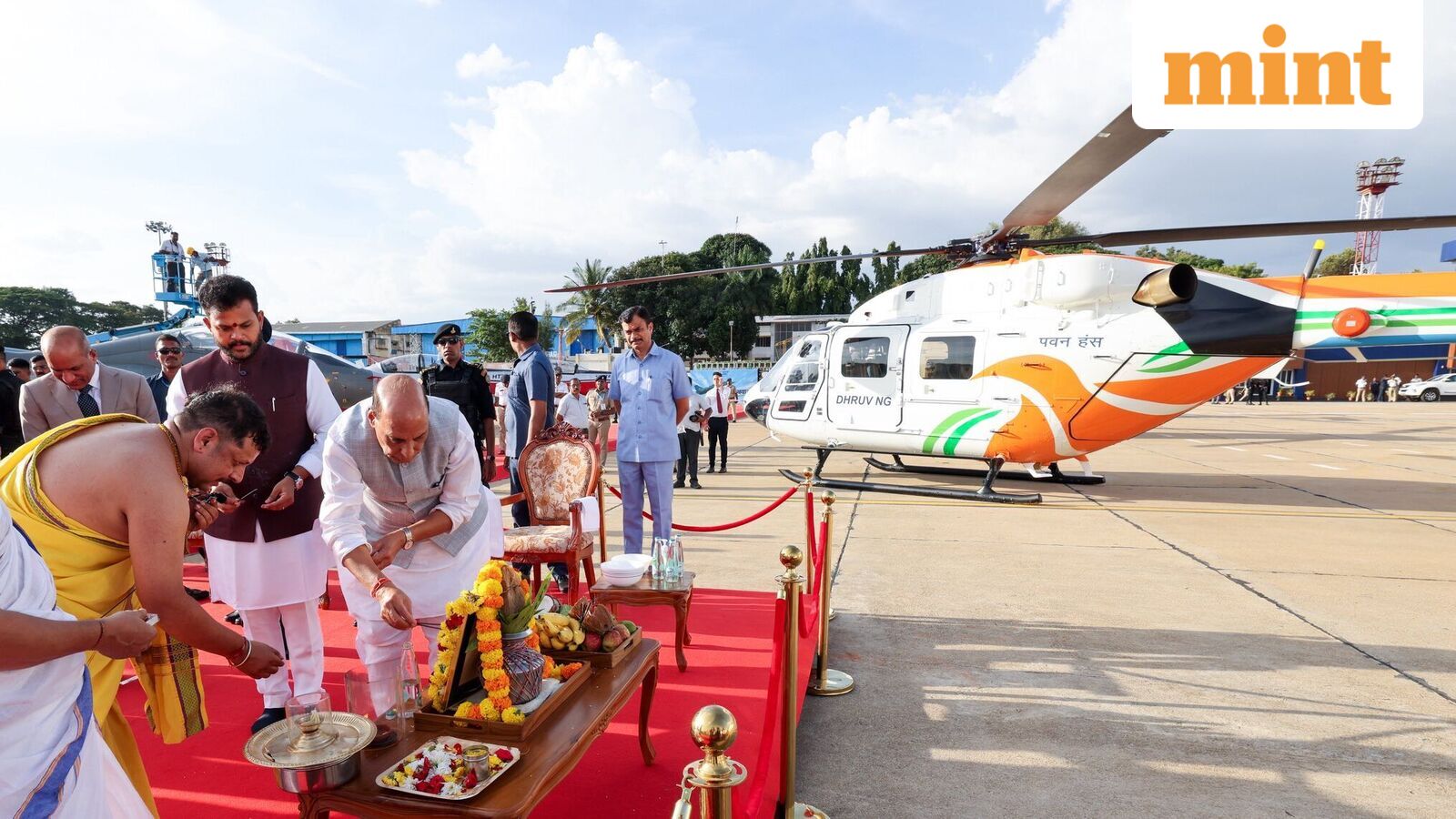
Marking a significant boost to India’s domestic aerospace manufacturing, state-run Hindustan Aeronautics Limited (HAL) on Friday handed over a new fleet of advanced indigenous aircraft to the Indian Air Force (IAF) and Pawan Hans Limited.
The handover ceremony was attended by Defence Minister Rajnath Singh and Civil Aviation Minister K Rammohan Naidu.
During the event, HAL delivered two LCA FOC Trainer aircraft to the IAF (completing the twin-seater deliveries under the FOC contract), three HTT-40 Basic Trainer aircraft, marking the start of deliveries under a 70-aircraft contract, and four Dhruv Next Generation (NG) helicopters to Pawan Hans Limited.
The handover, the Union Ministers said, marked an important milestone in the country’s journey toward self-reliance, highlighting the role of HAL and its industry partners in strengthening the domestic aerospace ecosystem.
Defence Minister Rajnath Singh said, “India is moving systematically towards Aatmanirbharta in defence, as the nation is manufacturing the state-of-the-art equipment indigenously ever since Prime Minister Narendra Modi-led Government began working with the core mantra of self-reliance.”
Push for an indigenous aerospace ecosystem
The platforms together represent HAL’s capabilities across military aviation, civil rotary-wing aviation, and pilot training, it said in a statement.
HAL CMD Ravi K said that the handover of Tejas FOC Twin Seater Trainers, HTT 40 Basic Trainers and Dhruv NG helicopters demonstrates HAL’s ability to develop and deliver platforms for diverse civil and defence requirements.
These platforms reflect the depth of capability that HAL has built over the years and the strength of the indigenous aerospace ecosystem that supports them, he said.
Speaking on the occasion, Civil Aviation Minister Naidu said that the certification and induction of the Dhruv NG into civil operations marked an important milestone for India’s indigenous civil aviation ecosystem.
He termed it a reflection of the growing capability of the Indian industry to develop and support advanced aerospace platforms for commercial applications. Naidu said Prime Minister Narendra Modi has given a clear vision for Indians to travel in Made-in-India civilian aircraft.
“Very soon Indians will travel in Made-in-India civilian aircraft,” the minister quoted Modi as saying.
Here’s all we know about these indigenous aircraft:
LCA Tejas FOC Twin-Seater Trainer
According to a statement shared by HAL, the LCA Tejas FOC Twin-Seater Trainer is a lightweight, all-weather, multi-role 4.5-generation aircraft designed primarily to support the training requirements of the IAF, while retaining the capability to undertake fighter operations when required.
It incorporates contemporary technologies, including relaxed static stability, a quadruplex fly-by-wire flight-control system, carefree manoeuvring, an advanced glass cockpit, integrated digital avionics and advanced composite materials for the airframe.
“These technologies have enabled India to develop and operationalise an advanced twin-seat fighter aircraft capability,” it said.
HTT-40 ‘Ankur’ Basic Trainer
The HTT-40 (Hindustan Turbo Trainer-40) is an indigenously designed and developed Basic Trainer Aircraft intended to meet the primary training requirements of the Indian Defence Services.
Designed by HAL’s Aircraft Research and Design Centre (ARDC), the aircraft is built around a proven turboprop engine and is designed to provide good low-speed handling characteristics and effective training for trainee pilots.
The HTT-40 incorporates a modern cockpit and avionics suite and is capable of performing a range of basic training and flying roles, aerobatics, general handling, instrument flying, navigation, night flying and close formation flying, it added.
Dhruv Next Generation (NG) Helicopter
Dhruv Next Generation is a HAL-designed and manufactured 5.5-tonne, light twin-engine, multi-role helicopter, officials said.
The Dhruv NG platform has been developed to address demanding operating conditions in India and has been upgraded to meet the requirements of the global civil aviation market, it said.
Its features include a civil-certified glass cockpit, a modern avionics suite, advanced navigation systems and enhanced situational awareness. Safety features include crashworthy seats, self-sealing fuel tanks, and a twin-engine configuration that provides redundancy.
(With PTI inputs)


