



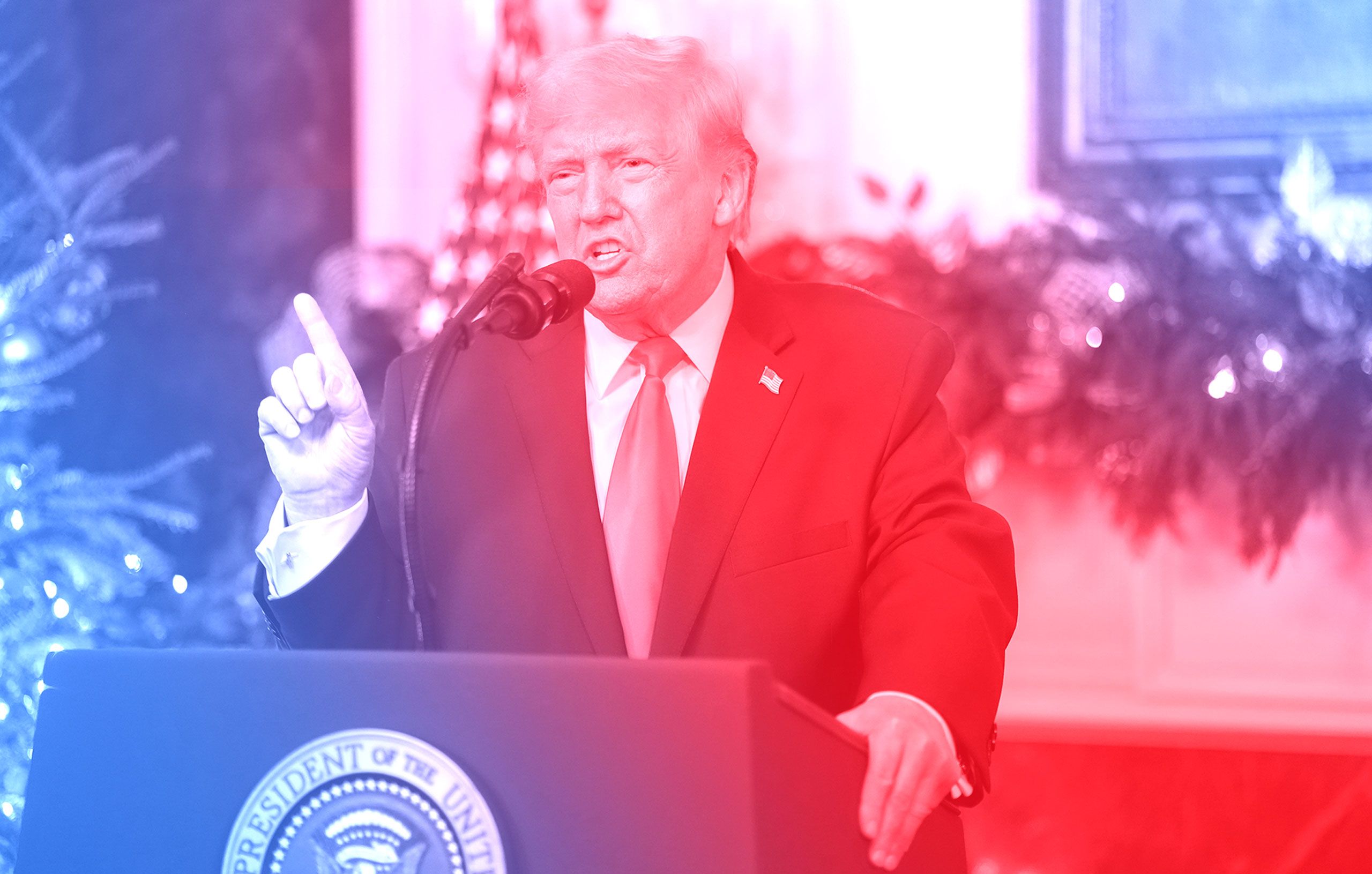
Many times in the past decade, Donald Trump’s public addresses have reminded me of old TV commercials for the electronics chain Crazy Eddie that I used to watch as a kid in suburban New Jersey—the rat-a-tat delivery, the breathless hype, the memorably absurdist slogans. (“His prices are INSAAAANE!”) But somehow this was never more the case than on Wednesday night, when the President spoke to the nation from the Diplomatic Reception Room of the White House, flanked by the soft glow of two Christmas trees and a portrait of George Washington.
The comparison isn’t exact, to be fair. Crazy Eddie’s legendary pitchman, Jerry Carroll, actually dressed up as Santa Claus for the chain’s famous holiday ads, for which Crazy Eddie presumably had to pay. Trump, in contrast, got free airtime from all of America’s major television networks for his Christmas commercial, which was delivered in the form of an eighteen-minute-and-thirty-three-second run-on sentence. That’s an awful lot of words to string together without much in the way of periods or common sense, though, by now, we all know there’s only one form of punctuation that Trump has truly embraced: the exclamation point. “I am bringing those high prices down and bringing them down very fast!” he declared on Wednesday night. “Boy, are we making progress!” “There’s never been anything like it!”
The centerpiece of the President’s speech was his announcement of a no-strings-attached deal for 1.4 million members of the U.S. military to receive year-end bonus checks of $1,776 each, in honor of next year’s celebration of the two-hundred-and-fiftieth anniversary of the signing of the Declaration of Independence. “And the checks,” he said, “are already on the way!” More financial presents were promised by Santa Trump in the New Year: a great new housing policy, a great new health-care plan. As the President put it, “You the people are going to be getting great health care at a lower cost!” I, for one, can’t wait, having recently received a three-dollar-and-eighty-six-cent reimbursement check from our health-insurance company for my son’s thousand-dollar-plus annual checkup.
If only Trump were actually selling discount electronics. Suffice it to say, there were never any examples of Crazy Eddie trying to sell new color televisions by claiming that Somali immigrants stole the old ones. When the website Defense One revealed overnight that the money for Trump’s so-called warrior dividend was being diverted from a $2.9-billion fund for military housing allowances set up by Congress, it was not so much surprising as predictable. Santa has to get the money for all those presents from somewhere, right?
But, as an advertisement for Trump’s year-end accomplishments, the speech had a whiff of desperation about it. Can it be that the Presidential huckster, with his approval ratings sunk down in the thirties, secretly knows that America isn’t buying what he’s selling? Why else was he talking so fast? A few hours before the speech, even a few Republicans on Capitol Hill had started to rebel, demanding a floor vote to extend the Affordable Care Act subsidies that are about to expire, which would send health-care prices skyrocketing for millions of people. In his address, Trump made no mention of this, instead blaming the coming price increases on Democrats, though they have spent the past few months fighting Trump to prevent them. That level of gaslighting, it seems, can take a lot out of a man. When his speech was over, according to a White House pool report, Trump turned to the press and said, “You think that’s easy?” then took a swig of Diet Coke. The sense that he was just going through the motions was only reinforced by what came next: “Susie told me I have to give an address to the nation,” he said, or, per the pool report, something closely approximating it.
Susie, of course, is Susie Wiles, Trump’s chief of staff, and part of the point of Trump’s comment was no doubt to remind the reporters that she is still calling the shots in his White House. Wiles, who is famously low-profile, found herself facing a rare bout of bad publicity this week, when her lacerating comments about the President and much of his inner circle to the author Chris Whipple, in eleven taped interviews in the course of the past year, were published in Vanity Fair.
Among the choicest bits: Wiles said that Trump, like her father, the late football commentator Pat Summerall, “has an alcoholic’s personality,” that Vice-President J. D. Vance has been “a conspiracy theorist for a decade,” and that Elon Musk was a drug-microdosing “odd, odd duck.” She also revealed herself to be a doubter when it came to many of the most famous outrages of Trump’s return to office, questioning everything from Musk’s destruction of the United States Agency for International Development—“no rational person” could be in favor of how it was handled, she told Whipple—to the Presidential pardons for violent pro-Trump rioters who stormed the U.S. Capitol on January 6, 2021.
Much of the news value came from the sheer novelty of a senior official in Trump’s reality-defying second term stating the obvious. On first read, it was sort of a relief to know that not everyone in that gilded asylum on Pennsylvania Avenue is deluded enough to believe the fairy tales they concoct for public consumption. But Wiles is no hero. In Trump’s first term, the kinds of officials who occasionally betrayed an uncomfortable attachment to the facts tended to be the ones who, it later emerged, were secretly pushing back against some of Trump’s excesses. I’m thinking of John Kelly, Trump’s first-term chief of staff who secretly consulted a book about his boss’s pathological narcissism and came to loathe Trump so much that, on the eve of the 2024 election, he called him a textbook “fascist.”
Read Whipple’s account more closely, and it’s clear that’s not what’s happening here. Wiles insisted to Whipple that she was neither an “enabler” nor a “bitch,” but what leaps out is how unwilling she has been to act on any of her bluntly spoken observations. In a choice between Trump and the truth, she would pick the President every time. In the many laudatory stories that have been written about her during the past few disruptive months, Wiles is often depicted as the strongest of Trump’s five White House chiefs. But the portrait that emerges in Whipple’s interviews is one of weakness—if Musk was so crazy, and Trump was so wrong about so many things, then how come it wasn’t her job to do something about it, for reasons of political self-interest, if not basic human decency?
One of the most revealing details in Whipple’s article is about Wiles’s West Wing office, in which she keeps a freestanding video screen next to the fireplace, with a live feed of Trump’s social-media posts. Was she sitting in there, watching the screen when Trump posted on Monday morning about the death of the Hollywood filmmaker Rob Reiner, blaming his gruesome murder on his liberal politics and “TRUMP DERANGEMENT SYNDROME”? Was she there when, a few weeks ago, he called for the death by hanging of members of Congress who dared to remind U.S. military personnel that they do not have to follow illegal orders? Does she bother to speak up when he demands outrageous acts of tribute, such as renaming the Kennedy Center for the Performing Arts after himself? Or when he continues his vengeful campaign of politicized prosecutions that she claims to have told him to stop after his first few months in office?The point is that it’s Trump’s unreality that governs Susie Wiles now; whatever her vestigial connection to the truth, it’s the President’s truth-challenged world whose trains she has tasked herself with making run on time.
Which brings me back to Wednesday night’s Presidential address. When Trump was done speaking, the press pool observed the handful of staffers who had gathered in the room, praising him for a “great” and “really good” job. Wiles, for her part, remarked not on what he had said but on the fact that he had stuck to the timetable. “I told you twenty minutes, and you were twenty minutes on the dot,” she told him. If what he says is wildly untruthful, enraging to millions of his fellow-citizens, or just outright bizarre, what does she care? It’s not her fault if he can’t close the sale. “I don’t think there’s anybody in the world right now that could do the job that she’s doing,” Whipple quoted Marco Rubio as saying of Wiles. And maybe he was right. ♦