







Good morning. Fortune 500 companies are already experimenting with blockchain, but many CFOs are still hesitant to move real money on-chain.
That topic came up in my conversation with Betsabe Botaitis, the new CFO of P2P.org, a company that helps large institutions earn returns from crypto assets.
P2P provides the behind-the-scenes technology, such as servers and security systems, that lets institutions earn rewards from cryptocurrencies like Ethereum and Solana. Normally, companies would need to run their own systems to do this, but P2P handles it for them. Founded in 2018, the company now supports more than 40 blockchain networks and works with banks, exchanges, digital wallets, and custodians.
Botaitis describes the company’s offering as “full-stack yield infrastructure.” This means helping institutions earn returns across different types of digital assets—not just one—while also giving them the tools they need for risk management, reporting, and compliance.
She explains that P2P started with basic infrastructure and is now expanding to serve institutions that want more complete solutions.
A CFO who speaks both Wall Street and Web3
Botaitis brings a mix of traditional finance and crypto experience. She started her career in retail banking, then held senior roles at Citigroup and LendingClub. Later, she moved into the crypto space, co-founding a blockchain company and serving as its CFO.
Most recently, she was CFO and treasurer at Hedera, a blockchain network designed for enterprise use. There, she managed large budgets and digital assets, led the organization’s first financial audit, and built systems to meet regulatory and institutional standards.
A recent survey found that a growing number of Fortune 500 companies are increasingly exploring blockchain initiatives. In her conversations with CFOs, Botaitis said there are still some who remain cautious about moving real money on-chain.
“The infrastructure exists,” she said. “The question is whether your organization is building the internal knowledge and partner relationships to move when your board is ready. The firms doing that work are already in conversations that others will have to catch up to.”
CFOs are looking for the same things they expect from any business partner: proven reliability, strong operations, and systems that fit into their existing risk frameworks, Botaitis said.
One major concern is regulation. P2P’s structure helps address this, she said.
“As CFO, my mandate is making sure our financial governance meets the standards institutional clients expect from any counterparty they put in a risk memo,” she added.
She frames the company not as a risky crypto bet, but as a reliable infrastructure provider—similar to a traditional vendor that would go through standard due diligence.
CEO Alex Esin also emphasized her experience, saying, in a statement, that it will help the company grow and work with large institutions. Botaitis highlighted the U.S. and Latin America as important growth markets.
In addition to her corporate role, she has been recognized in industry circles, including serving as an ambassador at the Fortune Most Powerful Women Summit and being named to CoinDesk’s Top 50 Women in Web3 and AI.
For CFOs still unsure about blockchain, her hiring sends a signal: the people building crypto infrastructure increasingly come from the same traditional finance backgrounds they trust.
Have a good weekend.
Sheryl Estrada
sheryl.estrada@fortune.com
Leaderboard
Fortune 500 Power Moves:
John Dietrich will step down as EVP and CFO of FedEx Corp. (No. 49), effective June 1 upon completion of the spin-off of FedEx Freight into a new publicly traded company. Dietrich, CFO since 2023, will remain with the company until July 31. Claude Russ, FedEx enterprise vice president of finance will serve as interim CFO, effective June 1. The company will conduct an internal and external search for a successor. FedEx affirms the FY26 outlook shared on its last earnings call, along with the 2029 targets shared at its Investor Day in February.
Nelson Urdaneta, CFO of Kimberly-Clark Corporation (No. 213), will serve as CFO for the combined entity following the completion of its pending acquisition of Kenvue Inc. (No. 281). Urdaneta became finance chief in 2022. He was previously at Mondelēz International for nearly 17 years, serving in financial leadership roles such as treasurer, corporate controller, and CFO of Asia Pacific.
Every Friday morning, the weekly Fortune 500 Power Moves column tracks Fortune 500 company C-suite shifts—see the most recent edition.
More notable moves this week:
Mark McGivney, SVP and CFO at Marsh (NYSE: MRSH), a global insurance broker and risk advisor, will assume additional roles as EVP and chief operating officer of the firm, effective April 15. McGivney, who has been Marsh’s CFO for over a decade, joined the company in 2007 and has held several senior roles across the firm. He served as SVP of corporate finance, COO and CFO of Mercer, and CFO of Marsh Risk.
Svetlana Makhni was appointed CFO of Prime Medicine, Inc. (Nasdaq: PRME), a biotechnology company. Makhni brings over 20 years of experience. Before Prime Medicine, she served as CFO of Marengo Therapeutics. Before that, she served as CFO of Escient Pharmaceuticals and CFO and head of operations at Bierman ABA. Earlier in her career, Makhni spent over a decade in investment banking and financial services at BMO Capital Markets, Goldman Sachs, Westbrook Partners and The Blackstone Group.
Seth Bressack was appointed CFO of Grow Therapy, a mental health platform. Grow Therapy recently raised a $150 million Series D that brought its valuation to $3 billion. In this newly created role, Bressack will lead the company’s finance function and help it scale. He brings more than two decades of finance and business operations experience spanning seed-stage startups, high-growth software companies, and public companies. Most recently, he served as VP of finance at Shopify. Earlier in his career, he helped scale MikMak as SVP of operations.
Christopher Filiaggi was appointed interim CFO of Corebridge Financial, Inc. (NYSE: CRBG), effective April 24. Filiaggi, chief accounting officer of Corebridge since 2023, will serve as interim CFO while the company prepares for its planned merger with Equitable Holdings, Inc. This appointment follows the previously announced transition of CFO Elias Habayeb. Prior to his current role, Filiaggi held finance leadership positions with Corebridge and American International Group, Inc.
Sean T. Woodward was promoted to EVP and CFO of AeroVironment, Inc. (AV) (Nasdaq: AVAV), a global defense technology company, effective May 1. Woodward succeeds Kevin McDonnell, who will be stepping down from the role, as announced earlier this year. Woodward has more than 22 years of experience in defense technology, including at AV, General Dynamics, and Honeywell Aerospace. Woodward joined AV in 2010 and has spent more than 15 years in leadership roles across the company. Woodward most recently served as CFO of AV’s Autonomous Systems segment.
Sean McCabe was appointed CFO of Cineverse, an entertainment technology company (Nasdaq: CNVS), effective April 20. He succeeds Mark Lindsey, with whom the company is in discussions to transition into a senior financial consulting role. McCabe previously served as VP and corporate controller at Cineverse in 2023 and 2024. He returns from Freestar, an ad-tech company, where he led accounting and finance teams.
Big Deal
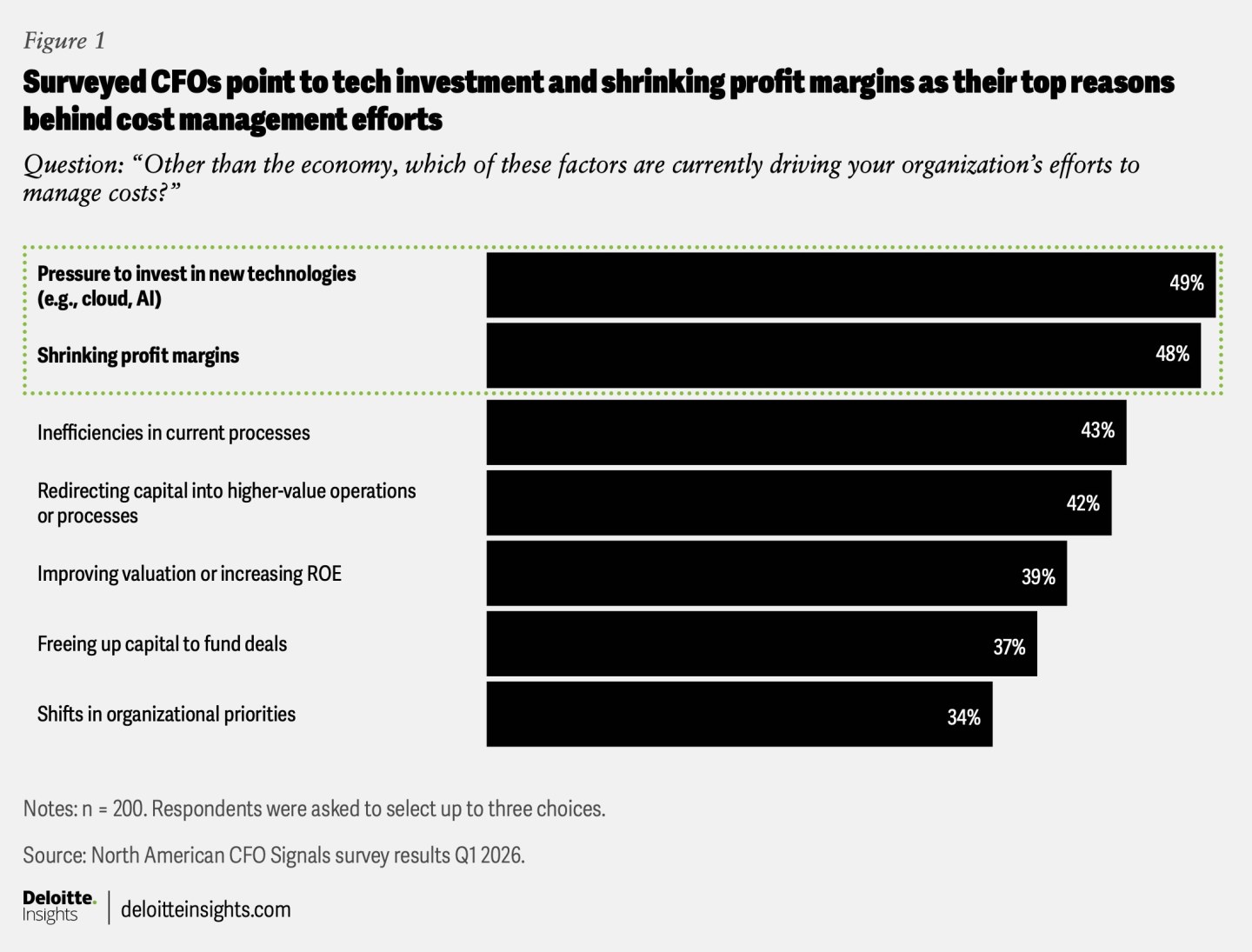
Deloitte’s Q1 2026 North American CFO Signals survey polled 200 chief financial officers from North American organizations with at least $1 billion in annual revenues. CFO confidence dropped slightly to 6.3 in Q1 2026, compared to 6.6 in Q4 2025, but still falls in high territory (6-to-8 range).
The survey was fielded in the first two weeks of March, just after the start of the Middle East conflict. In it, 52% of respondents cited cost management as their most worrisome internal concern—the top response. Six months ago, cost management ranked third, at 47%. Meanwhile, their top external worry is now supply chain disruption, which rose from 35% in the Q4 2025 CFO Signals survey to 52% this quarter.
When asked to select up to three factors driving their organization’s efforts to manage costs, 49% of respondents cited pressure to invest in new technologies, such as cloud or artificial intelligence. At the same time, 48% cited shrinking profit margins as a key reason they are prioritizing cost management now.

Going deeper
Here are four Fortune weekend reads:
“Why no nation is truly ‘energy independent’ while the Strait of Hormuz remains closed” —Jordan Blum
“The CEO of $8.5 billion Japanese car giant Nissan plays the drums in a band and hits the tennis courts to destress from the top job” —Emma Burleigh
“A secretive tycoon known as the ‘French Murdoch’ holds the key to Bill Ackman’s $64 billion bid for Universal Music Group” —Amanda Gerut
“Food companies are finally cutting prices. PepsiCo shows it’s worth it” —Phil Wahba
Overheard
“To build strong agentic workflows, retailers and brands should start with a specific challenge, break it into its component tasks, create a focused agent for each task, and build in specific points where human teams can review, validate and overrule if needed.”
—Anita Beveridge-Raffo, head of retail and consumer goods at Palantir Technologies, writes in a Fortune opinion piece.


