

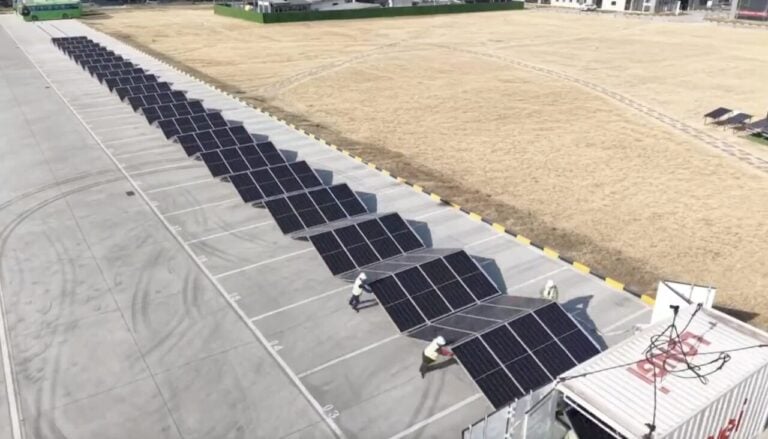
LONGi said the unit could be fully deployed without complex foundations, with a crew of six able to set it up “with a single button press” in three or four hours, depending on the size. It claimed the temporary system bypassed the need for lengthy land approval process, delivering immediate green power to remote locations.
The unit comes in two sizes – a 20 high cube (HC) version containing 184 modules able to provide 119.6kW of capacity, and a 40HC version containing 368 modules delivering 239.2kW of capacity.
The modules used in both are LONGi’s X10 single glass, back-contact model. For European projects, these are combined with GT series string inverters made by fellow Chinese producer GoodWe. Other inverters are used for other regions, LONGi said. They are installed into the unit before shipping from China.
LONGi said the system had been designed with robustness in mind, with the 10X modules offering operational reliability in harsh environments. The 20HC system can withstand wind speeds up to 21 meters per second during operation, with optional ground anchors and thicker structural steel components increasing the maximum wind resistance to 56 meters per second for storm zones.
LONGi said the system had achieved a levelised cost of electricity of 5.14 US cents per kilowatt-hour in Poland and 4.70 US cents per kilowatt-hour in Ukraine.
LONGi seals 80MW Greece module deal
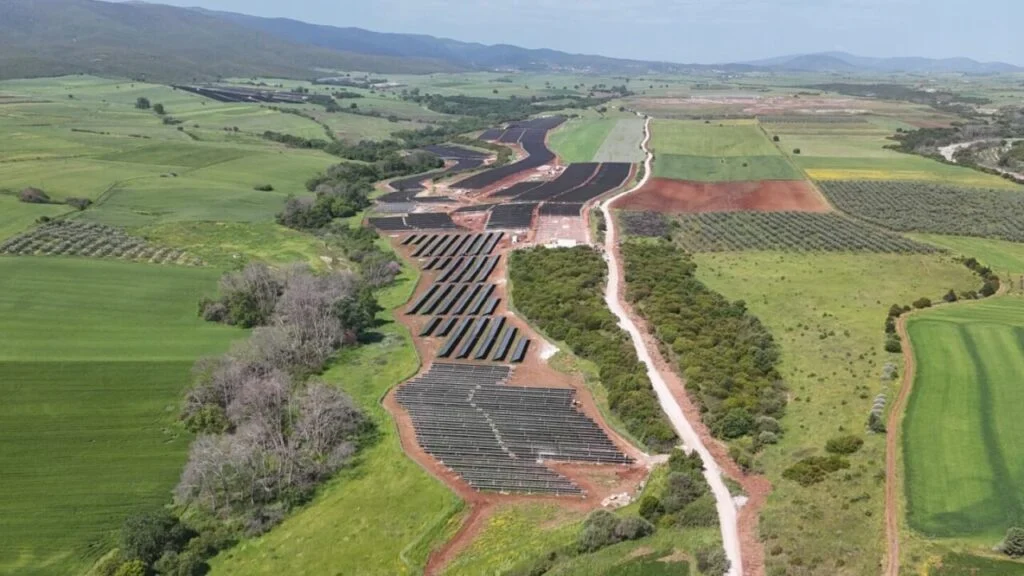
In separate news, LONGi said today it has received an order to supply 80MW of its back contact modules to an independent power producer in Greece.
The company’s modules will be used for two separate utility-scale projects being developed by Faria Renewables in the Thessaly region of Greece: the 45.51MW “Athamas” project in Almyros and the 36.15MW “Mykonos” project in Farsala.
Together, the projects will deploy over 125,000 of LONGi’s Hi-MO 9 modules, which the company said combine a higher power rating to maximise land usage with robust durability.
The Althamas project is due for grid connection by the end of July this year, while the Mykonos plant, which broke ground on 1 February, is expected to be online at the end of June 2027.
