





What are postpartum depression and postpartum psychosis?published at 16:30 BST
What is postpartum psychosis and why is it central in the Lindsay Clancy trial?
People who have just given birth can experience a range of psychiatric conditions, the most serious and life-threatening of which is postpartum psychosis.
The UK’s National Health Service (NHS) defines postpartum psychosis as a rare, serious mental health illness that should be treated as a medical emergency.
Patients can experience mania and depression as well as psychotic symptoms like delusions and a disconnection from reality. In rare, severe cases, they may harm or kill themselves or other people.
In the US, a major barrier to awareness and treatment of postpartum psychosis is that it remains unclassified in American medicine’s encyclopaedia of psychiatry.
Postpartum psychosis is very different from the “baby blues”, or postpartum blues, which affects around 85% of people who give birth and typically involves difficulty controlling emotions like anxiety, sadness and anger, according to the Cleveland Clinic.
Postpartum depression is more serious than the baby blues, with patients feeling many of the same symptoms but more intensely and for a longer period of time.
Doctors found no signs of psychosis, ‘so they were all wrong?’published at 16:28 BST
Some of the medications the defence says were making Clancy unbalanced were not even in her system when she left the mental hospital the first time, prosecutor Jennifer Sprague says.
She left the hospital because she wanted to go to her daughter Cora’s birthday party, Sprague says.
“She knew she needed help”, yet she still chose to leave the hospital, she adds.
None of the doctors she saw ever noticed any signs of psychosis, Sprague says, asking, “So they were all wrong?”
Then, Sprague says, Clancy was acting normal throughout January, in the lead-up to her children’s deaths.
If you saw a video of Clancy at the science museum with her kids, you wouldn’t be able to pick out the woman who is about to kill her kids, Sprague argues.
That’s because she was able to act normal and conform her behavior to the law, Sprague argues.
Clancy was a ‘functional adult’ who knew right and wrong, prosecution arguespublished at 16:24 BST
The prosecution says Clancy still knew the difference between right and wrong in the period leading up the murders in January 2023.
Sprague describes Clancy operating as a “functional adult” and “functional mom” including interacting with friends and going to the gym.
She says that proof of Clancy knowing the difference between right and wrong in that time, is how she told Patrick and her mother about her thoughts of harming her kids, but did not tell doctors in case her kids were taken away.
“She knew it was a bad thought, a wrong thought,” Sprague says.

Prosecutor says Clancy knew her approach to getting better was not rightpublished at 16:20 BST
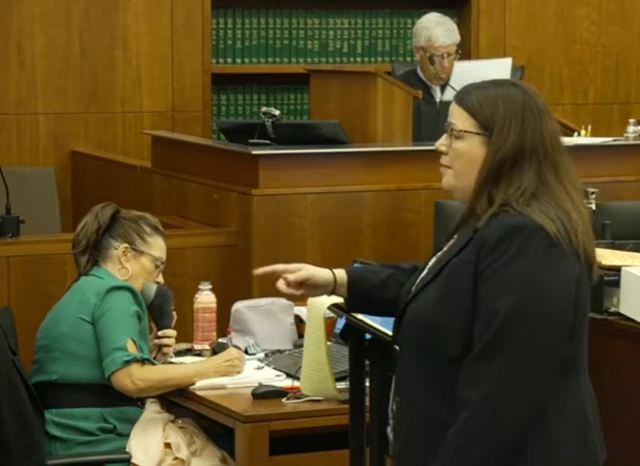
Sprague says Clancy wanted help and “wanted to get better, but she wanted to get better on her own terms”.
“As a nurse, she knew that’s not the right way to approach it,” Sprague tells the jury.
The prosecutor says Clancy was driven by a desire to “be herself again”.
“That’s understandable, that’s relatable… but she knew that’s not how it works,” she says.
Clancy had ‘abundance of care’, prosecutor arguespublished at 16:13 BST
Sprague argues that in raising her young children, Clancy had more support than most mothers have.
The prosecutor says Clancy had help from doctors, both sides of the family and a nanny who helped with housework and food preparation.
“This wasn’t a woman suffering from a lack of care… she had an abundance of care,” Sprague says.
This support doesn’t mean Clancy wasn’t struggling, Sprague says, acknowledging that the defendant had depression.
Sprague pushes back on the allegation that Clancy’s doctors failed her, saying they “were doing to the best they could with the information she provided them”.
Sprague says Clancy wasn’t always truthful about her medication dosages and that she would tell her husband and her doctors different things.
Prosecution says no doubt Clancy had mental health issues, beginning closing argumentpublished at 16:10 BST
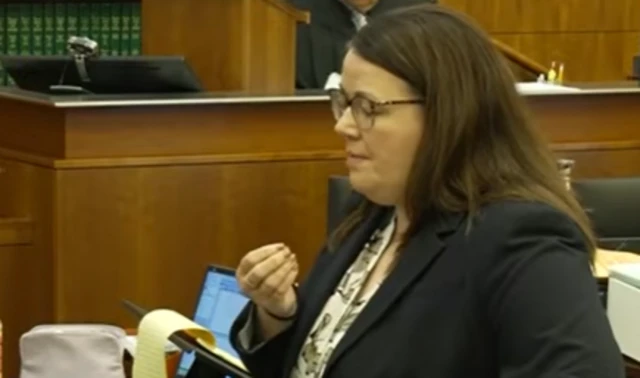
The prosecution are now delivering their closing argument and we’re hearing from Jennifer Sprague now.
She says there is no doubt Clancy was mentally ill, the question is if the mother of three could tell the difference between right and wrong at the time of the killings.
“It’s not the system or the DSM that caused her to strangle her kids,” Sprague tells the jury.
The DSM – Diagnostic and Statistical Manual of Mental Disorders – is the standard guide for mental health experts to diagnose patients.

Jennifer Sprague
Defence concludes closing argumentpublished at 16:09 BST
Reddington says the prosecution has argued that Clancy was not happy being a mother and didn’t want to live that life anymore so she planned to kill her kids and fake her own suicide.
But, he says, we know what a mess her brain was in at the time.
“‘My brain is being damaged. I will never be better,'” he says, referencing messages Clancy sent.
“That’s the evidence.”
She is not guilty of killing her children because she was suffering from a disease, he argues, adding that the prosecution is not able to prove otherwise.
And with that, his closing arguments end and the prosecution begins their own closing argument.
We will continue to bring you live updates and you can watch proceedings in court via the link at the top of the page.
Lawyer says message to mother shows Clancy’s ‘depths of despair’published at 16:01 BST
Reddington shows the jury a poster board of a message Clancy sent her mother. It reads:
“Mom will you please come up and stay with me for a bit I’m really sick. Something is wrong. I had horrible insomnia all night and I just don’t
know how I’m going to get through the day. I started taking the medicine my doctor prescribed for anxiety and I think it made things worse. Its just really scary
and I don’t want to be alone.”
Reddington says it shows the “depths of despair that this young kid was in, trying to raise three kids, trying to be a wife, trying to go back to work”.
Speaking about the prosecution’s argument that Clancy intentionally sent her husband away so that she could commit the murders, including googling how long he would be gone, he calls it “not true”.
“She didn’t want him out the house long, she was in distress, she wanted him home to help with the kids,” Reddington says.
He says she also looked into a constipation medication for one of the children. “Why would she do that?” he asks the jury.
Clancy’s journals track children’s schedules and her declining mental state, lawyer sayspublished at 15:58 BST
Reddington says the prosecutors have painted a picture of the defendant as “hard”, “manipulating” and “controlling”.
He argues that Clancy’s neurotic behaviours were evidence of her declining mental state.
The jury is shown Clancy’s journals, one of which contains detailed schedules for her children’s mealtimes, naptimes and bedtimes.
A separate journal contains accounts of her mental state. Here, Reddington says, she repeatedly wrote that she was having “horrible, intrusive thoughts” and “no motivation”.
Clancy’s handwriting devolved into “chicken scratch” as her mental state got worse, her lawyer says.
Defence says prosecution is attacking Clancy, as a womanpublished at 15:56 BST

US Reporter

We are hearing impassioned closing remarks from Kevin Reddington – like we have for the past few weeks – about Clancy and the killings.
One point we’re seeing Reddington centre in on is the personal attacks he says the prosecution has made about Clancy as an individual and a mother. He says they are attacking her personal character.
He accuses the prosecution of “manipulation” when they talked about Clancy going to a place called the Kingsbury Club which Reddington says is just a swimming pool.
Another point Reddington hones in on is how serious Clancy’s suicide attempt was.
He talks about how the prosecution tried to play that down but he details how difficult her recovery was and how ill the attempt means she was.
“She was reaching out for help and she’s not getting it,” Reddington says at one point.
All the while, Reddington continues to stress to the jury that it’s the prosecution’s responsibility to prove criminal responsibility.
Accused ‘never ran from anything’ and ‘owned what she did’ says lawyerpublished at 15:48 BST
Lindsay Clancy “owned what she did”, Reddington argues.
“She never ran from anything. She’s gone through evaluation after evaluation after evaluation,” he says.
Prosecutors have capitalised on the fact that on the anniversary of the deaths and on her children’s birthdays, she was in the hospital watching TV and meeting with her parents, Reddington says.
But, he says, that’s because she couldn’t just be “curled up in the fetal position, wailing, self-flagellating constantly for three and a half years”.
“She’s acting like a human being trying to exist,” he says.


Kevin Reddington
Clancy ‘lived for her kids’ before being told to ‘take more pills’published at 15:45 BST
Clancy’s attorney says she “lived for her kids” until meeting Dr Tufts, a mental health practitioner who Reddington says told her to “take more pills”.
He says the idea that Clancy was looking to score more drugs, as the prosecution alleges, is “another repulsive allegation”.
“She was scared,” he adds.
He describes how some witnesses described her – as a “hardworking nurse” and “hardworking mother”.
You can once again watch proceedings from within the courtroom via the link at the top of the page.
Clancy suffered major injuries following deaths of children, lawyer reminds jurorspublished at 15:39 BST
After turning to the crime scene and circumstances of the children’s deaths, Reddington moves on to Clancy’s suicide attempt and says she underwent surgery after suffering major injuries following the incident. This included crushed vertebrae and having to undergo a blood transfusion.
He says when she came out of surgery, she was greeted by lawyers, and made to sign documents.
“Do I need a lawyer?” he says she asked, to which he says investigators responded “write that down, she wanted a lawyer, that’s a bad thing… must be guilty”.
If you are suffering distress or despair and need support, you could speak to a health professional, or an organisation that offers support.
Details of help available in many countries can be found at Befrienders Worldwide. www.befrienders.org, external.
In the UK a list of organisations that can help is available at bbc.co.uk/actionline.
In the US you can contact the national 988 Suicide and Crisis Lifeline, external for support.
‘She took drugs as she was told to take them’published at 15:29 BST
Continuing to lay out his closing arguments, Clancy’s attorney Kevin Reddington reads out a list of prescriptions the defendant was taking.
“She took the drugs as she was told to take them,” he says, adding to his earlier argument that Clancy’s life changed because of the “damn medicine”.
Later, he briefly turns to address the prosecutors’ table, imploring them to explain why they spent a week trying to prove Clancy’s suicide attempt was not serious.
The judge interrupts him, banging his gavel and ordering him to address only the jury.
Clancy’s lawyer attacks prosecution argument as ‘repulsive’published at 15:25 BST
Clancy’s lawyer takes aim at the prosecution’s arguments, calling their claim that she killed her son first because she didn’t like him, “repulsive”.
He encourages the jury to consider the extent of the injuries Clancy suffered, against the prosecution’s claim that her attempted suicide was fake.
Our livestream has temporarily moved away from events in the courtroom but we will continue to keep you updated of what happens.
Defence says prosecution ‘ripped the soul out of this girl’published at 15:18 BST
“This is a prosecution that has ripped the soul out of this girl,” Reddington tells the jury.
“This is what they had,” he says, while showing a picture of the family. He says things change dramatically because the “damn medicine and lousy medical care that she got”.
Reddington says the prosecution maintains the burden of proof in arguing Clancy was not suffering from mental disease or defect when the killings were carried out.
“She was in psychosis,” he says.
“This young lady did nothing wrong in her life. She was a nurse, a daughter, a wife and a damn good mother.”
Closing arguments begin after weeks of ‘gut-wrenching’ testimonypublished at 15:11 BST
The closing arguments are now under way – Clancy’s attorney Kevin Reddington is up first.
He walks over to the jury and thanks them for their service, saying they have had to hear some of the “toughest, most gut-wrenching” testimony over the past few weeks.
He slowly names each of Clancy’s children then points to the defendant, saying “she knows loss”.
The three children are the victims of a “horrible, horrific act” that has been laid at the jury’s feet, Reddington says.
Clancy cries after judge mentions children by namepublished at 14:58 BST
The judge has listed the charges against Clancy, and in doing so, mentions each of her late children by name.
While this was happening, Clancy stared forward, taking deep breaths and blinking rapidly.
She then began to cry.
Reminder: You can watch live through the link at the top of the page.
What potential outcomes will the jury consider?published at 14:56 BST
US Reporter
Clancy is charged with three counts of first-degree murder, the case will soon be in the hands of the jury, here are the options they have:
- Clancy could be found guilty of first-degree murder. In the state of Massachusetts, first-degree murder – the intentional and premeditated killing of another person – carries a mandatory life in prison sentence without the possibility of parole.
- Clancy could be found guilty of a lesser charge including second-degree murder – committed with malice or extreme recklessness, but without prior planning – or involuntary manslaughter – causing death because of extreme carelessness. In either of those instances she’d face time behind bars.
- If she’s found not guilty by reason of insanity she will not be set free. She’ll go to a psychiatric hospital where her status will be periodically reviewed. She could remain in hospital for life.
Clancy’s defence team urges jury find her not guilty by reason of insanitypublished at 14:49 BST
Lindsay Clancy is not disputing that she killed her children, but has pleaded not guilty to murder charges, with her defence team arguing that she was suffering from postpartum psychosis when she took her children’s lives.
Her attorney Kevin Reddington has argued in court that Clancy should not be criminally responsible for the killings, and is urging the jury to find her not guilty by reason of insanity.
Her legal team has said Clancy experienced hallucinations and delusions after giving birth to her youngest child Callan, and she was undergoing medical treatment for psychiatric problems. She checked herself into a psychiatric hospital for a few days shortly before the deaths.
The defence brought forward witnesses, including members of Clancy’s family, who said she was a loving mother who had been experiencing a serious mental breakdown.


Defence attorney Kevin Reddington speaking during the trial