




Democratic legislative leaders on Monday called on voters to boycott USC’s upcoming gubernatorial debate if the university does not invite candidates who were excluded from participating.
The unsparing letter adds another layer of controversy to Tuesday’s forum, which as a result of the university’s selection criteria does not include any of the leading candidates of color.
“We are writing to demand you open the March 24 gubernatorial debate to all leading candidates,” said the letter sent Monday evening to USC President Beong-Soo Kim by Assembly Speaker Robert Rivas (D-Hollister), Senate President Pro Tem Monique Limón (D-Goleta) and the leaders of the legislative Latino, Black, Asian and Pacific Islander, Native American, LGBTQ, Jewish and women’s caucuses. “The outcry over this debate is deafening and includes legal demands from the excluded candidates’ attorneys, public calls by elected leaders across the state, concerns from the included candidates’ own campaigns, and growing alarm from California voters. Instead of responding to these valid concerns by expanding the debate, USC has doubled down.”
USC officials did not respond to a request for comment Monday evening. Tuesday’s debate is set to take place less than two months before ballots begin arriving in voters’ mailboxes, in the midst of a gubernatorial contest with a sprawling field of candidates that is more unpredictable than any statewide race in recent memory.
However, political scientists, public policy professors and researchers associated with USC, UCLA, Stanford, Harvard and several other universities across the nation issued a letter Monday defending Christian Grose, the USC political science professor who developed the methodology that determined which candidates were invited to participate in the debate.
They called on the university to publicly defend Grose, arguing that although scholarly debate is important, the criticism about the debate criteria he fashioned has turned ugly and is part of a broader effort to chill academic speech.
“What Professor Grose has faced … is not substantive or methodological debate. Attacks and insinuations from members of the political classes include completely baseless allegations of election-rigging, inconsistency, bias, and data manipulation,” the letter said. “These are harmful character assassinations. … They are of a piece with other attempts to strong-arm or malign scholars that have become all too common in America.”
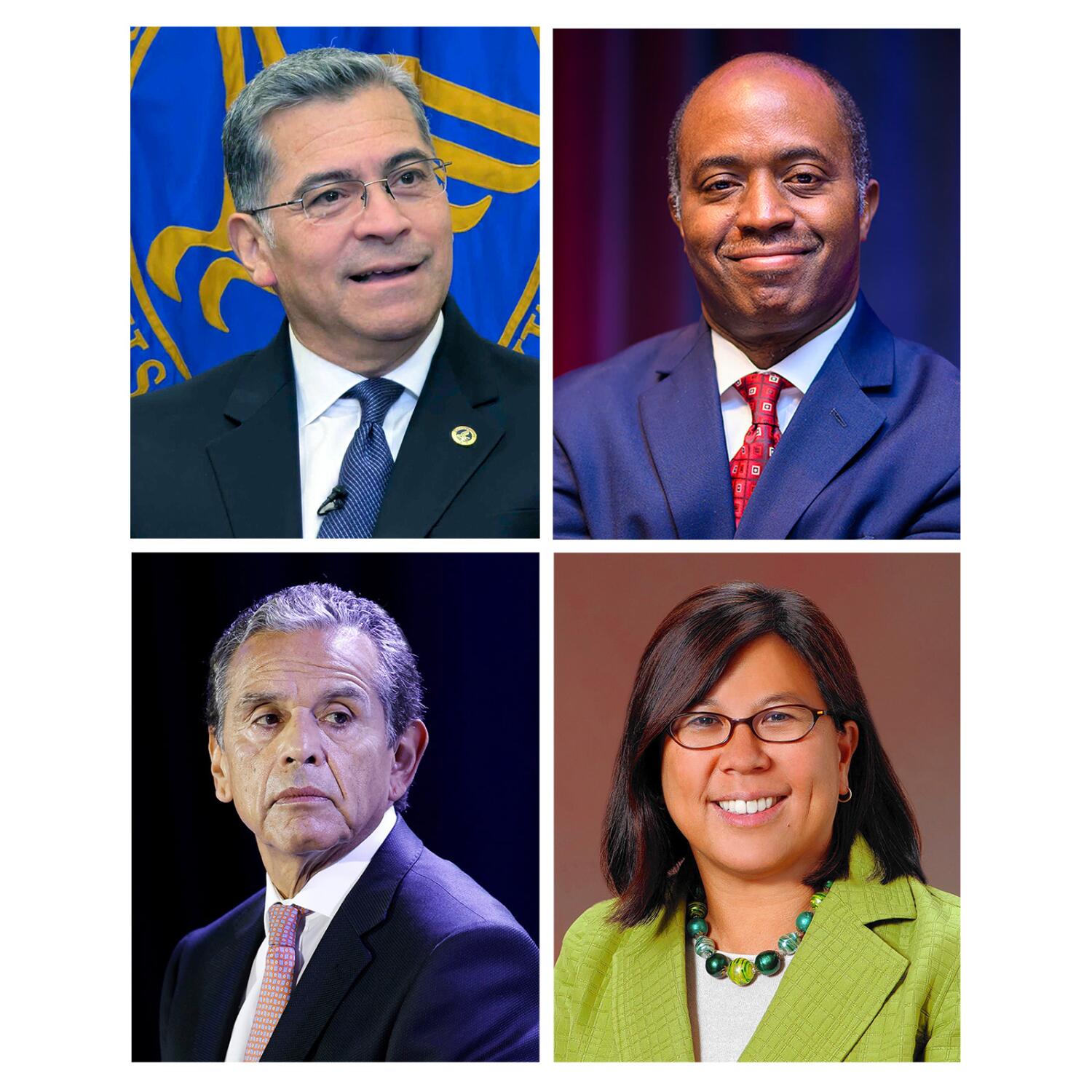
The controversy over the methodology the university used to select candidates centers on the inclusion of San José Mayor Matt Mahan — a white candidate who recently entered the race and is polling poorly — while former U.S. Health and Human Services Secretary Xavier Becerra, former Los Angeles Mayor Antonio Villaraigosa, state Supt. of Public Instruction Tony Thurmond and former state Controller Betty Yee were excluded.
“The university’s selection process — built on a formula never before used for a debate of this scale, has delivered a result that is biased,” their letter said. “When a methodology produces this outcome — one that elevates a candidate with notable ties to USC’s donor community and the co-director of the Dornsife Center for the Political Future — the burden falls on USC to explain itself, not on everyone else to accept it. If USC does not do the right thing, we call on California voters to boycott this debate.”
Mike Murphy, a co-director of the USC center hosting the debate, which is co-sponsored by KABC-TV Los Angeles and Univision, has been voluntarily advising an independent expenditure committee backing Mahan. The veteran GOP strategist previously said he had nothing to do with organizing the debate and that he had asked for unpaid leave at the university through the June 2 primary if he were to take a paid role.
USC has also received tens of millions of dollars in donations from billionaire real estate developer Rick Caruso and his wife. Caruso, a USC alumnus who served as a trustee for years, is also a Mahan supporter.
“I had no conversations with the debate hosts or organizers,” Caruso said in a statement to The Times on Monday. “This is the most important election for California in a generation, and I encourage everyone to be engaged, learn as much as possible about each candidate, then form an opinion who can move California forward in the most positive of ways. Watching debates is a part of that process. That is why I believe debates should include all the credible candidates.”
The debate sponsors released a joint statement on Friday defending their decision.
“We want to be clear that we categorically, unequivocally deny any allegations that the debate criteria was in any way biased in favor or against any candidate and want to clarify the facts,” said the statement by the USC Dornsife Center for the Political Future and its broadcast partners. “The methodology was based on well-established metrics consistent with formulas widely used to set debate participation nationwide — a combination of polling and fundraising — and developed without regard to any particular candidate.”
Hours later, the four prominent Democrats who were excluded from the debate called on their rivals to boycott the event, reiterating their concerns that the criteria used to determine who was invited to participate resulted in every prominent candidate of color being excluded from the forum.
The Democrats who are participating in the debate — Rep. Eric Swalwell of Dublin, former Orange County Rep. Katie Porter, billionaire climate activist Tom Steyer and Mahan — all i condemned USC’s selection criteria but did not pull out of the debate.
“It is a shame that USC has decided to elevate one candidate at the expense of others,” Swalwell wrote on X on Sunday. “USC, and every host of a gubernatorial debate, should employ fair, objective, and honest criteria for all candidates. I remain hopeful they will do so Tuesday night.”
Porter expressed similar thoughts.
“Criteria used to determine which candidates qualify to participate in a debate must be transparent, fair, and objective,” she wrote on X. “I’m disappointed by how USC handled the process for Tuesday’s debate. Candidates and Californians deserve answers.”


