







B
efore our interview begins, Milton de la Rosa — one of the vocalists in the Mexican band Latin Mafia — is busy playing the harmonica. “It’s crazy. It’s relatively simple until it isn’t. Playing clean notes is hard. We’re working on that right now,” he says as his twin brother Emilio and his older brother Mike arrive.
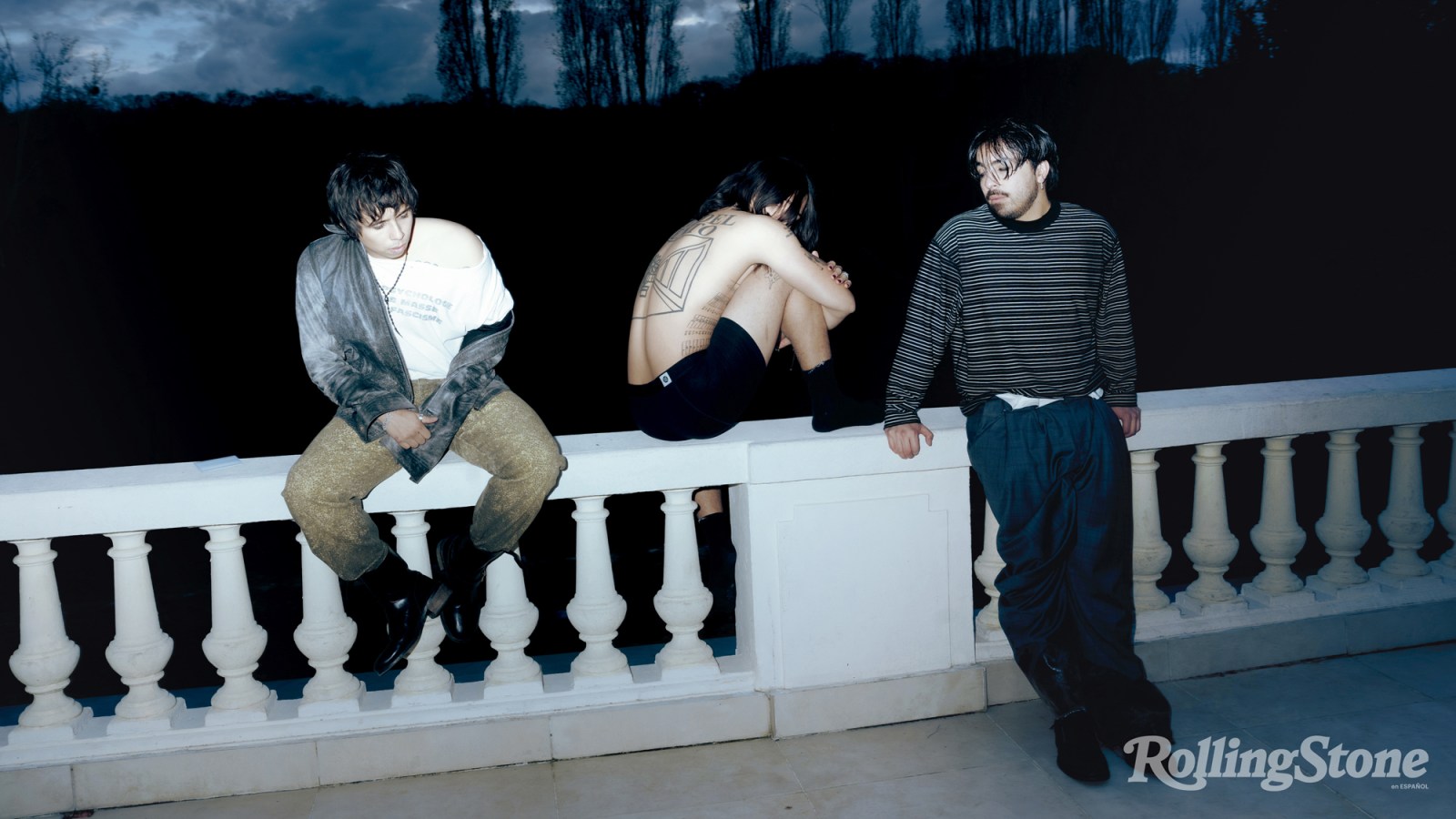
Latin Mafia, made up of the trio of brothers, just arrived from a trip to Paris, capping off an intense year that shot them to the top of the Latin music scene. During a rare break, they speak with Rolling Stone en Español about their latest project — and how they’re working on their mental health, learning new things, reflecting on success, and taking their career to the next level.
The guys have known how to step out of their comfort zone and evolve when necessary, breaking rules, and understanding that music is felt deeply. With that approach, they have connected with an increasingly large audiences, going from 200-person crowds to 200,000-capacity venues.
Clearly, their closeness as brothers came long before they became a band. They shared bunk beds since they were little — the kind with a mattress that slides out from the bottom. “We’ve always been very close. We played football, went to music lessons together. We’ve always been a very close-knit family. We slept in one room, in a three-tier bunk bed,” Emilio says.


“Even after we’d been able to make a living from music for quite some time, when things were going relatively well for us, we still lived at our parents’ house… Closeness isn’t something new for us; it’s something we’re very, very used to,” Milton adds. “I think that’s been pretty key to our dynamic as a project, not just as brothers or as friends. There’s no filter when we say, ‘No, for real, that’s terrible, that sounds wrong, we have to do something else.’ We really don’t hold back among ourselves.”
Since early on, music was a natural part of their daily lives. “It’s always been there; now we just had to understand it a little better,” Milton explains. Their approach began with exploration: “When we were kids, we unconsciously were like, ‘Oh, well, I’m just going to hang out with my friends and discover things,’” Mike recalls. “We’re really grateful to our parents because they always got us into that kind of thing… It was a lot of fun, but also very recreational — it was all about exploring and figuring out what we liked.”
Editor’s picks
That relationship with music has also been changed over time through hard work and personal discipline, as they continue to evolve even after achieving success with their debut. Milton references Tyler, the Creator: “He once said that he had to work at becoming good… that he was already doing things and had to learn to play the piano. He didn’t feel naturally gifted.”
That idea resonates directly with his own process. “Even if I don’t feel good at something, I’m very good at getting good at things,” he says, in contrast to the more intuitive talent he recognizes in his siblings. “Mike is a genius at production… Emi has a very refined ear, very good taste,” he adds. “I’m not afraid to screw up a million times because I know that, eventually… if there’s something we don’t know, we’re going to do it wrong until we get it right.” It’s more than a matter of innate talent, his focus is on repetition, healthy obsession, and constant work.
Like a lot of artists in the digital age, the Mexican brothers gained attention through TikTok, but the platform didn’t just give them an audience — it allowed them to shape their style through experimentation and a consistent routine of creating music videos. “I think we were lucky we didn’t have to release all that crappy music you put out before the good stuff,” says Emilio. “I feel like it’s something we’ve always had as a motto: ‘Make a thousand songs and release the thousand-and-first.’ It was a process where we could practice making music every day, all day long, and also build anticipation among people while we were doing it. By the time we felt ready to release something, it was what we felt was truly worth it,” Mike adds.
Related Content
However, the trio knew how to evolve and capitalize on likes and views, and turn them into listeners. “That’s also a very important point. I think we left TikTok at the right time. I don’t mean we just stopped doing it out of the blue, but it was a type of content that worked for us at the time, but we always knew we wanted to be musicians, not music content creators,” Milton says.
Those rehearsals resulted in songs that resonated with Mexican and Latin American audiences. Tracks like “Julieta,” “Julietota,” “No digas nada,” “Patadas de ahogado” featuring Humbe, “Sal rosa,” and “Perlas” — among others released under their former name, lvtin mvfia — showcased a versatile, fresh style. The brothers created a way of making music that doesn’t take itself too seriously, yet it reveals a genuine vulnerability in their lyrics and the sensitivity they share.
Today, the trio is in a new creative phase that emerged after their debut album, TODOS LOS DÍAS TODO EL DÍA. Those songs, they say, will always hold a special place in their hearts. “I have a deep appreciation for them, because it’s thanks to those songs that we were able to make the album. For that simple fact, I’m extremely grateful and appreciate them so much,” Mike says.
Emilio adds: “It’s a part of us that will always be there. We’ve always said that the album was the first time we sat down and said, ‘This is what we want to do.’ Before that, we did think about audiences, going viral, and finding a favorable situation to be able to explore.”
“We feel more connected to and identify more with the period following the album’s release, but we don’t hate anything we did before. I think it was a wonderful phase that was definitely necessary,” Milton says. “We strongly believe that not everything has to be too intense, not everything has to carry too much weight,” he adds. “We were much younger, experimenting, listening to new sounds, and discovering new things.”

From the start, Latin Mafia made it clear that they weren’t looking to fit into a mold or follow an established standard. When the world was waiting for the album that would follow songs like their hit “Julietota” — with the high expectations sometimes attributed to a full-length debut — the brothers decided to pause and really ask themselves what they wanted to do.
That’s how the concept of “feeling” became the backbone of the project. “I think it starts with the fact that it’s something we feel practically every day,” Emilio told Rolling Stone en Español a few days after the release. “We’re super sensitive people who get fixated on things. I think we feel everything either at full intensity or not at all, and that’s exactly what this concept is all about. We’re people who feel everything, and we wanted to reflect that in the sound.”
That’s how TODOS LOS DÍAS TODO EL DÍA came to be, and it divided opinions. Some didn’t get it; but those who did embraced it from the very start. The record is more experimental, more atmospheric. Rather than staying on the surface, it invites a deep listening, encourages the discovery of hidden meanings, and offers a sensory experience that goes beyond the conventional.
Today, more than a year after its release, they’re satisfied with the reception. “People have embraced it, have really cherished it, have made it their own. And the truth is, it’s an album that has also grown immensely on us. Every time we listen to it, we listen with great pride and joy. And I don’t know, we’re thrilled that people have been able to embrace it and have taken such a fondness for it, and that they’ve used it to find solace, to discover new emotions, or for whatever reason. We’re really, really happy about that, honestly.”
At the release party, the band filled all the seats at the Palacio de los Deportes in Mexico City with fans who were excited to hear the album for the first time. Later, as part of the tour, they sold out the venue three more times, as well as several other venues in Mexico, the United States, Colombia, Argentina, Chile, Peru, Spain, and many other countries as part of their Te odio y Te Extraño Mucho Tour. They were seen having fun around Mexico City with Rosalía, got nominated for a Latin Grammy, and established themselves as one of the biggest acts in Spanish-language music today. 2025 was a whirlwind year, filled with planes, stages, and adrenaline rushes.
But 2026 also marked an inevitable hiatus. “To be honest,” Milton says more seriously, “it’s been a pretty tough start in terms of health, mental health, peace of mind, whatever you want to call it.” More than a setback, the pause feels like the end of a cycle that demanded they stop and look inward. “Thankfully, I can say we’re at the end of a difficult phase… so maybe something good is coming.Who knows?”
“There will be a lot to write about…,” Emilio jumps in. “After TODOS LOS DÍAS TODO EL DÍA, we felt like we had nothing left to say, nothing left to talk about. Now, we definitely have a lot to say. It’s cool to be, in a way, grateful for your most vulnerable self, to be at peace with your saddest self, your most depressed self, your most anxious self. In the end, it’s a part of you that exists, and even if you want to get rid of it, it’s something that will always be with you.”
Today, the brothers are focusing on themselves, going to therapy, and riding bikes around Mexico City. “We’ve been biking, walking, thinking, relaxing,” Emilio says.
The brothers are living the life they always imagined. They’re achieving their goals, traveling the world, financially secure, and collaborating with artists they admire — yet, at the same time, they can be overcome by deep sadness that stems from anxiety and depression. “It’s really hard to think that you cannot see that from the outside, ‘Oh, well, luckily, life — or God — has blessed us with so many things: being able to make a living from music, which is what we love; traveling, meeting people, collaborating with them, getting to know artists who you might have been the biggest fan of back in the day, and now we’re friends.’ I feel like life has given us so many blessings that there are times when you can feel like you’re being ungrateful. And it’s strange, because you think, ‘I don’t know why I feel this way, if the things life has given me are good and luckily I’m healthy… It even gives you a sense of ‘Why don’t I feel the way I’d like to feel?’” Milton muses.
After an intense year, taking a break meant starting to look inward and asking questions that don’t usually come up when everything is moving so fast. “I was talking to a psychologist because right now I’m seeing three psychologists and a psychiatrist. I said: ‘We’re going to tackle this from every angle.’ I’m bombing the anxiety and depression,” Milton confesses. “I asked [the psychologist] about this feeling… about a month ago, a question arose among the three of us: Are there really people who aren’t struggling? Someone who doesn’t suffer, or who doesn’t have something on their mind, or who isn’t going through something? Is there really anyone whose brain chemistry works perfectly, or who doesn’t have a day when something isn’t going the way one would expect? […] If we’ve always been thoughtful, this is the most thoughtful era we’ve ever had,” he adds, laughing.


TODOS LOS DÍAS TODO EL DÍA has taken on a deeper meaning in their imagination because of the emotional weight captured in their songs. Audio clips of their loved ones and experiences that have shaped them make up the songs. Their grandmother, who passed away just a few days before their first performance at the Palacio de los Deportes, closes the album with an audio clip that says: “Ay, muchachitos tramposos. Trampositos. Dios me los bendiga mucho. Dios me los bendiga. Que lleguen con bien y regresen con bien [Oh, you little rascals. You little cheaters. May God bless you all greatly. May God bless you. May you arrive and return safely.]”
That show featured one of the most emotional moments I’ve ever experienced at a concert. When the fans learned of their grandmother’s passing, they prepared a tribute by holding up signs with her name. Upon seeing this, the brothers broke down on stage in front of an audience of over 20,000 people. “Emilio says it might have been the saddest day of our entire lives,” Milton notes. “That day was very, very difficult. Because there were two shows in a row, we thought that the first one felt like ‘Damn, she’s not watching,’” Emilio recounts. “And the second one felt like: ‘She is watching. We have to make it great because she is watching.’”
“That comparison was key for both shows,” he continues. “We’ll always remember the first one as something really intense — we couldn’t even finish it. Barely two days had passed, and we’d been carrying that feeling of ‘We want her to see it’ for a while, because the Monterrey Arena show was coming up and we wanted her to be there.”
“At that moment, when the posters came out, I remember I had never felt so broken before,” Milton says. “Not even among my close friends. It felt like a very intense vulnerability, because we couldn’t even sing, our voices were breaking, I had to wipe my nose; I mean, it was full on crying, not just a tear, it was ‘I can’t control this weeping.’”
One thing to admire about Latin Mafia is thst they always leave room for imperfection. They don’t strive for flawless technical execution, but for what feels right in the moment. It’s a mindset they’ve carried with them since before the album and that continues to guide their creative process. “My relationship with imperfection is that nothing is perfect. The hardest part about striving for perfection is that you’re never going to get there. You’ll just end up frustrated and driving yourself crazy. I feel like the beauty of imperfection is that it’s the most human and the most real thing possible. So that’s what connects with people, or what makes you feel things, because everything is like that. Nothing is perfect,” Mike explains.
That idea also reflects the way they work. “Yesterday, for example, we had a session with Álvaro Díaz, and I feel like he understands that there are different ways of working when it comes to making music,” he continues. “We have a very established way of doing things. We like to have the microphone right next to us and throw out ideas, throw out melodies. And there are people who only record when their engineer arrives. All that is valid, but they’re two totally different ways of doing it.”
“They give you different results,” Emilio says. “You learn by watching those people, and those people learn by watching you. That’s something that can give you a lot of feedback. We’ve really come to realize that—everything is imperfect, in a way, but it’s beautiful,” the older brother emphasizes.
“Just like Mike says, I think there’s a pretty unstable relationship with perfection. There’s even a misconception about it, we’re all obsessed, when I feel like the most beautiful things in the world have never been perfect. They’ve been special.”
Collaborations and encounters with other artists have also been key to their evolution. Working with names like rusowsky, Yandel, Fred again.., Omar Apollo, Akriila, and now Álvaro Díaz, as well as seeing other projects live, has opened up new ways for them to understand the creative process. “I think we’ve experienced specific moments in the studio and at shows where we felt something shift. I’d particularly highlight that something that changed my life as an artist was seeing Tyler, the Creator live at Coachella. I remember that I’m not the same person before and after seeing him. Seeing the attention to detail he had in everything, how he commanded the stage and the audience…,” Emilio says.

“We’re people who are openly influenced by what we see and hear. When we go into the studio with someone and see that they work completely differently from us, maybe the next day when we go into the studio, we’ll try to see how that person did it and do it that way, to see if it gives us a different result. So, honestly, we do mix things up, we do mix everything up a little bit,” he says, reflecting on that versatility that is now a hallmark of their sound.
Now that they’ve achieved major milestones, their perception of success has changed. They no longer see it as a fixed point, but as something that’s constantly being redefined based on where they are at the moment. “Success is such a broad term, and I think that maybe at some point, when you’re just starting out, it might mean hitting certain numbers or filling a venue you really liked. I think it’s changing all the time. For example, at one point, one of our dreams was to play a show for 200 people, and suddenly you play a show for 20,000, three or four times, and you think, ‘OK, that’s a dream come true, I’m being successful. I feel good with my family, with my friends. I’m making the music I like. I’m successful.’ At the end of the day, I think it’s something that’s constantly changing. Tomorrow, we’ll never know,” Emilio explains.
“I don’t think we’ll ever be successful, because I believe the definition of success is conditioned by what I don’t have right now. Maybe today I want something and I’ll have it tomorrow, but tomorrow I’ll need something else in my life. And I think we’re okay with that, because that way I think we can be successful many times,” Milton muses.

“I feel like it’s that pressure to constantly want to overcome yourself and give your all, to exceed the limits you’ve set for yourself or thought you had, and maybe even try to break through them,” Mike adds. “I feel like that’s what we always have, and yeah, it’s pretty intense pressure, but it motivates us a lot and keeps us grounded in the fact that, as you say, nothing is perfect. So we keep moving forward along those lines, continuing to seek that perfection and trying to break through it.”
There are things they know for a fact they don’t want to lose as the project continues to expand: their everyday life, a normal relationship with the world outside of music. “Our everyday life, to being able to go for a walk, ride a bike, go to the movies. It’s something we never want to give up. Every time we meet someone, they ask us, ‘Doesn’t it bother you when people ask for photos?’ I might like it one day, but not the next; it might sometimes make me feel uncomfortable or whatever, but I’m not willing to let that rob me of going for a walk and feeling the air, or doing therapy on a bike, or being able to go to the movies and stand in queue for 40 minutes. Because in the end, we’re just three guys making music. It’s a way of living life, we’re just doing our job. I don’t want to give up being able to do the things I like, to be able to live a quiet, everyday life, the way I’ve always learned to live.”
Along those same lines, Emilio adds that they also don’t want to lose the original drive that led them to create: “Never lose the artistic need for expression. I feel like there are people who put out music just for the sake of it, without any underlying desire to actually do something. At the end of the day, this is an act of expression, a way of expression. I’m not just making music because it sounds nice, you know? It’s because it’s an act of liberation, of expression. And I think losing that takes away all the soul and all the meaning of why you’re doing it.”
Today, Latin Mafia is in a phase of rediscovery and reinvention. As for specific plans for the future, is an album with Fred again.. on the way? “You said it, not us [laughs]. We’re working on something. We’re very, very happy. We have a very, very strong friendship with Fred again..; we love him dearly, we admire him greatly, and yes, we are working on a project with him.”
Trending Stories
They also confirmed that a Latin Mafia documentary is in the works, and the brothers even showed me their upcoming photo book. “We’re working on a lot of things,” Emilio says. “Lots of music, audiovisual content, publishing projects. There’s a bit of everything. There’s a lot coming up. We’re just about ready to release it. By the time this comes out, I think our photo book for the album’s anniversary, the vinyl, will already be out. Here’s a spoiler [they show me a copy]. It’s not quite finished yet, but here it is.” “Yep, it doesn’t have a cover — you make the cover. Inside there’s a sticker of the photo, and then you stick it on the cover.”“We’re first and foremost fixing our mental health,” Milton says with a laugh. “We’re having new experiences, meeting friends and people, experiencing new things, so we can finish what we’re doing. So yeah, we’re inspired, we’re very happy.”
Latin Mafia seems clear on what they want to do: to grow without losing themselves. Amid the spotlight, success, and pressure, they’re committed to keeping their feet on the ground, nurturing their connections, and having their music feel like a way of expressing it all.
Production Credits
Executive Producer: Alejandro Ortiz @xalejandro.ortiz Director of Photography and video: @Directony Styling: @Jotaeka @Miltondrm @Emiliodrm Makeup: @Normajaneid Hairstyle: @Kimgarduno Production: @Roymunguiaa @Samiradelarosa


