






- A new AI-powered camera system is being experimented in the Australian state of Queensland to identify koalas crossing the road in the dark.
- The cameras could be incorporated into smart road signs to warn drivers about koalas crossing up ahead.
- Vehicle strikes are a huge contributor to koala mortality; koalas are often forced to cross roads to move across habitats that have been left fragmented by deforestation and urbanization.
A new AI-powered camera system could potentially make road crossings less of a nightmare for koalas.
Scientists have developed a camera that can be incorporated into smart road signs to warn passengers about koalas crossing the roads. A prototype of the technology captured and recorded a koala crossing a road in real time in the Australian state of Queensland, validating the methodology for the first time.
Developed by scientists at Griffith University in Queensland, the camera is an expansion of previous work where the scientists built a database to detect koalas crossing roads.
The Australian government has declared koalas (Phascolarctos cinereus) an endangered species in Queensland, New South Wales and the Australia Capital Territory. Population counts of these marsupials are hard to maintain because they usually live high up in trees and are nocturnal animals. “They can be hard to see,” Douglas Kerlin, senior research fellow at Griffith University’s School of Environment and Science, told Monday in an email interview. “They are distributed across such a vast area that it is difficult to really know how many there are with any certainty.”
Koalas face threats to their survival from multiple quarters. While deforestation and urbanization have destroyed eucalyptus forests, their primary habitats, they also face the risk of diseases. To make matters worse, the deadly Australian bushfires of 2019 and 2020 decimated their populations across the country.
As human encroachment into forests rise, these animals often have to cross roads to travel across their fragmented habitats. As a result, vehicle strikes have also become a significant cause of koala mortalities. According to a database maintained by the University of Queensland, between 2009 and 2014, 52% of reported wild koala deaths in southeastern Queensland were due to car strikes.
“There has been considerable investment in trying to keep koalas off roads,” Kerlin said. “But we don’t really understand how koalas interact with the infrastructure that has been put in place, like exclusion fencing, under and over passes.”
It was to look into this issue that the team started developing the technology in 2021.

The artificial intelligence models were trained with images and videos collected from local wildlife and conservation parks. The team also partnered with local community groups that had deployed cameras at different locations. The models have been trained to recognize 16 fauna groups that are common to southeastern Queensland.
In the field, camera traps deployed by scientists capture videos whenever the in-built motion sensors are triggered. Each video is then transferred to servers where the trained models parse through it and identify whether it includes an image of a koala. The cameras have been deployed at more than 40 locations across the region, many of which were chosen to understand how koalas enter a particular corridor or to check if they’re using a particular road.
However, gaps persist. Scientists are attempting to figure out the power requirements for the cameras to record longer videos. Currently, the cameras capture videos that are often too short to be able to deduce what the koala was about to do. “For instance, sometimes they would walk into the frame and approach a fence,” Kerlin said. “But the video would cut out before we could see what actually happened when the koala reached the fence.”
As they figure out solutions to these technical hiccups, the scientists are also working to link the camera system to smart road signs in the region. The ultimate goal is to display warnings to drivers asking them to slow down if there’s a koala detected to be crossing the road at the time.
“You either have to stop wildlife crossing the roads when cars are in the area, or you have to get drivers to take more care if wildlife is about,” Kerlin said. “We are addressing the latter.”
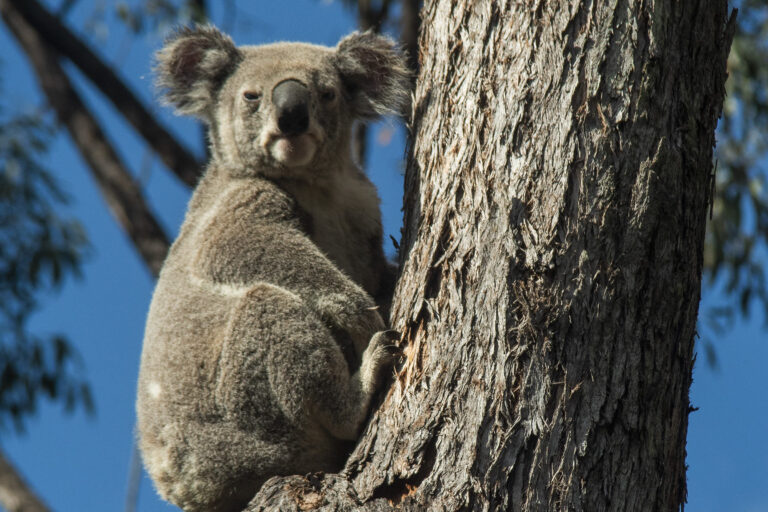
Banner image: Koalas have been declared an endangered species in many states in Australia. The marsupial faces several threats to its survival. Image courtesy of Griffith University.
Abhishyant Kidangoor is a staff writer at Mongabay. Find him on 𝕏 @AbhishyantPK.


