







The following story contains some spoilers for Gail Daughtry and the Celebrity Sex Pass.
IT DOESN’T FEEL like David Wain and Ken Marino even have to try. The duo have been friends and collaborators in comedy ever since meeting in 1988 on their first day of college at NYU, and the brand of laughs they’ve made their signature seemingly comes to the two of them as quickly, easily, and naturally as breathing and blinking come to the rest of us.
“Well, hello!,” Marino, an on-again, off-again Knicks fan, says on a late June afternoon when he sees my hat honoring the NBA’s newly-minted champions. “What a feeling, right?”
Generally the on-screen talent, Marino has a relentless energy that is big, bold, and loud. Wain, who mostly operates behind the scenes as writer-director, keeps things dryer and more restrained. He shows me a new issue of the New Yorker that he’s just acquired. “I stole this from the coffee shop today. It’s a magazine about the Knicks,” he says, before I mention that I haven’t been able to find that issue; it’s sold out everywhere. “Sorry,” he adds, with the kind of quiet, implied wink that you might only pick up on if you know this duo’s exact style of humor.
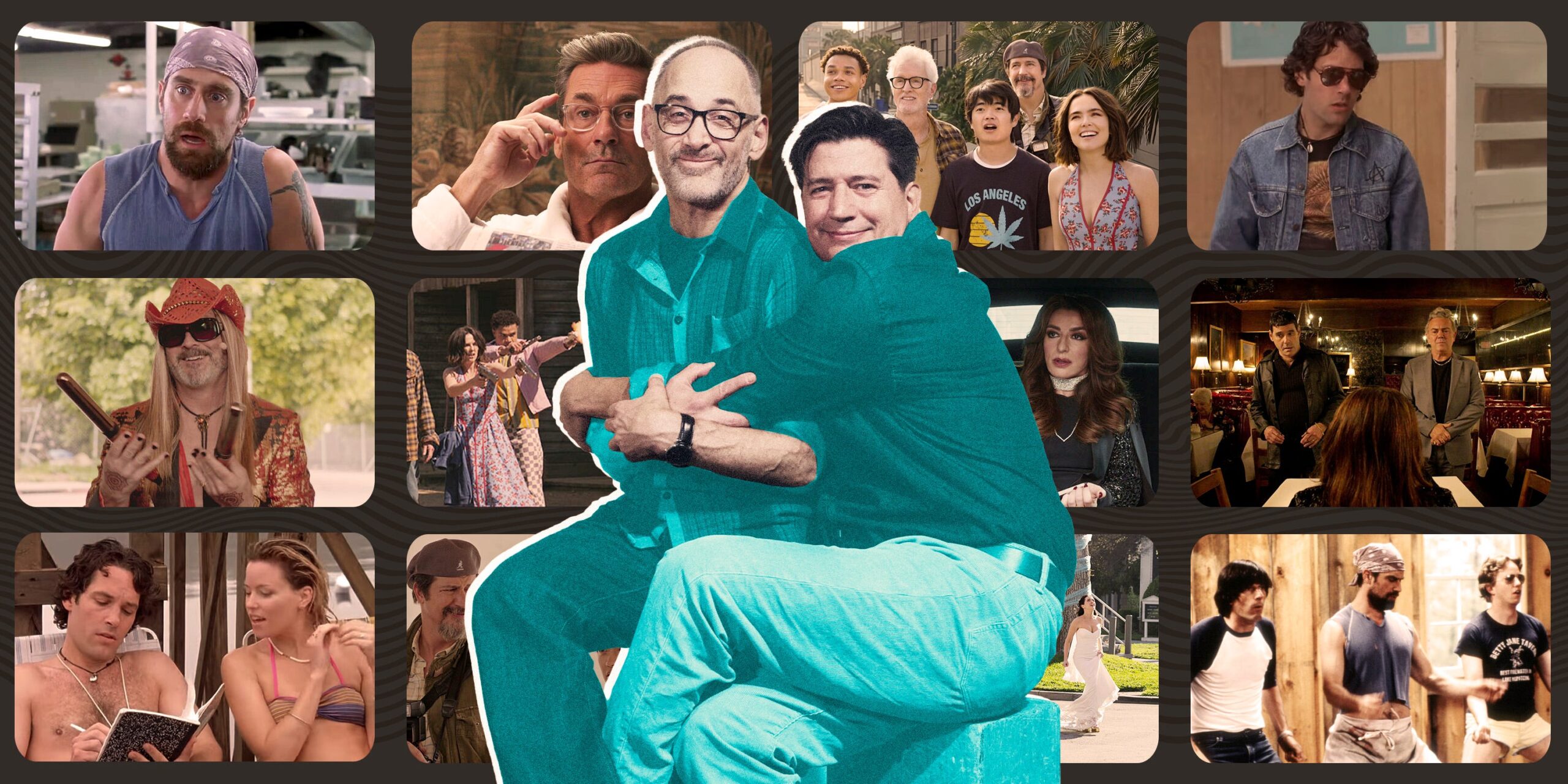
The pair have worked together on movies like the absurd summer camp romp Wet Hot American Summer, a cult classic comedy that Wain directed (and co-wrote with Michael Showalter) and in which Marino is a vital member of the ensemble cast—and which happens to turn 25 later this month. The pair got their start together in the State, a sketch comedy troupe that began during their NYU days, also featured comedy friends like Showalter, Joe Lo Truglio, and Michael Ian Black, and eventually became an MTV television series of the same name. Their working relationship—and friendship—hasn’t slowed down even a little bit in the time since (They even play music and tour the country together as founding members of the Middle Aged Dad Jam Band).


Wet Hot American Summer
“I would call it lucky and fortunate and sort of lovely,” Wain says. “People ask about the backstory, and it’s reminded me just how long and deep it’s been. It’s just really cool to have the opportunity to work with someone who’s your friend first. We have mutual respect for each other. We have different skill sets, but they complement each other. It’s been really fun to continue to have the privilege to keep creating and working together over all these years.”
Marino jumps in. “Yeah, I think the beauty of…”
Wain cuts him off. “No. I kind of said it.”
“Oh, you did,” Marino concedes. “David covered it.”
“Got it,” Wain adds.
“David said it,” Marino says in agreement.
“I said it all,” Wain concludes. “That’s the kind of give and take I was just trying to demonstrate.”
Throughout our conversation, that tends to be the pattern things take. Wain, framing his glasses-clad face with a baseball cap and a brown jacket, and Marino, clean shaven in a denim jacket, always have a thoughtful answer for any question, but are liable to slip right into a dry, farcical bit without a moment’s notice. When you’re as talented as these guys are at improvising, and you’ve got a friendship with decades of chemistry built in, well, that comes with the territory.
That chemistry shines through in the work, too. The pair’s latest film, the fourth they’ve written together (following The Ten, Role Models, and Wanderlust) is called Gail Daughtry and the Celebrity Sex Pass, and is exactly what it sounds like. A woman named Gail Daughtry (Zoey Deutch) makes a deal with her fiancé that both can pick a celebrity who they can sleep with, absent of any consequences or judgment, if they ever get the chance. When the fiancé quickly cashes in on their deal following a random celebrity encounter, Gail is left to go on a Wizard of Oz-inspired journey to fulfill her end of the bargain—and that means tracking down everyone’s favorite celebrity crush, Jon Hamm.


Gail Daughtry and the Celebrity Sex Pass
Hamm and his Mad Men costar John Slattery are only a couple of the famous friends who make outlandish, surprising, and, yes, very funny cameos in Gail Daughtry, but the movie floats on the strength of Wain and Marino’s work together; It’s a story that’s absurd and surprising and feels unique, but also contains the special magic that fans of the duo’s work have come to know and expect. (Marino also co-stars as Vincent, a washed-up paparazzi photographer and aspiring screenwriter).
With Wain behind the screen as writer-director and Marino co-writing and on camera, it’s clear the two have a handle on everything, and had a whole lot of fun along the way. Still, all bits aside, there’s room for sincerity in the equation too. “I think as you get older, you value the things that are precious and important and unique and special,” Marino says. “And, so, it’s easier to recognize that stuff. It’s a really wonderful friendship. I’m glad we have it.”
As Gail Daughtry and the Celebrity Sex Pass arrives in theaters and Wet Hot American Summer approaches its 25th anniversary, Men’s Health spoke to Wain and Marino about their decades of friendship and collaboration, why surprising each other has always been the whole point, and their favorite memories surrounding Wet Hot.
MEN’S HEALTH: A lot of friendships don’t last a fraction as long as yours has. What’s the key to not only maintaining that friendship, but having such a strong working relationship at the same time?
DAVID WAIN: There are a lot of answers to that, but one that comes to mind is during the State, on a regular basis, we would be like, “Okay, let’s have a check-in,” and we’d get together on a regular basis. Forget the specific work, and just check in on how we’re feeling about stuff. And so, every so often, we do the same thing. We’re like, “Let’s just check in and see where we are, what our bigger-picture concerns might be.” If we have friction, we talk it through. We’re not afraid to. Stuff like that.
KEN MARINO: The other thing is we try to take a three to six-month trip together every year to some exotic location. So Bali or Cancun or New Zealand. We’ll just go anywhere for six to eight months.
DW: Then, every other year, we’ll do an 18-month trip.
MH: What’s been the best one?
KM: The moon.
MH: What’s a typical writing session for you two like?
DW: It depends. On Gail Daughtry and a couple others we’ve done, we’ve gone into a room with no idea at all, and then emerged after seven 12-hour days in a row with a first draft. That’s how we got it kickstarted. Then, otherwise, we sit down—ideally together in the room, or on Zoom—and just stay focused and try to do whatever we’re trying to do. But I find that I’m much better at writing when I’m accountable to a partner. It helps me sit down and not get distracted as much.
KM: Same. It’s so much more fun to write with somebody, because then you’re in a room saying things and getting immediate reactions and hearing laughter. Or you hit a wall, and then the other person ‘Yes, and’s, and brings it somewhere else. Then that sparks another idea for you.
And so Dave and I have done that together, on and off, since the State days, and it’s a fun process. Then the practical thing is Dave always sits at the typewriter, because he knows how to type, and I do this [Gestures clumsily typing with single fingers]. It’s something that would, I’m sure, drive Dave crazy—and has in the past.


MH: Do you ever surprise each other?
DW: I would say that’s all we’re doing. That’s the whole point. The crazy thing about writing comedy is hopefully every single joke is one that’s never been heard before. And so the whole idea is to surprise and delight as much as you can with everything you’re doing.
KM: Sometimes when we write something, we know it’s maybe a placeholder. We’re like, “That’s a good one,” or that’s a variation of something we’ve done in the past. Then as we get closer… If we’re in editing or pre-production, or whatever, then we start to go, “Well, can we better that? What’s a fresher version of that?” or, “How do we build on that?” or, “How do we comment on that?” And so, yeah, we’re always trying to surprise each other, and Dave always surprises me.
MH: How did you arrive at the concept for Gail Daughtry?
DW: It wasn’t particularly fascinating. We were brainstorming and we thought at first of this idea of a couple with a celebrity hall pass. Like, what could we explore around that? What would be the exaggerated … [Pretends to drift off to sleep mid-sentence]
KM: Oh, David, wake up. David! We’re still doing it.
DW: I’m sorry. I got so bored with my own—
KM: That’s all right. We just waited. We wanted you to just get a little rest. You all right?
DW: Yeah, I’m good. Yeah. But you get the idea.

MH: You guys have worked with John Slattery and Jon Hamm before, but did it take any extra convincing to get them to play funny versions of themselves?
KM: Nothing too big. Like, foot massages…
DW: No, surprisingly, that was the easiest part. Once we had a script that we were happy with, we sent it to the two of them, and they both responded and said, “Sure, let’s try it,” which was definitely not something we assumed they would say.
MH: Slattery in particular is playing this totally ridiculous character—there’s a line where he says something about how he hasn’t gotten a job in 10 years. I feel like he probably got a kick out of that.
DW: I think he had a really good time doing this, because it is this riff on himself, and it’s totally different. It reminds me, in an inspirational way, of the way they did John Malkovich in Being John Malkovich. I’ve always found that idea fun.
MH: At one point, someone yells “Charles Boyle!” at Joe Lo Truglio, a reference to his character in Brooklyn Nine-Nine. Did you shoot parts of this movie out in the wild?
DW: A lot of that stuff around actual Hollywood, we did shoot in various ways. That particular sequence you’re referring to, we had Mather Zickel and Joe Lo Truglio literally just walking around, talking to random people on the street, and we were shooting them from across the street, where they couldn’t see the camera. We didn’t have the budget nor the desire to set all those situations up. It was more fun just to go.
KM: That “Charles Boyle” moment was not something we planned or told somebody to say. They said it and then we had it. It made an early cut, and it just made us laugh every time. That’s the sort of thing I haven’t seen and we haven’t seen. So that was sort of a fresh, cool, fun joke to drop into our story, because with the language of the comedy we’re doing, it works.
DW: One of my favorite moments we shot that we did not put in was them dancing with this woman on the street, who was just a random woman. There was also a guy with a snake. But some people just wouldn’t sign a release no matter what…
KM: Oh yeah. What was the deal with that woman?
DW: She was like, “I never sign anything.”
KM: No, but what were they doing?
DW: I forget. I think she was just really funny in the way she was dancing, and they were just dancing with her like that. It wasn’t that she had any particular issue. She’s just like, “I, as a practice, never sign anything.”
MH: I bet you’ll find some real characters out there sometimes.
DW: Especially on Hollywood Boulevard.
MH: Ken, the last time we spoke, you said you’d put your body on the line for Party Down. Was there anything like that for Gail Daughtry?
KM: I don’t think so. Not that I can remember…
DW: What about when you got on that big water thing over the lake, where it goes up in the air?
KM: No, that was Eastbound and Down.
DW: Oh, right, right, right.
KM: I did put my body on the line for that. That hurt actually, my crotch. But the biggest physical thing, it’s sort of in the movie. I’m outside my car, and I’m going to get a phone call. I’ve got to jump through the window. Then I was like, “I’ll just do it like I’ve done in the past. I know, I’ll just do it.” Then I had Dave yell, “Action,” and I get the call, and I run over to the driver’s side. I made sure the door’s locked and I’m trying to get in. Then I tried to jump in, and I realized my body is just not functioning the way it used to. So, it was really awkward. In the movie, we cut out before it gets real awkward.
DW: I remember our first assistant director, Jason, when we saw Ken starting to do that, looked at me. He’s like, “Ugh. Does Ken realize he’s in his 50s, not his 20s?”


MH: Speaking of physicality, there’s a John Slattery action sequence late in the film. How did that come together? I can’t imagine he’s done anything like that before, let alone in a comedy.
DW: We have a stunt guy we’ve worked with for many years on different projects named Vlad Tevlovski, and he ran point on that.
KM:It was scripted as an epic 10-minute-long fight scene, and Vlad, our stunt guy, was like, “This is great,” and we’re like, “We only have one day to shoot it.” He’s like, “All right, I’ll figure it out.” Then he brought all these incredible stunt guys in, created this fight sequence, brought Slattery in, showed Slattery. Slattery was like, “All right. Yeah, I could do this. I could do that.”
Meanwhile, Slattery is older than me. Then we had a stunt guy. It was like this big whole ordeal. But, somehow, Vlad figured out this ginormous fight sequence. And then we wound up cutting it down to 45 seconds.
MH: But we see him kick a substantial amount of ass. So, a well-packed 45 seconds.
KM: Yeah. It’s dense. I mean, he knocks a guy’s face off.
DW: By the way, that was not really Joe Lo Truglio. We had a stunt guy, and that’s whose face we knocked off. And then we paid for the stunt guy to have his face reattached later.
KM: Hindsight being 20/20, we should have just done a special effect, because the amount of money it cost to get this guy’s face put back on…
DW: Yeah, that was very stupid.
KM: Half the budget of the movie!
MH: On a related note, I’d love to talk about Wet Hot American Summer, which has its 25th anniversary coming up later this month.
KM: Pass.


MH: Is there one moment that stands out when you think back about it?
DW: I don’t have one that I just have in my mind all the time, but when you said it, what came to mind was the surprisingly poignant moment at the very end, when Michael Showalter has his arm around by Janeane Garofalo, and they just walk off after he’s been dumped. For such a ridiculously stupid movie to have that little moment at the end, that feels beautiful to me.
KM: I have several. I mean, I had worked with Chris Meloni on a little independent movie right before that movie, and to see him come in and be Gene and his scene…
DW: By the way, Ken is being modest. The movie is Dances with Wolves, which did extremely well.
KM: I mean, it won Oscars! But that’s irrelevant. Anyway, so Chris and I were in Dances with Wolves, and then we moved on to this movie. His scenes with A.D. Miles always made me laugh. Him humping the fridge… incredible. I also just always think of Rudd picking up a fork. That was when I was like, “Oh, shit, this guy is incredible. Who does that?” What an inspired, wonderful moment. What was on the page, Dave?
DW: [Starts typing on his computer] I’m going to look it up, because I do marvel that is one of the most famous scenes I’ve ever been associated with in any way, and it could not be more simple. It’s nothing, and yet he made it into this absolute masterpiece in a way.
KM: It’s also how it’s captured. It’s just this … I don’t want to say a happy accident, but I have to believe there’s some spontaneity to it, because I can’t imagine it was scripted. And so, the camera captures it perfectly, and I just love it.
Then, of course, I love the tree crashing, and me and Joe laughing about the thing that you don’t get to see, when I go and save the rafters. But we stay on Joe’s character for budgetary reasons and comedic reasons.


MH: The little moment that really got me when I rewatched the other day was at the end of the movie, when Christopher Meloni’s character motions to the can of vegetables, and the can of vegetables does a little head nod of approval in return. I was cracking up in the middle of the night.
KM: Well, how often do you get to see a can of vegetables show real emotion? You know what I mean?
MH: I do.
KM: And so, when you get to capture that on film and it’s up there on a big screen, and you get to see a can of vegetables do something it doesn’t normally get to do, or even have the abilities to do. It’s nice.
MH: This was a small movie at the time, but it’s picked up so much steam over time, and now we’re talking about it 25 years later. Was there a moment when either of you realized ‘Oh, this is a thing’?
DW: I mean, the movie was essentially ignored at the box office by the distributor. It was essentially a non-event theatrically. Then the DVD came out almost a year later. Then it was about a year after that, you started to hear about it on the internet, and around, and people being like, “What is it?” and you’re like, “Wait, does this movie still have something going on with it?” We had our first midnight screening two years after it came out, and it was packed and people were dressed up and going crazy. We’re like, “Oh my God.” That comes to mind.
KM: Yeah. I mean, about a month ago, I was like, “I’m going to celebrate the 25th anniversary of this movie and watch it with the sound on for the first time.”


MH: The first time I ever saw the movie, I went in totally blind. And it wasn’t until a decent chunk in that I started realizing what it was really going for. Is that a common experience you’ve heard about?
KM: I’ve heard about a lot of deaf people going in to see it, but no blind people.
DW: I’ve heard about a lot of blind people. I’ve heard about dozens of blind people going to see it. They call me all the time.
MH: But you’ve heard about people not quite knowing, going in, what kind of comedy it was going to be.
KM: I think that’s why early on people, like critics, were like, “I don’t know what the hell this is,” because it was different and they weren’t sure what to make of it, or didn’t give it the consideration of, hey, it’s smarter than just a dumb comedy. There’s love and thought put behind it, and it’s unique and it was fresh. I think that a lot of people had to step back and maybe watch it again to realize what it was and what it was trying to do.
DW: [Cutting back in] Okay, I found the script! I was looking for the script. In the actual shooting script [For the Paul Rudd utensils scene], scene 28, it says, “Andy begrudgingly, slowly, painfully buses his one dish. He acts like he’s been in the desert without water for weeks. Beth doesn’t budge. At a certain point, Andy looks up at Beth, hoping she’ll see how difficult this is for him, and let him off the hook. She doesn’t. Finally, he gets the plate onto the cleanup tray and collapses dramatically. Beth rolls her eyes.”
KM: So a lot of it’s there, but I think what wasn’t there, and what was the inspirational part of it, and then again, a testament to Paul Rudd, is the fork dropped.
DW: And the sunglasses business. That was so genius, and that’s all Paul.
KM: Yeah. His sunglasses dropped after he picked up the fork. That’s what made it such brilliant physical comedy.
DW: I think it’s very parallel to what was probably the most talked about scene in our other movie, Wanderlust, we did with Paul, him talking in front of the mirror, which also was a funny little moment on the page, but then he took it to another whole universe.
KM: Interestingly enough about that one, that one was a page of the weirdness he was saying. So, already it was weird. Then he somehow found a way to make it weirder.


MH: There’s always been such an element of time with Wet Hot American Summer, with one of the most famous scenes in the movie being the crew talking about their plans for 10 years later, and then, years later you got to make the two Netflix series, both a prequel and a sequel. Now that it’s 25 years on, is there any part of you that would want to revisit this world again for another story?
DW: I would say never say never, but I do feel in a way when we did the Wet Hot 10 Years Later Netflix show, we really did put an ending on it. And so, I’d do the ending we had. But again …
KM: And for me as a fan, I just want to see the kids’ version, The Wet Hot Babies. And so, all those characters as babies, animated. I think that’d be fun.
This interview has been edited for length and clarity.
Buy Gail Daughtry and the Celebrity Sex Pass Tickets Here
Buy Wet Hot American Summer 25th Anniversary Re-Release Tickets Here




Evan is the culture editor for Men’s Health, with bylines in The New York Times, MTV News, Brooklyn Magazine, and VICE. He loves weird movies, watches too much TV, and listens to music more often than he doesn’t.


