







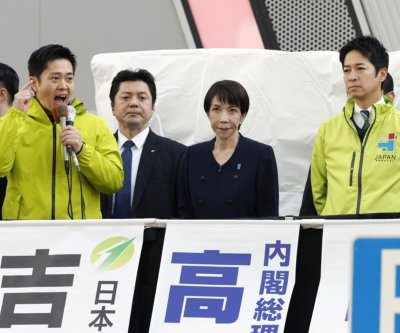
Japan Innovation Party leader Hirofumi Yoshimura, second from left, and co-leader Fumitake Fujita, right, attend an election campaign rally with Japanese Prime Minister and Liberal Democratic Party leader Sanae Takaichi, center, in Tokyo on Jan. 27, 2026. Takaichi was re-elected prime minister after the Feb. 8 general election. Photo by Franck Robichon/EPA
June 18 (Asia Today) — The Japan Innovation Party, a junior partner in Japan’s governing coalition, has called for the early introduction of nuclear-powered submarines as the government prepares to revise its three principal security documents.
The party also urged a review of Japan’s prohibition on allowing nuclear weapons into the country, potentially widening debate over a major shift in Japanese security policy.
The Yomiuri Shimbun reported Thursday that the party approved its recommendations Wednesday and plans to submit them to the government next week.
The three security documents are the National Security Strategy, National Defense Strategy and Defense Buildup Program. Together, they establish Japan’s principal national security and defense policies.
The recommendations argue that Japan must strengthen mutual defense obligations to improve the credibility of the alliance with the United States.
The party called for removing the second paragraph of Article 9 of Japan’s Constitution, which renounces the maintenance of war potential, and allowing the unrestricted exercise of collective self-defense.
One of the proposal’s most significant elements is the early acquisition of nuclear-powered submarines.
The party said such vessels could travel and remain submerged for longer periods than conventional submarines, making nuclear propulsion essential for submarines equipped with vertical launch systems capable of firing long-range missiles.
It called on the government to invest in research and development and immediately begin planning for their eventual deployment.
The submarines proposed by the party would be powered by nuclear reactors but would not necessarily carry nuclear weapons.
The recommendations, however, also address nuclear deterrence. They state that nuclear deterrence should be placed at the center of Japan’s national strategy.
Citing U.S. plans to deploy a nuclear-armed, sea-launched cruise missile by 2032, the party called for creating conditions that would allow U.S. nuclear-powered submarines carrying nuclear weapons to make port calls in Japan.
The proposal also challenges one part of Japan’s three non-nuclear principles.
Japan has long pledged not to possess, produce or permit the introduction of nuclear weapons into its territory.
The party said Japan should retain the commitments not to possess or produce nuclear weapons but conduct a realistic review of the prohibition against their introduction.
It also called for studies of the legal, institutional and operational issues involved in nuclear sharing, under which a non-nuclear country participates in aspects of the operation or delivery of nuclear weapons belonging to an ally.
The proposal would move Japan beyond its longstanding reliance on the U.S. nuclear umbrella toward more direct discussion of how nuclear deterrence might operate.
The party also called for security-related expenditures, including defense spending, to exceed 2% of nominal gross domestic product in fiscal 2026.
For the medium to long term, it proposed using defense spending of more than 3% of GDP as a benchmark, referring to levels among like-minded countries in the western Pacific.
Japan has been strengthening its military capabilities in response to China’s military expansion, North Korea’s nuclear and missile programs and Russian military activity.
The Japan Innovation Party’s recommendations expand that debate to include nuclear-powered submarines, revisions to the non-nuclear principles and possible nuclear-sharing arrangements.
Such proposals are likely to prompt intense domestic debate over Japan’s Constitution, its exclusively defense-oriented policy and its postwar commitment to nuclear restraint.
Because the recommendations come from a governing coalition party, attention will focus on whether they are reflected in the government’s revision of the three security documents.
— Reported by Asia Today; translated by UPI
© Asia Today. Unauthorized reproduction or redistribution prohibited.
Original Korean report: https://www.asiatoday.co.kr/kn/view.php?key=20260618010006430


