

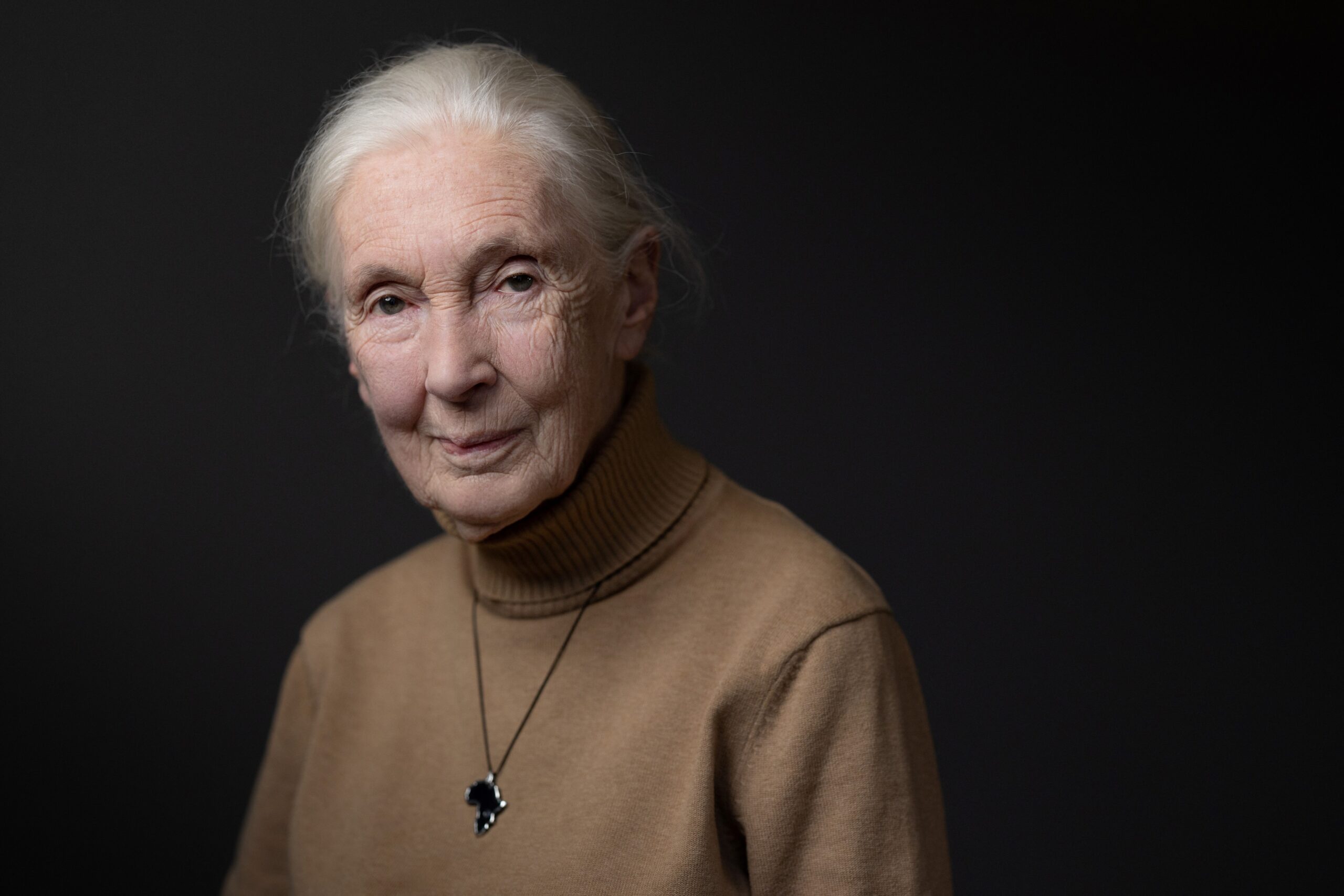
Dr. Jane Goodall, the pioneering primatologist who forever changed the way we look at chimpanzees, has died at age 91. On October 1, 2025, the Jane Goodall Institute announced that its namesake and founder had died of natural causes while on a speaking tour in California.
“Dr. Goodall’s discoveries as an ethologist revolutionized science, and she was a tireless advocate for the protection and restoration of our natural world,” the organization’s statement on social media reads.
In 2024, Anna Rathmann, executive director of the Jane Goodall Institute, noted to Grist, “[Goodall will] frequently get asked by journalists, ‘Oh, Jane, you’ve lived this amazing life, you’ve done all these things, you have all these accolades. What’s your next adventure?’ And she’ll kind of sit there contemplatively, and then she’ll go, ‘My next great adventure will be death.’”


Jane Goodall appears in the television special “Miss Goodall and the World of Chimpanzees” originally broadcast on CBS, Wednesday, December 22, 1965.
CBS Photo Archive/Getty Images
In the 1960s, Dr. Goodall’s groundbreaking research into how chimpanzees behaved in the wild revolutionized the study of primates. In her later career she became a passionate environmentalist dedicated to protecting the planet and all of its creatures. As a Glamour Woman of the Year in 2008, Dr. Goodall said, “You can’t solve all the problems of the world, but each day you can do something. A certain peace comes from doing what you feel you should be doing.”
Women were not generally accepted within scientific fields when Dr. Goodall began her career in the 1950s. But perhaps being a woman is what allowed her to revolutionize the study of chimpanzees in the first place. Dr. Goodall had no formal education when she began working with Louis Leakey, only enough chutzpah to cold call the famed anthropologist and convince him to hire her. Impressed with Goodall’s self-taught knowledge, Leakey sent her to Gombe Stream Chimpanzee Reserve in Tanzania to observe chimpanzees in the wild. “He felt that being a woman might be beneficial because he thought I might be more patient with the wild animals,” Goodall said in a Chatham House interview in 2021, and perhaps he was right.


Jane Goodall appears in the television special “Miss Goodall and the World of Chimpanzees” originally broadcast on CBS, Wednesday, December 22, 1965.
CBS Photo Archive/Getty Images
Goodall applied a sociologist’s empathy to her research on the chimps, giving them names and describing them as individuals, which was decried, at first, as unscientific. “I was told at Cambridge I shouldn’t have named the chimps and that they should have had numbers,” Goodall once told the Guardian. “I wasn’t allowed to talk about them having personalities, and certainly not about them thinking or having emotions.”
But it was this, dare I say, feminine approach which led to her groundbreaking discoveries. In getting so close, Goodall was able to observe one chimp, whom she named David Greybeard, fashioning a blade of grass into a tool. Before Goodall’s discovery, the use of tools was thought to be a purely human behavior. Goodall’s research described, for the first time, chimpanzees’s complex social relationships and other supposedly human behaviors like affection.
There were also ways in which being undervalued as a woman was, in itself, an unexpected boon. Goodall wrote in an essay for Time, “Being a woman helped me in practical ways, too. Africa was just moving into independence and white males were still perceived as something of a threat, whereas I as a mere woman was not.” And she told Chatham House, “Other scientists were grumpily saying, ‘She’s only getting this credit because she’s a National Geographic cover girl and she’s got lovely legs,’” but she could also reframe this blunt sexism into a sort of advantage. “I did think, if having lovely legs—which I did because I’ve looked at the film—helps to get money to do what I want to do, then thank you legs.”


Conservationist Dr. Jane Goodall is awarded the Presidential Medal of Freedom by U.S. President Joe Biden in the East Room of the White House on January 4, 2025 in Washington, DC.
Tom Brenner/Getty Images
Lovely legs or Cambridge-approved methodology or no, Goodall’s research was so monumental that the scientific establishment had no choice but to take her seriously. Her influence not only set the stage for likeminded young women to follow in her footsteps, but also for the establishment to regard these women with more respect than they might have otherwise. Goodall spent the latter part of her career more focused on environmental activism than on the study of chimpanzees, but her name is still culturally synonymous with the field of primatology. Is it any accident, then, that primatology is now one of the very few areas of science with near gender parity?