

The atrium at Copenhagen’s Statens Museum for Kunst (SMK) is a place where the past meets the present. Affectionately dubbed ‘Sculpture Street,’ it connects the 19th-century neo-Renaissance palace that housed the original art gallery with a modern extension, where light pours in through the glass roof and lush greenery surrounds the space. It was the ideal setting for Institution by Galib Gassanoff to make its Copenhagen debut, in celebration of the Milan-based designer’s Zalando Visionary Award win.
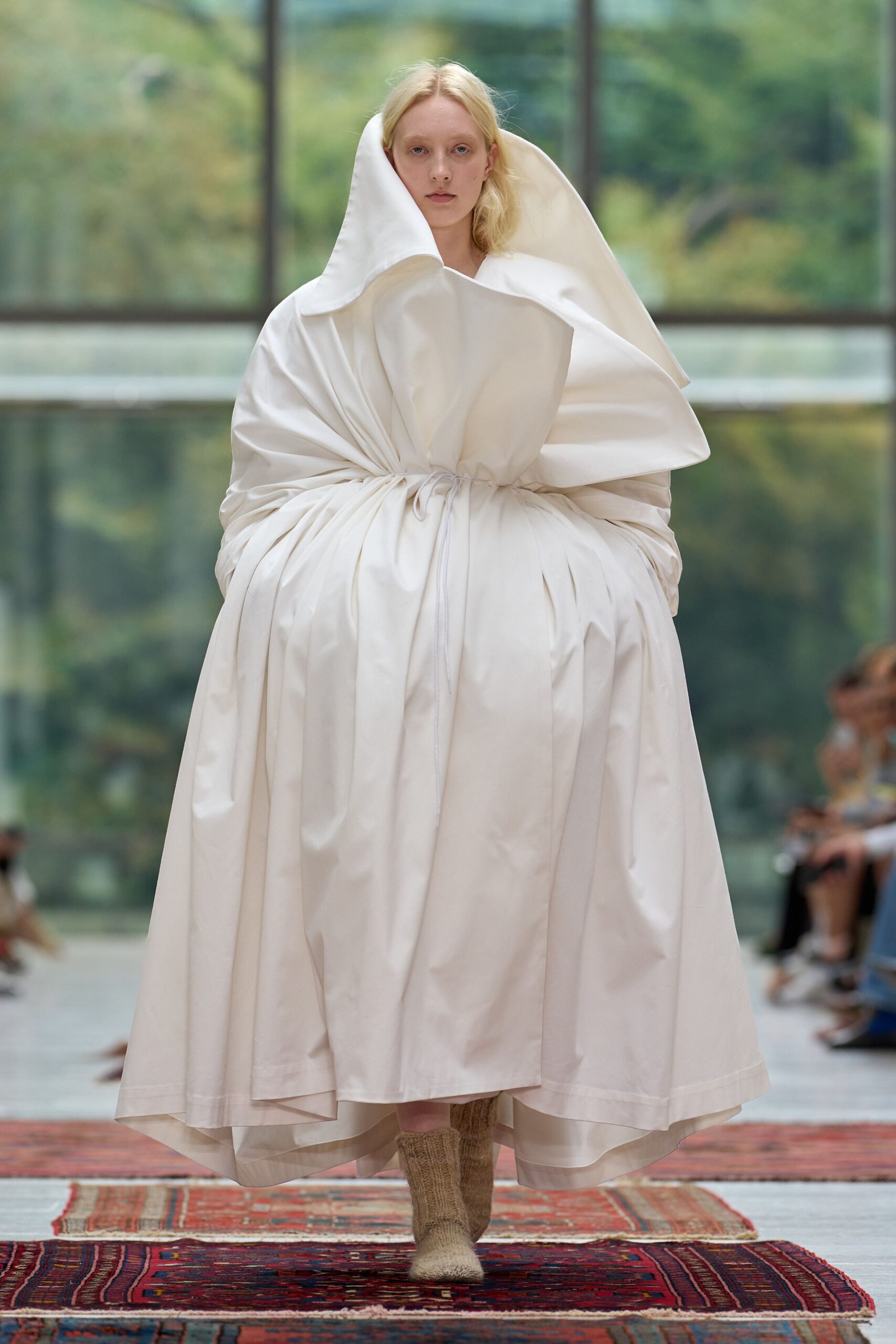
The collection bridged traditional Georgian and Azerbaijani crafts with a modern sensibility, starting with the runway, which was lined with rich woven carpets sourced from the Caucuses, Anatolia, Northern Iran, and Central Asia. “I grew up surrounded by these carpets and we never walked on them with shoes,” said Gassanoff. “When we entered the home, we left our shoes at the door.”
When the models came out, they wore thick ‘jorab’ socks, hand-knitted by two Azerbaijani artisans, using wool from their own livestock (sisters Gassanoff met in Georgia’s Kvemo Kartli region last November). “I always love to include the human story, the endangered craftsmanship that nobody values anymore,” he added. “Showcasing that, and bringing it to a younger generation, is my mission with Institution.”
The collection was peppered with reminders of home, but Gassanoff managed to create a kinship with Danish fashion too. He captured the clean lines and elevated minimalism that Copenhagen is known for, but there was a duality there, a nuance in the way he imbued the clothes with coziness, or hygge. In the hands of another designer, the sculptural cloaks and billowing shawls might have looked monastic or austere. Gassanoff made them feel cocooning instead.
The show opened with oversized robes, belted at the waist; their swathes of white and beige fabric undulating over padded hips were a nod to the constructivist sculptures Gassanoff grew up with. A pleated version fanned out from the waist through rounded shoulders, while a gauzy cardigan version was semi-sheer and slouchy. While Gassanoff typically gravitates towards black and brown, the lighter colors allowed the craftsmanship to shine. It was richer and lighter at once.
Three white looks made from fine silk chiffon and embellished with jangling Georgian ‘Tetri’ coins closed the show. The fractional currency was first introduced in 1995, four years after Georgia’s independence from the Soviet Union. Including them—subverting them—was a subtle nod to the political situation in Georgia, where repression has reared its head in recent years, said Gassanoff. At the same time, the coins are something everyone in Georgia touches on a daily basis. Like the carpets, they are a reminder of home.
