




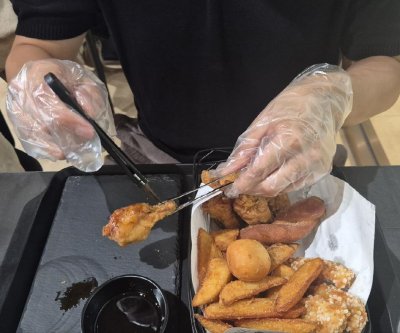
1 of 4 | A visitor applies sauce to fried chicken with a brush at Kyochon F&B’s training academy in Osan, South Korea. Kyochon says preparing one chicken requires an average of 72 brushstrokes. Photo by Asia Today
July 19 (Asia Today) — “Dip the brush at least 1.2 inches into the sauce, shake it three times and brush each side of the chicken three times.”
The eyes of the participants followed Do Min-su’s hand as he moved a brush across freshly fried chicken Wednesday at Kyochon F&B’s training academy in Osan, about 30 miles south of Seoul.
Layers of glossy soy sauce spread across the crisp coating, demonstrating a preparation method the South Korean fried chicken company has maintained for decades.
Kyochon converted its former headquarters in Osan into an education and visitor center after moving its main office to Pangyo last year.
The academy opened in January as a place where domestic and international visitors can experience the company’s cooking methods and brand philosophy. About 9,600 people from 77 countries visited during its first six months, according to Kyochon.
The building has one underground level and three floors above ground. Its main experience area on the second floor covers about 4,973 square feet.
Training can be conducted simultaneously in three spaces called the Honey Room, Soy Room and Red Room. The floor also contains a brand exhibition area, cooking stations and a smart kitchen.
The exhibition traces Kyochon’s expansion beyond fried chicken into other food and beverage businesses.
Displays introduce the group’s Fermentation Workshop 1991 traditional liquor brand, Moon Bear craft beer and K&P Food, which produces the pickled radish commonly served with Korean fried chicken.
The cooking demonstration attracted the most attention.
Do, who leads Kyochon’s 1991 School team, lowered a 2.28-pound chicken into oil heated to 356 degrees Fahrenheit. The sound of frying filled the room as the aroma spread through the demonstration area.
The first frying took about 10 minutes.
Do said Kyochon fries chicken at a higher temperature than many other brands to create its characteristic crisp texture.
The chicken weighed about 1.62 pounds after the first frying because moisture had escaped during cooking.
The staff then shook off loose pieces of batter over a wire screen in a shaping process before frying the chicken again for one to two minutes.
Its final weight was about 1.41 pounds.
The two-stage process creates the thin, crisp coating associated with Kyochon chicken.
After the frying was completed, attention shifted to the application of sauce.
Kyochon calls its method the “333 sauce rule.” The cook dips the brush at least 1.2 inches into the sauce to collect garlic particles, shakes it three times and brushes each side of the chicken three times.
Preparing one chicken requires an average of 72 brushstrokes.
“The repeated brushwork ensures that the sauce is applied evenly so customers get the same flavor from every piece,” Do said.
Restaurants may slightly adjust the amount of sauce in response to customer requests, he said, but they must remain within standards established by the company.
Across from the cooking area, a collaborative kitchen robot repeatedly moved its mechanical arms as visitors watched through a glass partition.
The robot automatically handled battering and both stages of frying.
Kyochon said 33 of the robots are operating at 25 restaurants in South Korea, while four are in use at three overseas locations, including restaurants in the United States.
The company plans to expand kitchen automation by developing additional battering equipment and robots capable of applying sauce.
After the demonstration, participants took up their own brushes.
They applied sauce with varying levels of skill, finished their own chicken and concluded the program by eating the food they had prepared with side dishes.
Kyochon is developing Kyochon 1991 School as a program for introducing Korean fried chicken culture to international visitors.
The company works with 11 organizations, including the Korea Tourism Organization and the Korean Food Promotion Institute, to offer programs for foreign tourists.
It has also held culinary exchange events with visiting international chefs.
Beginning next year, Kyochon plans to add programs in which visitors can make pickled radish, traditional Korean fermented sauces and traditional alcoholic drinks.
“The Osan academy was created to allow visitors to directly experience the cooking philosophy and brand competitiveness Kyochon has developed,” a company representative said.
“We will expand our education and experience programs, create more opportunities to engage with customers in Korea and overseas and develop the academy into a center for promoting the value of Korean fried chicken.”
— Reported by Asia Today; translated by UPI
© Asia Today. Unauthorized reproduction or redistribution prohibited.
Original Korean report: https://www.asiatoday.co.kr/kn/view.php?key=20260719010006513