







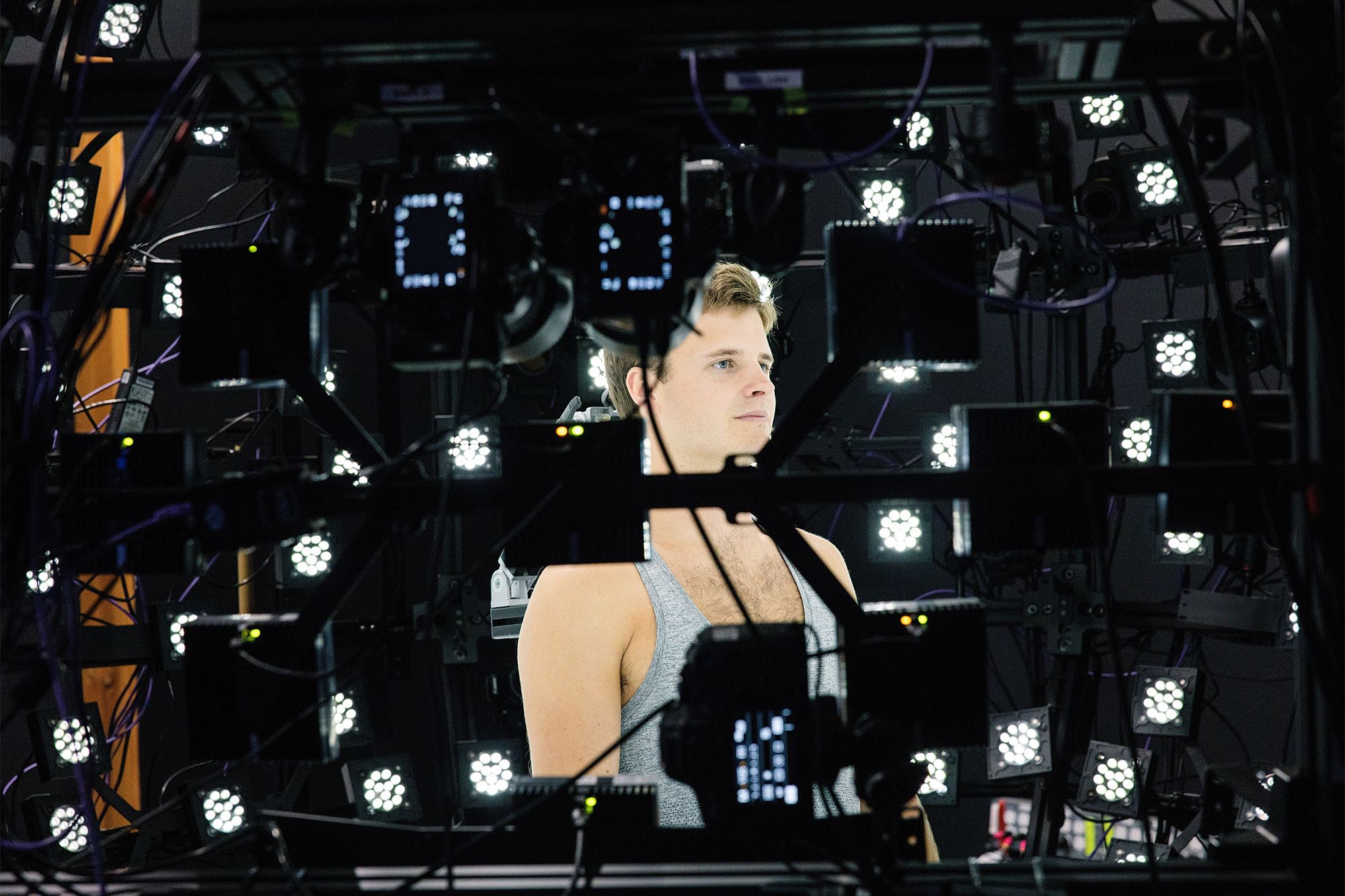
I’ve come to watch what may be the end of the (entertainment) world as we know it. The three machines arrayed before me are designed to capture every inch of a performer’s body—their facial expressions, their physical movements, the grain of their voice—and use this data to create an AI likeness. The devices look like something out of an old science fiction movie about the tech-addled dystopian future.
But then, we’re living on the precipice of that tech-addled dystopian future. Hollywood actors are already locked in an existential face-off with AI: If the technology is now good enough (more or less) to replicate the performance of actors, dead or alive, why wouldn’t studios choose AI performers over ones made of flesh? Unlike humans, digital creations don’t need to be pampered, fed or emotionally coddled.
The facility I’m visiting, tucked away in an industrial neighborhood on LA’s west side, also happens to be run by talent agency Creative Artists Agency. The talent agency handles the careers of many of the world’s biggest actors, athletes and influencers, some of the very people whose livelihoods are most threatened by the creeping ascent of AI. The agency is offering its clients an opportunity to have themselves voluntarily scanned in this nondescript building, dubbed The Vault—a choice it paints as crucial. “We had this vision that in an age of AI, protections of one’s likeness, one’s voice, one’s IP were only going to become more important,” says Alexandra Shannon, CAA’s head of strategic business development. “And the commercial opportunities would be profound.”
What kind of opportunities? Digital alter-egos can be used for post-production fixes, so an actor doesn’t need to return to set for reshoots, and to speed up the original filming process. They can also be used for de-aging characters, creating performances in different languages, or preserving the voice or likeness of an actor whose health is deteriorating, as was the case with CAA client Eric Dane. Maybe you’re an in-demand athlete or musician with just a small amount of spare time between games or tours; you can send out your AI clones to do commercials for you.
Then there are more innovative possibilities “You now can have authors build a digital clone of themselves,” enthuses Liz Randall, a former Apple exec who is CAA’s head of business operations and strategic development. “You can ask them questions, like, ‘Hey, I’m on this page, what’s going on here? Help me understand this character.’ It’s coming, all this participatory media.” Shannon points to European football coach José Mourinho, who partnered with Snickers on an interactive campaign in which his AI avatar gives advice to fans in personalized videos. “A deal like that typically would be very specific: A talent shows up, and they have one piece of content that comes out of that,” she says. “Now, with this technology, there was zero in-person time, but you have hundreds of thousands of individual assets.”
I was ready and willing to try out the scanning process myself—until I learned that the first step was to put on a skintight gray patterned bodysuit. CAA employee Joey Flanigan kindly volunteers to play digital guinea pig instead. Within minutes of my arrival, he’s standing inside the full body rig, a round metal arena covered with 204 cameras. Different flashes can preserve skin tones in a multitude of lighting scenarios, whether on a sun-bleached beach, a grungy subway train or a basic bluescreen. The rig even measures the shadows between fingers and other body parts, so they can be recreated with perfect accuracy. Flanigan’s current position—arms and legs spread apart—is a key pose, according to Randall: “It can be used for gaming or for costumes, so that if he was in production as Spider-Man, we would have a model of him and could start working on his outfit.”
The second rig is a light-covered globe with spiralling lights that the crew has nicknamed Dorothy. (Because we are not in Kansas anymore.) It’s designed to focus on facial features, isolating every muscle. The data can be used for special effects work or as a reference for a video game artist creating a character around a performer. An iPad sits at the front of the machine, flashing facial expressions for Flanigan to imitate.
In just three seconds, the technician extracts 714 images with which to create a super high-res 3-D model of his face; it appears on a nearby computer screen with terrifying pore-level detail. At this point, I congratulate myself for not undergoing the scanning process, leaving my own pores unexplored. “It’s incredible the amount of detail that we have, which is the reason why I will not ever do this,” Randall agrees. “I don’t need to see my wrinkles and sun spots.”
The next machine looks the simplest; it resembles an old-fashioned switchboard operator’s station. But this rig is designed to replicate an individual’s nuances, absorbing their quirks as they tell personal stories and move naturally, catching them in off guard moments.
“You might have pictures of Meryl Streep from red carpets, scenes from a movie or memes. But you’re never going to be able to get those in-between moments, that subtle difference between being sarcastic and feeling guilty, or a teasing laugh,” Randall says, from footage generated from public appearances. “Here we’re actually directing a performance. This technology has been deployed only in the latest and greatest superhero movies. So we’re talking about that level of quality.” Athletes who come into The Vault similarly show off their athletic moves—how they’d throw a football or dribble a basketball.
The aim is to create digital assets that are flexible enough to be used over and over in lots of different ways, whether in movies, video games, advertising, or interactive projects. No matter how quickly AI technology evolves, Shannon says that capturing this particular moment in time is valuable—especially for a performer late in their career. “A legacy client coming in here might view this as something that their families and their estates can have forever.”
This technology is precisely the kind of thing that might’ve been helpful to the makers of As Deep as the Grave, a film featuring a posthumous AI-created performance by the late Val Kilmer. Although the makers of that film have conjured a ghost-version of Kilmer out of just a handful of family photos and audiotapes, Shannon believes that performers who actively create their own digital assets will allow filmmakers on high-profile projects to “get over that uncanny valley” that can make even high-quality AI-assisted projects feel not quite right.
Hollywood guilds are currently wrangling with the perils and possibilities of AI. SAG-AFTRA supports the NO FAKES Act, which recently cleared the Senate Judiciary Committee and grants individuals rights over the use of their voice and likeness in digital replication. Although SAG-AFTRA executive director Duncan Crabtree-Ireland knows that some performers have very mixed feelings about AI replicas, he says, “The reality is that a lot of our members spend a lifetime building up a persona that has real value, not only to themselves but to their families.” Shannon also notes that this new idea of legacy has real appeal for celebrities—the possibility of remaining center stage “well beyond however many years we are here on earth.”
For an agency like CAA, this tech allows clients to own and control their digital dopplegangers—and gives potential employers confidence that the rights to this AI character have been cleared.
“A couple years ago, more often than not we were advising our clients not to take [AI] deals that were coming their way,” Shannon says. Now that artists own their own data, “we have a pretty steady stream of deals, from the video game space to ad agencies to platforms that want to be creating avatars and doing things like that.” Some of the deals have pages of guardrails and approval rights, setting down boundaries for any future use of these replicas.
That was the initial appeal to most CAA clients who took advantage of this service, according to Shannon: “They have really been the ones that were most scared of the technology and wanted to solely think about this as a protective measure, because now they own their assets. Anyone who chooses to do anything other than work with their own assets would be infringing on their rights.” But over the last year, there’s been more interest in its innovative possibilities. This, by the way, is how the final season of the HBO series The Comeback ends: with Valerie Cherish (Lisa Kurdrow) coming to terms with her AI replica making additional seasons of a bad sitcom, while the real Valerie gets to do more fulfilling work on another series.
As I stare at a computer screen, a deluge of Flanigan’s features appear. These hundreds of photos can be digitally knit together and sent out to work in ways we probably haven’t yet imagined. Will today’s celebrities soon be sending their AI clones into our laptops to chat with us, advise us, keep us company?
Crabtree-Ireland is sanguine that this technology won’t replace human interaction. “One of the things that digital replicas and synthetics can’t do is live a human life outside of the project on the screen, and there is a growing interest in that live connection,” he says. Think Cameo, which capitalized on the public’s craving for “real” interactions with celebrities. Shannon agrees that digital personas won’t be a replacement, but a complement. “They’ll create fan engagement models that never could’ve existed before,” she says. “Think about the ability to interact directly with your favorite sports player, or design an album cover for your favorite musician, or speak to your favorite global superstar in your local language—all with their permission. That’s where we think the world is going. But who knows? It’s anyone’s guess.”
-
What Ever Happened to Marvel’s Wunderkind X-Men Showrunner?
-
Blackpink’s Lisa Pulls Back the Curtain on the Life of a K-Pop Showgirl
-
How Garth Fisher Became the Go-To Plastic Surgeon for the West Coast Elite


