






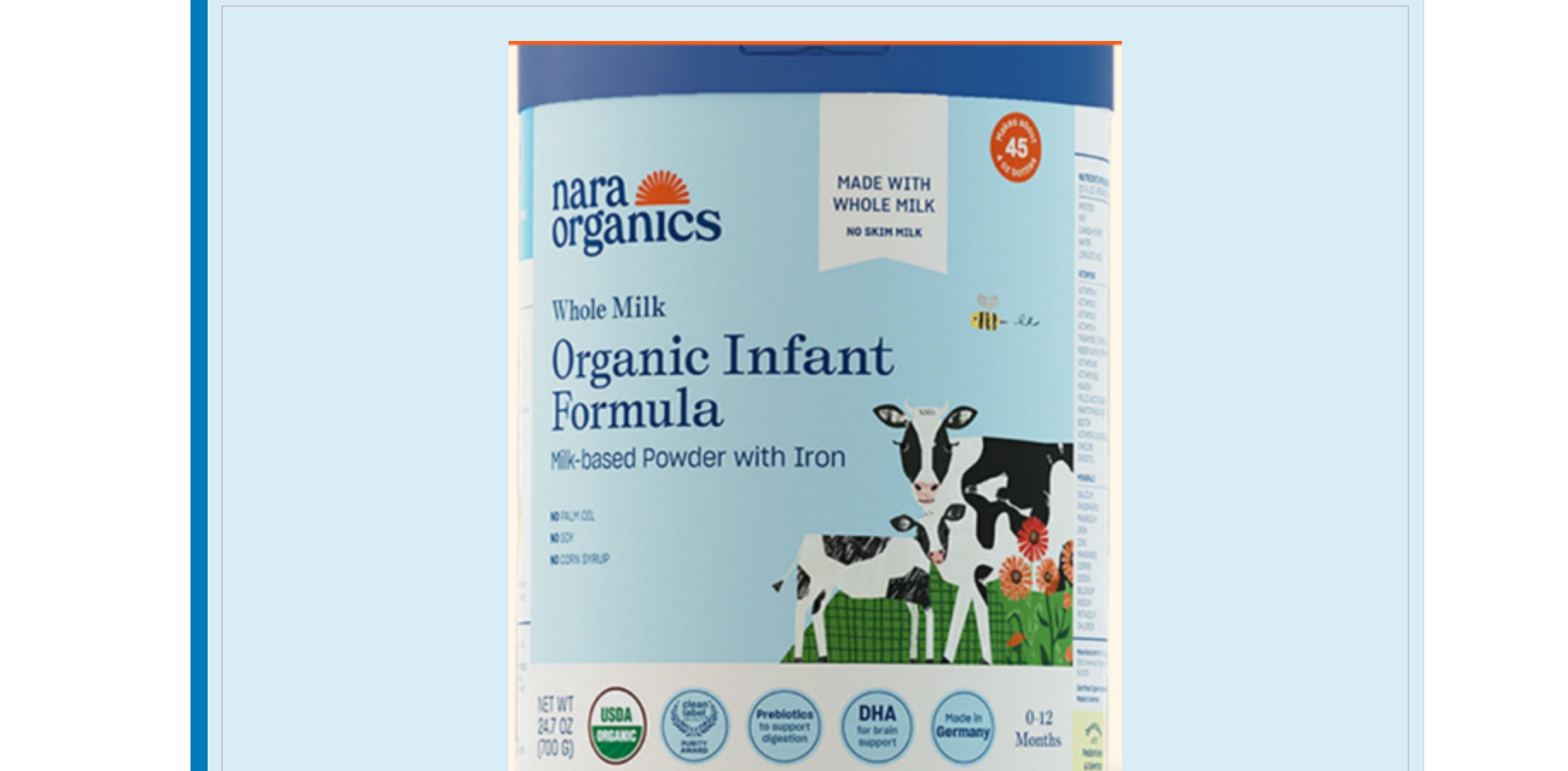
The U.S. company that sold infant formula related to the most recent outbreak of infant botulism imported the product from Germany.
However, Nara Organics has not named the specific manufacturer of the formula.
“Nara works with a state of the art manufacturer in Germany who has over 70 years of experience making top European infant formulas,” a company spokeswoman told Food Safety News.
The spokeswoman has neither responded to questions about the name of the German manufacturer nor provided comment about why the name is being withheld from the public.
So far the outbreak has sickened three babies across three states, California, Pennsylvania and Washington, according to the Food and Drug Administration. They ranged in age from 2 to 5 months old when their illness began. All three consumed Nara Organics Whole Milk Organic Infant Formula.
All three infants were hospitalized and treated with BabyBIG®, the FDA-approved treatment for infant botulism. No deaths have been reported.
A U.S. representative issued a statement on June 16 calling on Congress to pass the bipartisan Infant Formula Safety Modernization Act.
“In just seven months, we have experienced two outbreaks of infant botulism tied to powdered infant formula. First, a ByHeart outbreak which sickened 48 sick babies across 19 states, and now Nara Organics with babies in three different states – all of them between two and five months old – now fighting for their lives,” said Rep. Rosa DeLauro, D-CT.
“This is not an isolated incident, it is a concerning pattern that begs the question; are we doing enough to ensure the safety of infant formula in this country? Before ByHeart and Nara Organics, in 2022, there was Abbott’s facility in Sturgis, MI, that shutdown after a cronobacter sakazakii outbreak, triggering a nationwide shortage that left families scrambling for formula and babies hospitalized and in some cases, dead.
“The food we give our babies must meet the highest standard of safety. Right now it does not, and the gaps in the system are clear. Multiple crises year after year show the current system is not working, and we must be doing more.”
The Infant Formula Safety Modernization Act is endorsed by the American Academy of Pediatrics, Consumer Reports, Prolacta, Consumer Federation of America, Environmental Working Group, Center for Science in the Public Interest, STOP Foodborne Illness, and the Association of Public Health Laboratories.
The outbreak and recall
The California Department of Public Health reported that the infections are among infants who were fed Nara Organics Whole Milk Organic Powdered Infant Formula. The babies became sick in April and May.
The implicated organic formula was distributed nationally across Target retail stores, Target.com, and Nara.com between July 2025 and June 2026.
Officials in two states have collected leftover infant formula for testing. This testing is underway, and results are expected in the coming weeks.
The FDA contacted the firm and recommended that it conduct a recall due to the severity of illnesses and the epidemiological signal. On June 13, 2026, Nara Organics agreed to recall all of their Nara Organics brand Whole Milk Organic Powdered Infant Formula. Consumers should not use recalled infant formula.
Affected Product Details:
- Nara Organics Whole Milk Infant Formula, 700g, with UPC 860013251901
- Nara Organics Whole Milk Infant Formula, 400g, with UPC: 860013251918
All lots currently on the market are included in this recall, and the specific codes are as follows. The lot code can be found on the bottom of each can.
- 408125075E14F2
- 708125076E14F2
- 708125083E14F2
- 408125139E14F2
- 708125141E14F2
- 708125145E14F2
- 708125174E14F2
- 709125273E14F2
- 709125280E14F2
- 709125288E14F2
- 409125307E14F2
- 70926019ENNB
- 70926029ENNB
- 70926035ENNB
- 70926039ENNB
- 70926042ENNB
Nara Organics Whole Milk Organic Infant Formula makes up less than 1 percent of all infant formula sold in the United States and this outbreak does not create shortage concerns of infant formula for parents and caregivers, according to the FDA.
Thoughts from a food safety expert
Seattle food safety attorney Bill Marler said the pattern is more than troubling.
“We have been here before,” Marler said. “In March 2023, the FDA told this entire industry, in writing and naming Clostridium botulinum, that powdered infant formula had a documented history of botulism and that manufacturers had to control for it. None of this was unforeseeable. It was preventable.
“Three babies are in the hospital. Mercifully, no one has died. But a recall after the fact is not a food safety system — it is a bad apology. After the ByHeart outbreak, the FDA had to send warning letters to Target, Walmart, Kroger and Albertsons because recalled infant formula was still sitting on store shelves — in some cases restocked and discounted — weeks after the recall began. So, I want to know what has changed. I want to know why we test finished formula for botulism only after babies get sick instead of before a single can ships. And I want to know why, when a baby survives a formula-related illness, the manufacturer is under no obligation to tell the FDA at all.
“My firm represents more than twenty other families whose infants were poisoned in the ByHeart outbreak — the first formula-linked infant botulism outbreak ever recognized. I have spent more than thirty years sitting with parents on the worst day of their lives, and there is nothing abstract about an infant on a ventilator. If you have this formula in your home, stop using it today — but keep the container, because your health department may need it. And if your baby is feeding poorly, can’t hold up their head, or seems unusually weak or floppy, do not wait. Call your doctor now.”
For more information about FDA’s ongoing efforts to ensure the safety of infant formula please see FDA’s Clostridium botulinum Illnesses Associated with Consumption of Powdered Infant Formula webpage.


