





- In the Chom Penh community protected area, Indigenous Forest rangers told Mongabay they cannot access places where people have prayed, made offerings, fished and camped for generations.
- The community protected area designation lets the Kuy people engage in sustainable farming and manage the forest, which is tucked inside the Beng Per Wildlife Sanctuary about 70 miles south of the Thai border.
- A representative from Santana Agro, a cashew processing company that operates in the area, denied allegations the firm is encroaching into the protected area.
PREAH VIHEAR, Cambodia — Ruos Lim knows what is at stake as he sets off with 10 men to patrol the Chom Penh forest.
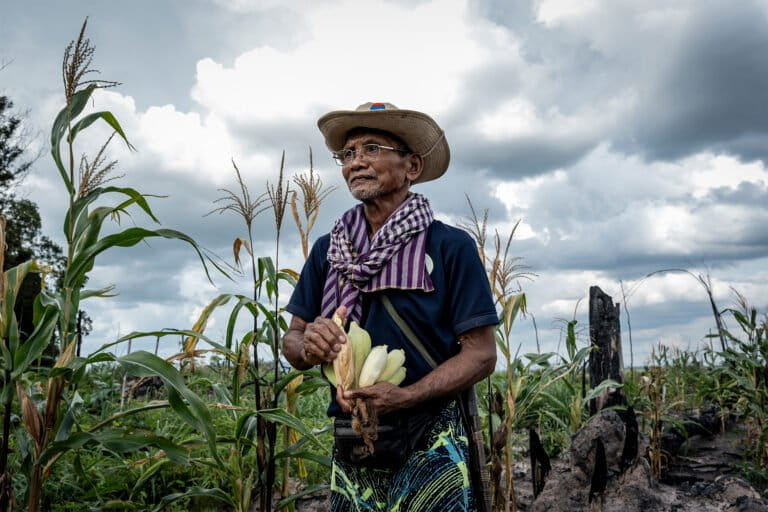
Lim is part of the Kuy people who have relied on the forests in northern Cambodia for generations. Despite being in his 70s, Lim leads the men along windy trails as they look for signs of illegal logging and land clearing.
“If we lose this sacred place, it’s like losing our Indigenous identity,” he said.
The Kuy fear they are at risk of seeing hard-won safeguards stripped away in Chom Penh, and they allege that Santana Agro Products Co. Ltd., one of Cambodia’s leading cashew companies, is encroaching onto their land to expand its farming operations. The company refutes the allegations.
The accusations have run so high that, in January 2025, about 200 Kuy people reportedly protested by blocking Santana Agro tractors being driven to clear forests on disputed land in another part of Cambodia. This was not the first time they massed to protest Santana’s activities, and Mongabay detailed Santana Agro’s expansion and deforestation in the region in a 2024 investigation.
For Lim and his team of volunteers, the effort to save the forest and take matters in their own hands began a quarter of a century ago. They began patrols and other efforts to protect the forest, in the hope the government would officially recognize their people’s rights to the land.
“At that time, patrolling was very difficult and chaotic. The loggers had machetes and guns,” Lim said. “There were so many loggers who threatened us because we tried to protect the forest for the community.”
Lim said his team chased off logging gangs and destroyed access roads used to haul timber out of the forest.

In 2010, the country’s Ministry of Environment declared Chom Penh a community protected area, part of a government program to give Indigenous peoples across the country more say in control of ancestral lands.
It was a milestone victory for the Kuy. While the designation does not grant ownership, it lets the Kuy engage in sustainable farming and manage the forest, which is tucked inside the Beng Per Wildlife Sanctuary about 70 miles south of the Thai border.
The Kuy people have used its timber to build homes. It helps provide food, including wild vegetables. During Lim’s patrol last summer with a Mongabay reporter, some members of the team foraged for mushrooms and bamboo shoots.
At one point, Lim slumped into his hammock, his weathered hands working tobacco. A burst of laughter from the card game going on behind him drowns out the distant calls of gibbons.
In 2020, the ministry almost doubled the size of the community protected area. Now it covers 3,500 hectares (8,649 acres) — about 10 times the size of New York’s Central Park in the U.S.


Patrol team protects the forest
As part of the effort to fend off illegal logging, Lim and several others established a permanent patrol station in the forest in 2018. Lim said he was inspired to increase his efforts after traveling a year earlier to meet other Indigenous leaders in the Philippines.
“I saw the passion in the people, fighting for their country and place,” he said. “I felt something inside of me.”
The patrol team, he believes, makes a difference. “Day by day, the big loggers started to decline,” he said.
Today, the patrol team has grown to around 20 members, and they believe they have almost entirely put a stop to outside logging. Where they once tracked illegal loggers through dense undergrowth, they mostly spend their time raising chickens, foraging for wild vegetables and sharing their deep knowledge of the forest with the occasional group of youth.
“The difference between then and now is like earth and sky,” Lim said.

Satellite imagery analyzed by Global Forest Watch at the University of Maryland in the U.S. supports that belief. There are strong indications that the effort is working. The Indigenous community-managed area lost about 7% of its primary forest cover between 2002 and 2025.
That is dramatically less than the surrounding Beng Per Wildlife Sanctuary, which lost about 77% during the same period. Vast swathes of its forest have been illegally logged and transformed into rubber plantations,
When asked for their secret, the patrol members all give the same answer: Cohesiveness.
“There are so many Indigenous communities, especially around this area, that had protected forests,” Lim said. “But now I see a lot of them are breaking up.”
“If there’s any weakness in the community, or greedy members who want to take bribes, [companies] will find a way to break the community,” said Thoeun Jouch, 41, who moved to the forest in 2018 after hearing about the Boeng Chhouk patrol station. “For us, though, we’ll keep fighting.”
Lost land pains the Kuy people
But the land that has been lost has been painful for community. Satellite imagery shows two ponds — called Andong Srey and Andong Bros — were cleared of surrounding forest between January and February 2025.
The ponds mark the site of an ancient Kuy village. Community members said they cannot access places where people have prayed, made offerings, fished and camped for generations. They blame Santana.
“Those two sites are sacred areas that are part of our Indigenous history,” said a member of the community, who chose to remain anonymous out of fear of retribution. “When we lose the spiritual forest and lakes, it’s like losing our Indigenous Kuy culture and identity too.”
Mongabay was unable to verify rumors suggesting Santana Agro was linked with deforestation at the ponds.
Ouk Kimsan, a Santana Agro director, told Mongabay in September 2025 that his company was not behind the clearing. “Santana [Agro] doesn’t have [this] land as you mentioned,” he told reporters.
Khvay Atitya, spokesperson at the Ministry of Environment, the agency responsible for the management of protected areas, deferred all of Mongabay’s questions to the Ministry of Agriculture, Forestry and Fisheries (MAFF), which is responsible for managing land concessions.
Khim Finan, MAFF spokesperson, did not directly answer Mongabay’s questions about whether Santana Agro was behind the clearing or how the land had been granted.
“From our understanding, the Ministry of Environment and Santana are undertaking an agroforestry initiative in deforested areas to help communities move away from relying solely on forest products, while creating jobs and protecting the remaining forests,” Finan said.

On the day that Mongabay went on patrol with Lim, with the sound of gibbons in the air, the forest’s tranquility was shattered by the sounds of distant machinery beginning to work. Just 3 kilometers (1.86 miles) south, bulldozers and excavators were tearing through primary forest — similar to that found in Chom Penh.
For now, the community’s leader Ruos Lim plans on spending the rest of his days in Chom Penh.
“I won’t give up on this area,” he said. “I’ll stay here until the day I can’t stay anymore.”
But Lim does worry whether time is on the side of the Kuy. He turned and looked back at the other patrol members.
“As you can see around us, it’s mostly older people. They stay here, they’re brave, they’re strong, and they’re not afraid to protect [the forest],” he said. “I worry a lot about the youth these days. If they don’t pay attention, this mission might not continue to be successful in the future.”
Banner image: Ruos Lim, 71, a Kuy Indigenous community leader, harvests corn he planted at the L4 station in Beng Per Wildlife Sanctuary. Image by Roun Ry/Mongabay.


