

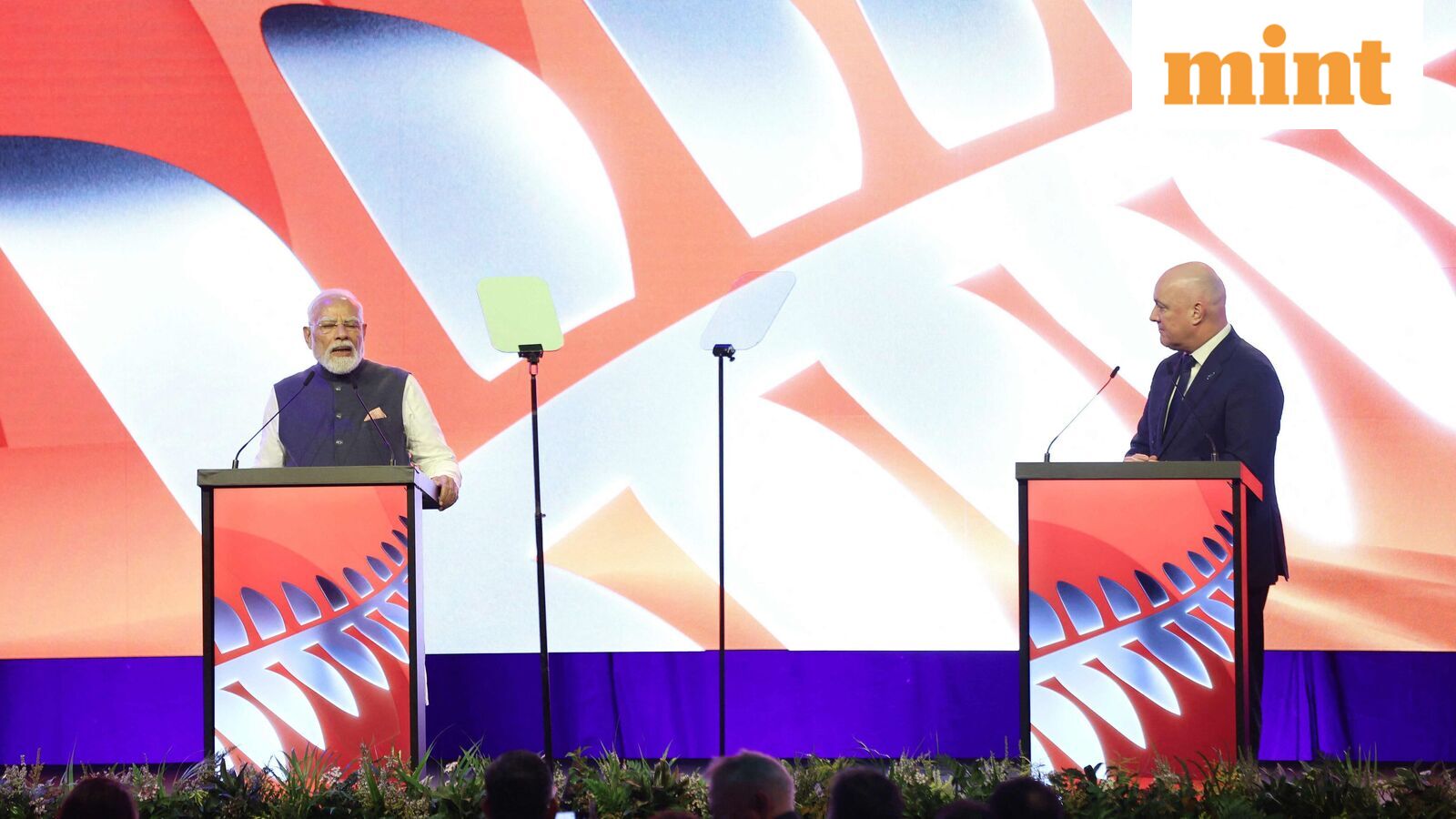
India and New Zealand agreed to work towards doubling bilateral trade in goods and services to NZ$7 billion, or approximately ₹35,000 crore, by 2030, as Prime Minister Narendra Modi and his New Zealand counterpart, Christopher Luxon, on Saturday (local time) welcomed the momentum in trade and economic ties between the two countries.
PM Modi arrived in New Zealand on Friday (local time), marking the first visit by an Indian Prime Minister to Auckland in 40 years. On Saturday (local time), the two leaders held delegation-level talks and encouraged businesses to deepen ties, explore opportunities, and build on complementarities between the two economies.
Quick answers to key questions
The India-New Zealand Strategic Partnership aims to deepen cooperation in various sectors, doubling bilateral trade to NZ$7 billion by 2030 and establishing frameworks for political, economic, defence, and security engagement.
PM Modi’s visit is historic as he is the first Indian Prime Minister to visit New Zealand in 40 years, marking a significant milestone in the bilateral relationship between the two countries.
The partnership is expected to boost trade and economic cooperation by enhancing business ties, encouraging investments, and supporting New Zealand’s role in India’s Viksit Bharat goal of becoming a developed nation by 2047.
Key agreements included the finalization of the Free Trade Agreement and a Memorandum of Arrangement on tourism, facilitating direct flights between India and New Zealand.
The Maritime Security Dialogue is significant as it aims to enhance cooperation in maritime security, an essential aspect of both countries’ interests in maintaining a free and open Indo-Pacific.
India-New Zealand joint statement
In a joint statement released on Saturday, the Ministry of External Affairs (MEA) wrote that PM Modi and Luxon agreed to “an ambitious long-term vision for the Strategic Partnership, which aims to take bilateral relations to a new level, strengthen existing cooperation mechanisms, and explore new avenues for deepening cooperation, both bilaterally and multilaterally.”
Citing the long-standing friendship, shared democratic values, strong people-to-people connections, and common interests in the Indo-Pacific, the two leaders agreed to upgrade India-New Zealand ties to a Strategic Partnership. The two sides also approved the India-New Zealand Strategic Partnership: Roadmap to 2030, which will serve as the framework for bilateral cooperation over the next four years.
Political and diplomatic engagement: The two leaders welcomed the growing momentum in high-level political engagement and agreed to maintain regular reciprocal visits and meetings between their Prime Ministers and ministers, including on the sidelines of regional and multilateral forums.
They also agreed to set up a regular Foreign Ministers’ Dialogue aimed at providing strategic guidance to review the progress under the Roadmap to 2030. Additionally, they agreed to encourage regular engagement between the parliaments of both countries.
Defence and Security cooperation: To combat transnational and organised crime, PM Modi and his New Zealand counterpart agreed to strengthen practical law enforcement cooperation and to work towards the early formalisation of arrangements on counter-narcotics cooperation and law enforcement cooperation between the relevant agencies.
India and New Zealand have agreed to establish an annual Maritime Security Dialogue to boost cooperation and coordination. Welcoming Auckland’s nomination of Maritime Security as a key pillar under the Indo-Pacific Oceans Initiative, the two sides agreed to explore cooperation.
The two leaders also reaffirmed their common interest in maintaining a free, open, peaceful, and prosperous Indo-Pacific. To advance this objective, they agreed to deepen maritime cooperation through the newly signed Maritime Cooperation Arrangement (MCA), an Implementing Arrangement on Cooperation in Matters of Hydrography and Nautical Cartography, and a Mutual Logistics Support Arrangement focused on the maritime domain.
Trade and economic cooperation: PM Modi and Luxon welcomed the conclusion of the Free Trade Agreement (FTA). They also noted that Auckland can support New Delhi’s Viksit Bharat goal of becoming a developed country by 2047, including through cooperation in trade, agriculture, skills, innovation, clean energy, sport, and other areas.
A Memorandum of Arrangement on tourism was also signed during PM Modi’s visit, encouraging airlines to commence non-stop direct flights between India and New Zealand.
The two leaders also reaffirmed their commitment to global peace and security, expressed concern over the renewed escalation of tensions in the Middle East, and called upon all parties to exercise restraint.
About the Author
Swati Gandhi
Swati Gandhi is a digital journalist with over four years of experience, specialising in international and geopolitical issues. Her work focuses on foreign policy, global power shifts, and the political and economic forces shaping international relations, with a particular emphasis on how global developments affect India. She approaches journalism with a strong belief in context-driven reporting, aiming to break down complex global events into clear, accessible narratives for a wide readership.
Previously, Swati has worked at Business Standard, where she covered a range of beats including national affairs, politics, and business. This diverse newsroom experience helped her build a strong grounding in reporting, while also strengthening her ability to work across both breaking news and in-depth explanatory stories. Covering multiple beats early in her career has helped her be informed about her current work, allowing her to connect domestic developments with wider international trends.
At Live Mint, she focuses on international and geopolitical issues through a business and economic lens, examining how global political developments, foreign policy decisions, and power shifts impact markets, industries, and India’s strategic and economic interests.
She holds a Bachelor’s degree in English (Honours) from the University of Delhi and a Master’s degree in Journalism and Mass Communication from Guru Gobind Singh Indraprastha University. Her academic training has shaped her emphasis on precision, analytical rigour, and clarity in writing. Her interests include global political economy and the intersection of geopolitics with business.
Outside work, Swati focuses on exploring her passion and love for food. From fancy cafes to street spots, Swati explores food like a true foodie.
