






Summary
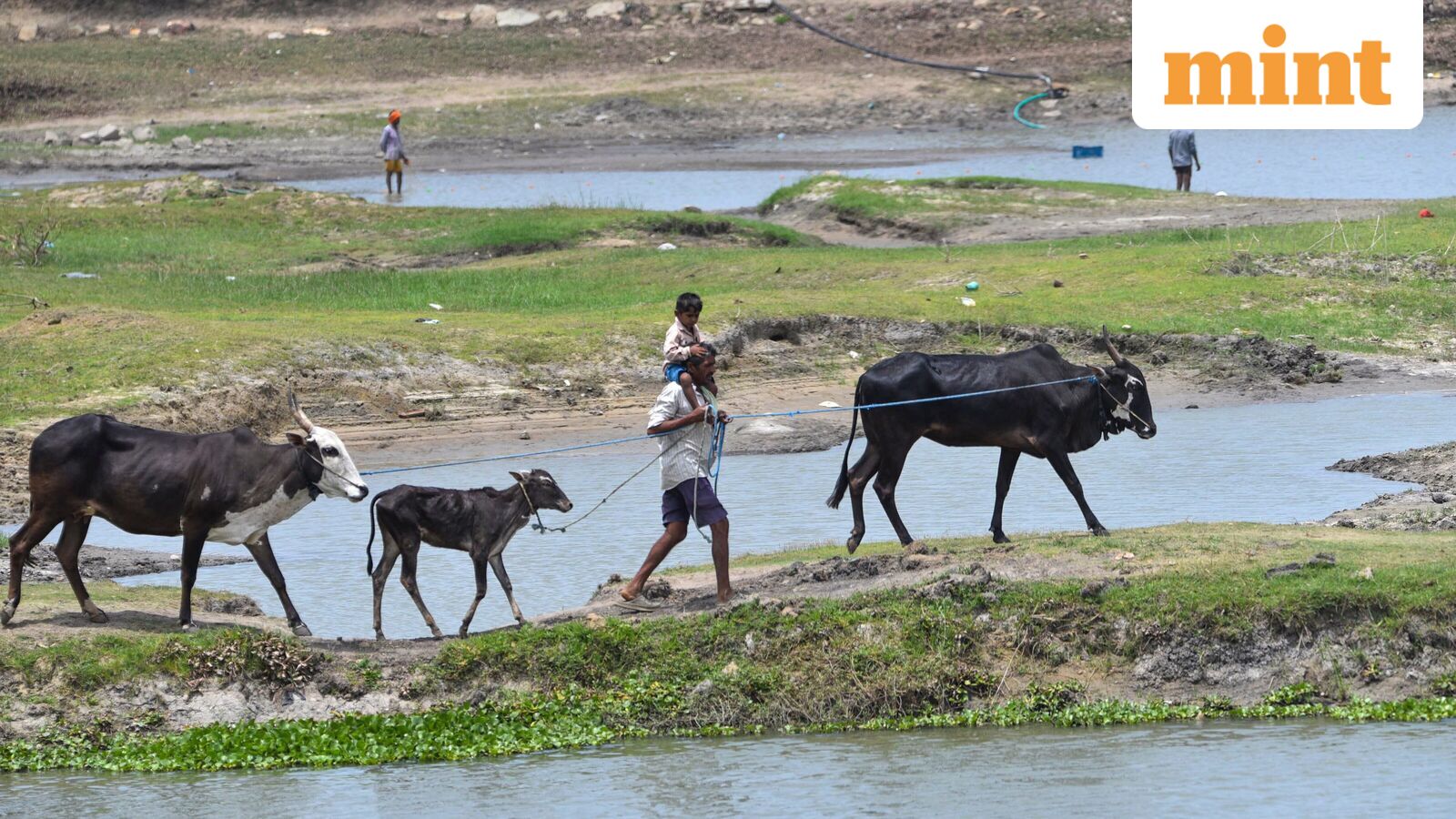
From Mumbai’s shrinking lake supply to Pune’s alternate-day water rationing, a poor monsoon is testing India’s water system, already stretched by rising demand and groundwater overuse.
India’s monsoon got off to an unusually weak start this June, recording the fifth lowest monthly rainfall since the record began in 1901. This offered little relief to river basins and reservoirs drawn down by summer heat.
By mid-June, Mumbai’s lakes held barely a month’s worth of water, while Pune moved to alternate-day supply as its reservoirs fell to a fifth of capacity. High groundwater extraction, declining per capita water availability and uneven rainfall continue to expose deeper structural weaknesses in India’s water security.
Dry descent
Reservoir storage recorded one of its steepest declines in recent years between the end of April and the end of June as an exceptionally hot summer depleted water levels faster than usual and a weak start to the monsoon failed to replenish them.
Data from the Central Water Commission (CWC), which tracks 166 reservoirs, shows storage fell from over 38% of live capacity in late April to 26% in the week ending 2 July.
The monsoon arrived on 4 June, but offered little relief: the IMD recorded a nearly 40% rainfall deficit in June. The latest figure, as of week ended 2 July, is close to the 10-year average for the period, but sharply below the 42.5% recorded a year earlier, a sign of how quickly a weak monsoon start can erode reserves built up over time.
Uneven strain
Monsoon this year was also uneven, translating into uneven water stress.
Reservoir levels across large parts of southern and eastern India—including Kerala, Karnataka, Telangana, Odisha and West Bengal—fell well below their respective 10-year averages for the week ended 2 July, according to CWC data.
Over the past week, storage slipped further in 21 of the 24 states’ reservoirs monitored. Only Jharkhand, Mizoram and Chhattisgarh saw a modest improvement, however, both Jharkhand and Mizoram remain well below their long-term average.
The strain is already spilling into agriculture.
Kharif sowing is already down as of 26 June. The impact could also spill over to rabi crops as they are reliant on irrigation facilities and face even greater exposure to reservoir depletion, said Gaura Sengupta, chief economist at IDFC First Bank.
Ground reality
Many parts of India depend heavily on groundwater for both domestic consumption and agriculture. When reservoirs and rivers run low, reliance on groundwater increases further.
According to the Central Ground Water Board’s (CGWB) latest assessment, India extracted 247.2 billion cubic metres of groundwater, equivalent to 61% of its annual extractable groundwater resources. Agriculture alone accounted for nearly 87% of total groundwater extraction.
However, groundwater’s own recharge leans heavily on the monsoon, which means a weak reservoir year and a weak monsoon could add pressure on groundwater levels.
In Punjab, Rajasthan, and Haryana, where extraction already exceeds the extractable resource, monsoon rainfall supplies 73-86% of annual recharge. Agriculture alone made up 85-95% of groundwater use in these states. If reservoir storage stays low, farmers in these states have fewer alternatives to groundwater for irrigation.
Numbers talk
11 of 15: The number of river basins in India that are approaching severe water stress, according to research by the Council on Energy, Environment and Water (CEEW).
279: The number of polluted river stretches identified across India, as per the Central Pollution Control Board’s (CPCB) 2025 report on ‘Polluted River Stretches for Restoration of Water Quality’.
25.5: India’s score out of 100 on the ‘Unsafe Drinking Water’ indicator, as per the 2024 Environmental Performance Index (EPI) report by Yale and Columbia universities.
150 billion litres: The estimated volume of annual water consumed by India’s data centres to cool processing infrastructure, as per a 2025 report by market research firm Mordor Intelligence.
6%: The projected contraction in India’s GDP by 2050 due to water scarcity, according to NITI Aayog’s Composite Water Management Index.
Power squeeze?
Uneven monsoon rainfall and depleted reservoir levels are affecting not just irrigation supply but also the refill of reservoirs that support hydropower generation.
CWC data for the week ended 2 July shows that 24 hydroelectric reservoirs were storing water below their respective 10-year averages—the benchmark the agency uses to define “normal” storage.
Among the largest hydropower reservoirs monitored by the CWC, three with installed capacity exceeding 500 MW were holding less than half their normal storage levels: Nagarjuna Sagar in Telangana (-56%), Tehri in Uttarakhand (-54.5%) and Koyna in Maharashtra (-51.6%).
Electricity demand remains elevated, with peak demand crossing 250 GW consistently in recent weeks. Hydropower makes up only a part of India’s electricity mix, but lower reservoir levels can limit its ability to meet peak demand, adding pressure to the grid.
Parched future
The weak and uneven monsoon comes at a time when India is already grappling with high water stress. District-level projections from NITI Aayog’s India Climate and Energy Dashboard show large parts of peninsular, central and northern India already facing water scarcity in 2025.
The country’s annual per capita water availability has declined steadily with population growth, from over 5,000 cubic metres in 1951 to 1,486 cubic metres in 2021, placing it below the internationally recognised water-stress threshold of 1,700 cubic metres. It could decline further to 1,367 cubic metres by 2031 and 1,228 cubic metres by 2051.
This year’s uneven rainfall adds to that long-term pressure. It’s a reminder that concrete efforts are needed to address India’s water challenges and build systems that shields it from monsoon-related vagaries.
About the Author
Manjul Paul
Manjul Paul is a data visualization specialist and financial journalist with eight years of experience turning complex datasets into stories that matter. Her data storytelling spans long-form reporting, explainers, and multimedia formats, translating technical analysis into clear, engaging narratives.
Her reporting covers a wide range of economic, corporate, and policy subjects. On the fiscal side, she has produced data-driven stories on India’s budget, fiscal policy, GDP and inflation trends. She has also undertaken deep analysis of large-scale government surveys, including the Time Use Survey and National Family Health Survey, to uncover meaningful socioeconomic insights. Her financial reporting includes analysis of quarterly earnings data from samples exceeding 3,000 listed Indian companies, tracking sectoral trends and shifts in corporate performance.
Beyond economics, Manjul brings five years of COP summit coverage and a fellowship with the Oxford Climate Journalism Network (OCJN), reflecting a sustained commitment to climate and energy policy. Her political data work spans general and state elections, including detailed examination of candidate affidavits.
She brings strong analytical rigour, editorial judgment, and proficiency in data visualization tools and programming, and is passionate about applying her skills to produce impactful work on economic policy and environmental sustainability.