






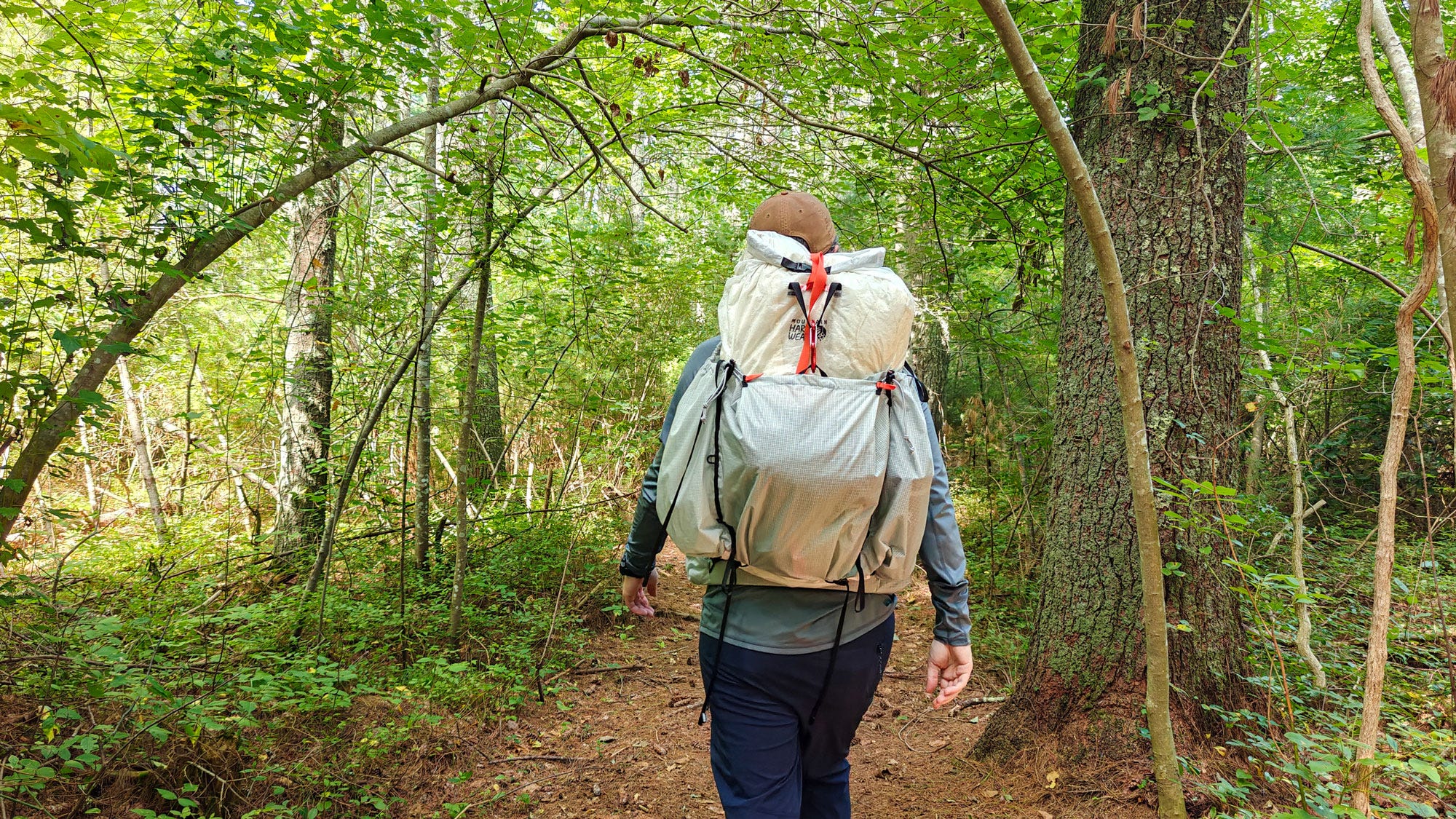
ULTRALIGHT HIKING GEAR has finally gone fully mainstream. In the last few years, every outdoor gear brand worth its salt has added everything from featherweight tents and sleeping bags to gram-conscious water bottles and rain shells to its catalog. Hiking backpacks are no exception, and Mountain Hardwear’s next-gen Alakazam hiking backpack series is the proof. With cutting-edge materials, a “barely-there” construction, and bulletproof durability, this thru-hiker-friendly pack promises to do it all—for a price.


Pros
- Next-gen ALUULA fabric is extremely durable and weatherproof
- Incredibly light, especially for a framed pack
- Giant, expandable exterior pockets and customizable storage/organization options
- V-shaped frame and articulating hipbelt make for a comfy carry
- Premium look and feel
Cons
- Expensive
- Not hydration reservoir compatible (necessary for full weatherproofing)
- Tiny shoulder/hip pockets
| Total Volume | 65L (45L interior + 20L exterior pockets) |
| Materials | ALUULA Graflyte ultra-high molecular weight polyethylene (UHMWPE) |
| Weight | 1 lb 14.3 oz (for M/L size) |
| Max Load | 40 pounds |
What I Like


The Alakazam 45 holds a lot more than it appears.
STRAIGHTAWAY, THE ALAKAZAM 45 feels like a premium hiking backpack. The all-white design is striking, and the ALUULA shell fabric stands out as a high-end, durable material that’s a step above most other packs on the market. Indeed, this is the first framed pack that I’m aware of that’s using the material. It’s the darling of the premium backpack world because it’s adhesive-free and bonds/welds to itself, which reduces seams (and seams are weak points). Because it’s manufactured by fusing its fibers at a molecular level, it also won’t fray or delaminate. All of this makes it not only lighter but significantly more durable than the already great Dyneema fabric used in high-end packs from Hyperlite and Zpacks. With the Alakazam’s true dry-bag-style, roll-top closure, it’s completely weatherproof, and I’ve had zero issues with water getting inside despite hiking in light and moderate rain.
It’s also shockingly lightweight, “tipping the scales” at just 1 pound 14.3 ounces (for the M/L—the largest size available). That puts it squarely in the sub-two-pound ultralight category. I found that lack of weight very noticeable on the hips and shoulders, especially after a long day on the trail. The combination of load lifters, a V-shaped frame that properly distributes weight to the lower body, and Mountain Hardwear’s proprietary Gait Keeper hipbelt—a clever design that swivels as you move to naturally distribute the load—makes for an extremely comfortable carry.
The side pockets are generously sized to hold larger gear like tents, sleeping mats, tripods, and more, making it the ideal capacity for overnight camping. A large rear stash pocket, trekking pole loops, and vertical daisy chains all provide additional options for lashing and stashing your gear around back in a completely customizable way. The vest-style harness also offers a few easy access pockets that are functional, but small.
Watch Out for


The side pockets are so deep it’s easy to lose a water bottle in them.
THERE’S NO GETTING around the fact that this bag is pricey. There are plenty of capable, weight-conscious bags in the $300-to-$400 range, including a few suggestions below. So, the nearly $600 price tag of both bags in the Alakazam series may be the deciding factor for many buyers.
At that price, there are a few shortcomings worth noting. The most obvious for me is the lack of hydration reservoir compatibility. While there is an interior “sleeve” pocket that will fit a reservoir, the bag’s roll-top closure means an opening for a hydration tube isn’t possible while still keeping the bag weatherproof. If you prefer to hike with a bladder instead of traditional water bottles, this may be a deal breaker.
The Alakazam’s exterior side pockets are expandable, providing roughly 20 liters more capacity than the “45” name might lead you to believe. But the pockets are actually so deep and floppy that it can be difficult to retrieve even a typical one-liter bottle. I was actually surprised at how easy it was to lose my gear in these pockets. The design also makes it very difficult to reach back while wearing the pack and grab your water bottle on the go. My 45 fit well enough that I was able to finagle my water bottle out of a purpose-cut slot in the bottom of these side pockets, but I can see how this might be an issue for some.
Lastly, the hipbelt pockets are small—comically small. I was able to fit, say, just my car keys or one Clif bar or my Garmin inReach in each. But they’re not even big enough for a moderately sized smartphone. The stretchy vest pockets are only slightly larger and more usable. But overall, I wish all of these front access pockets were at least 30 percent larger. This seems doable while adding minimal overall weight to the pack.
Thankfully, there are alternatives to the Alakazam 45:
- For a similar, but more streamlined option, I like Hyperlite Mountain Gear’s Unbound 55. It’s comparable in almost every way to the Alakazam 45, including weight, total capacity, and overall quality of materials, but it’s cheaper. That’s entirely thanks to the use of Dyneema fabric over ALUULA. What further sets this pack apart is that its design is far sleeker without the baggy side pockets of the Alakazam.
- For a very similar but cheaper option, check out Mountain Hardwear’s own Kazam 45. It uses traditional ripstop nylon/polyethylene instead of ALUULA. This makes the Kazam heavier by 10 to 11 ounces, but roughly half the price with many of the same features.
- A more comfortable option is Gossamer Gear’s Mariposa 60. It’s heavier than the Alakazam because it doesn’t use ALUULA fabric. But the trade-off is better padding and a better fit that makes it more comfortable. Plus, it’s way cheaper.
Verdict


The hip belt and frame helps distribute weight well.
MOUNTAIN HARDWEAR MAKES it clear that the Alakazam (both the 45L and 60L variations) is designed for hardcore, no-compromises hikers who demand a lightweight, durable hiking backpack, no matter the price. On all of these fronts, it delivers, thanks entirely to its bleeding-edge ALUULA fabric. It’s among the lightest medium-sized framed backpacks I’ve ever tested that’s both light enough and durable enough for thru-hiking. The just-right, compressible form factor is likely to please day hikers who appreciate extra space for their gear, but expandable enough to allow for overnight essentials like a sleeping bag, sleeping mat, and extra food and water. And it’s all wrapped in an extremely durable, weatherproof shell that’s built to survive just about any weather conditions.
Unfortunately, like most of the best outdoor gear, you’ll pay handsomely for the privilege of owning it. At nearly $600, this is a very expensive backpack—enough so that it may be entirely out of reach for many hikers. If you’re a passionate, weight-conscious fastpacker, love being the first on the block with new outdoor toys, and/or you just have money to burn, the Alakazam is worth the spend. For everyone else, I suspect Mountain Hardwear’s Kazam 45 is nearly as good an alternative at roughly half the price.


Mike Richard has traveled the world since 2008. He’s kayaked in Antarctica, tracked endangered African wild dogs in South Africa, and survived a near-miss great white shark attack in Mexico. His travel advice has appeared on the websites for Forbes, Travel + Leisure, CNET, and National Geographic. He loves the great outdoors and good bourbon, and (usually) calls Tulsa, Oklahoma home. Mike also enjoys speaking in the third person.

Ryan Brower is the Senior Gear and Reviews Editor at Men’s Health, where he tests the best products in outdoor gear, tech, running shoes, and more. He has written about the outdoors for nearly two decades and was previously the Managing Editor, Content Performance at Gear Patrol. He holds a B.A. in Sport Management and is a Certified Beer Server, having previously covered the craft beer industry. Ryan currently lives on the water in New Jersey with his wife and their dog.


