



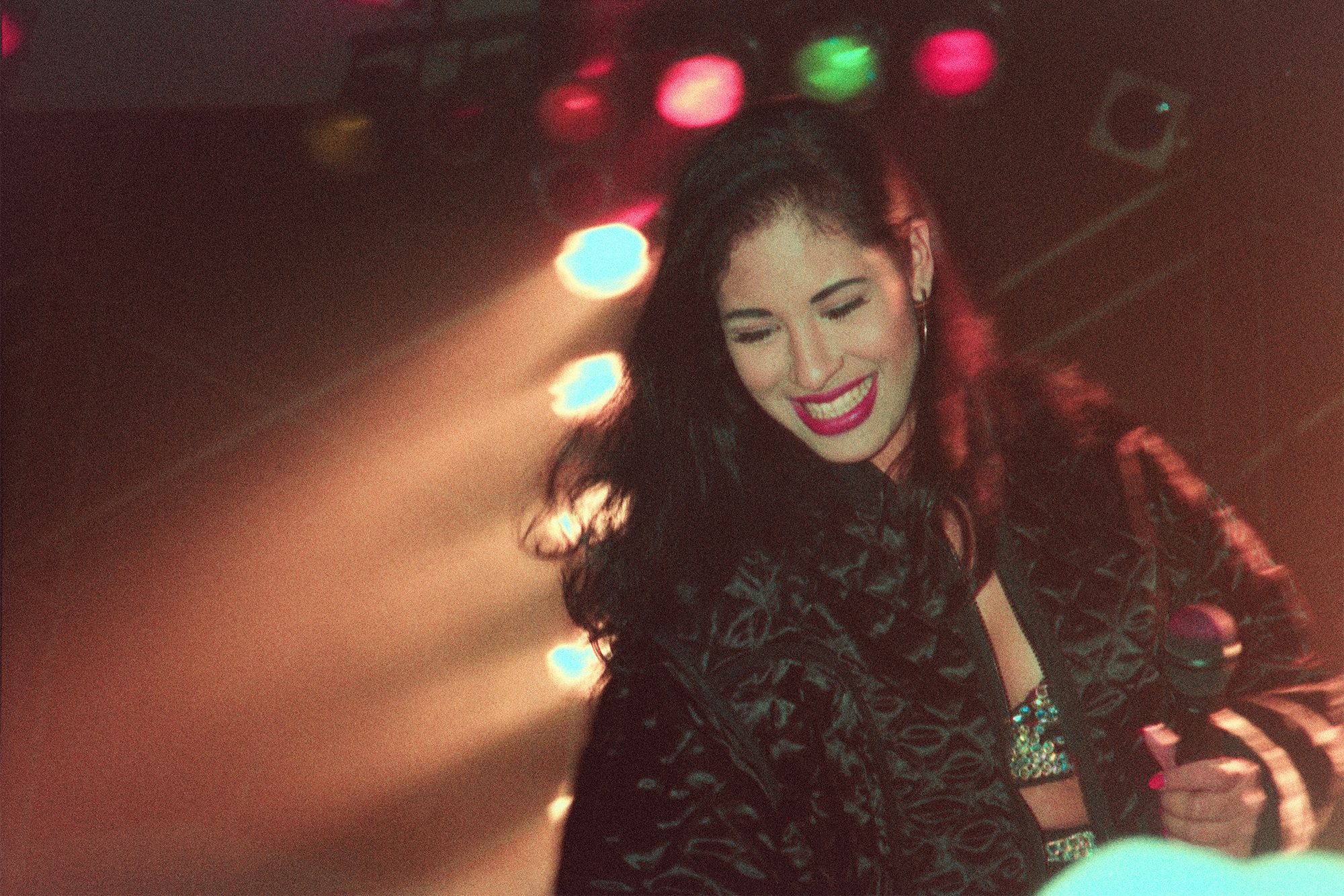
The new Netflix documentary Selena y Los Dinos tells an inspirational story of a hard-working family band’s ascent from playing tiny restaurant back rooms to selling out the Houston Astrodome. It’s also difficult to watch without wondering what Selena Quintanilla, the preternaturally gifted lead singer of Los Dinos, might be doing now had she not been killed in 1995 at the age of 23. How many more Grammys would she have under her belt? Would she have moved into films, shooting them in between albums? Would she have a clothing line at Fashion Week, or financially fruitful Target collabs? Would she be touring with her own children, or even grandchildren, just as her parents toured with her?
To tell the story of Selena and her family, Emmy-nominated director Isabel Castro (Mija) sifted through family archives and previously unseen footage from the Quintanillas’ private home videos. Castro also conducted candid interviews with Selena’s parents, Marcella and Abraham; her sister and drummer, Suzette; her bassist-songwriter brother, A.B.; and her guitarist husband, Chris Pérez.
Suzette is now the steward of Q Productions, the Quintanilla family’s hometown HQ. For this project, she wanted to find a director who could sift through the family’s massive archive to tell a story that would resonate with the generations of fans who still make the pilgrimage to visit the Selena Museum in Corpus Christi, Texas, and wider audiences as well. Castro is a lifelong fan herself who found she had “really great chemistry” with Suzette in their first Zoom conversation. For Suzette, the vibe was mutual. “She reminded me of home, like I’d known her for a long time,” she says of Castro. “Before we hung up on the call, I texted my lawyer, ‘She’s the one.’” The child of Mexican immigrants and raised in Connecticut, Castro could relate to how the Quintanillas had a foot in two cultures: “Selena was so inspiring to me because of her unapologetic confidence in her identity.”
Over the course of two years, Castro and producer J. Daniel Torres spent about 10 hours a day, five days a week, poring through the material, clocking moments that would best serve the story. The sheer volume was daunting. “Suzette opens the door to this room with floor-to-ceiling bookcases of VHS tapes, CDs, flash drives, original film, albums, and boxes with photos,” she says. “It felt like we entered a sacred space, and I found it overwhelming in this way I’d never experienced in my career—both in terms of process and deciding how to distill this into a film. But the responsibility of access to that archive is what drove me and the whole team to work as hard as we did.”
Interviews with the Quintanilla family were a delicate process that took six months. Marcella, the family matriarch, was especially reluctant about participating. Says Suzette, “My mother suffers from depression from losing my sister. She gets extremely emotional, and I didn’t think she was going to do it. I had to tiptoe around it and do the whole cute face on her, like, ‘Please, Mom, it’s important for you to be a part of this, because you played a huge role in keeping us grounded and showing us the way we deserve to be as women.’”
The doc lifts the curtain behind the Quintanilla family enterprise, showing behind-the-scenes footage of an off-duty Selena, free of spangled stage clothes and her trademark red lipstick, smiling wide in curlers and joking around with her family. We see the siblings navigate their adolescence and young adulthood on tour with their parents. We see Selena embark on a side hustle as a clothing designer. We see her fall in love with the new guitar player on tour, and marry him.
We also see the Texas-born Selena learn Spanish to the point of comfortable fluency so she can better communicate with the Mexican press. Interviews show Selena, the mouthpiece of Los Dinos, as precociously poised, funny, graceful, and open, occasionally managing objectification and microaggressions by flipping the script. “There were so many sexist interviews that, at one point, I’d created a montage. It was so creepy,” says Castro. “When I’m facing insidious racism or sexism, I think about Selena, because she held a mirror up to the person—like, ‘How does it feel for it to be said to you?’ She just had this way of reflecting back onto people, and I find that such a powerful lesson in terms of how to stand up for ourselves.”
Tragically, there was only one way for the documentary to end. In 1995, Selena was shot and killed by the president of her fan club. “The murder was never that interesting to me,” says Castro. ”It’s a senseless tragedy people sensationalize. But it overshadows the unbelievable power and joy of Selena’s life and what she created. Often, the Latino experience is only understood within the lens of victimhood, and this film tries very hard to avoid that. I wanted to ground it exclusively in the emotions of the family and show that the pain is still there through the passage of time. But Selena represents the joy and power of the Latino identity and experience. I want people to come away from the film feeling that, and hopefully being drawn to the music.”
Suzette and her family are happy with how the film celebrates their music and keeps Selena’s memory alive. “I just don’t want anybody to forget her,” she says. “Sometimes, when we lose a loved one, only our inner circle remembers them, but Selena is loved by the world. It means so much to me for everybody to walk away from this film with a good feeling, because that’s what music does, you know?”
I asked Castro and Suzette what they thought Selena might be up to if she were still here. “She’d be a huge star,” Castro offers without a nanosecond of hesitation. “And I think she’d be running a massive fashion company.” Suzette pauses solemnly before saying, “We used to talk so much about how, one day, we were going to have kids and make sure they played together. I guess she knew that she wouldn’t stop singing because she told me, ‘I’m going to get my own bus. I can have the kids on the bus so they don’t bother anybody.’ But the only thing I know for certain: If she were still here, she would definitely be a mom. She would have been an incredible mom.”
-
Olivia Nuzzi Returns With American Canto: Read the Exclusive Excerpt
-
An Oral History of LA Nightlife in the Early 2000s
-
Donald Trump’s History of Insulting a Woman’s Appearance
-
How Chloé Zhao Is Navigating Hollywood as a “Deeply Neurodivergent” Director