




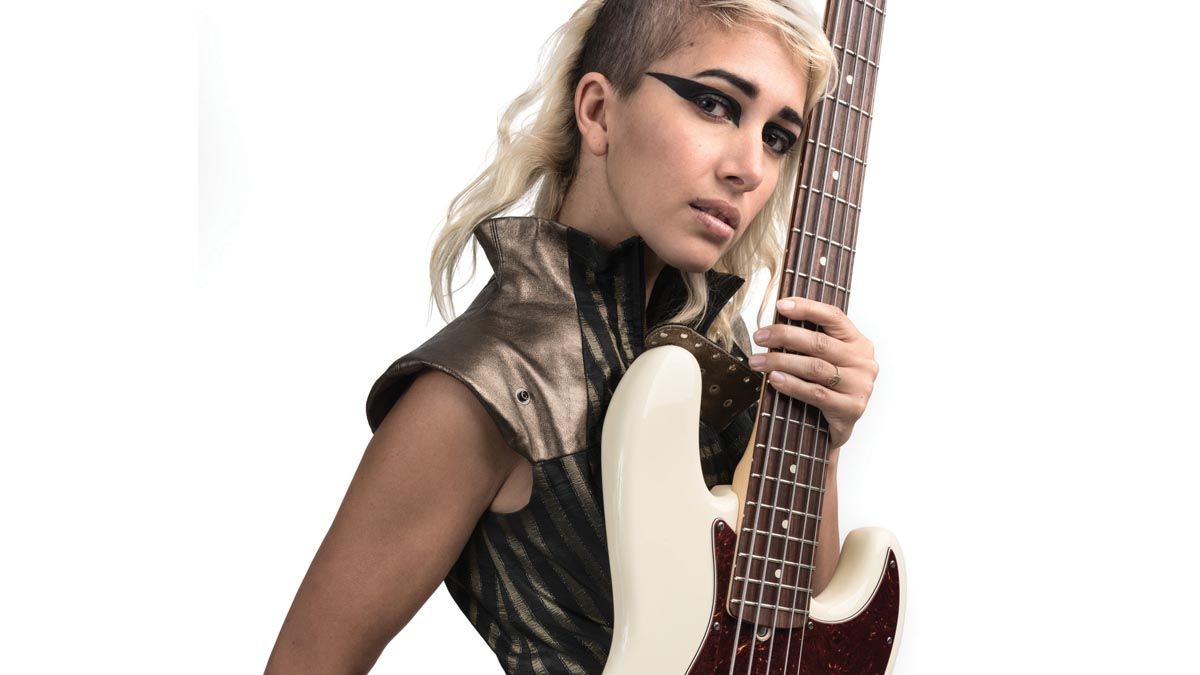

As bassist for Cher, Ashley Reeve has a front-row seat to the onstage spectacle of one of the world’s most celebrated stars – from top-tier choreography to iconic costume changes.
“Once a show like that gets going, it’s like an unstoppable train,” says Reeve. “Everything is timed – to the lights, the dancing, the entire sequence – so you have to know it inside and out.”
Reeve’s development hit a growth spurt prior to landing the bass chair with Cher, having already tackled the excitable heaviness of rock band Filter, alongside her husband Chris Reeve on drums, and the groovy, often quirky music of CeeLo Green, and Adam Lambert.
Article continues below
“When I found out I was going to be playing for Cher, I blocked out a month of my life to focus on the set. I wanted to make sure I absolutely nailed it. From what I knew, there were only going to be a couple of rehearsals beforehand, whereas a lot of artists rehearse for a full month. That wasn’t the case here.
“When we finally rehearsed, we played it through once – and it went so well that the music director just said, ‘Alright, time for lunch.’ After lunch, we ran it one more time, and I felt great about it. We were all really lucky – the chemistry was there, and everything was ready for the show.”
Cher – If I Could Turn Back Time (Here We Go Again Tour) – YouTube


The process of studying an existing bassline, writing out her own charts, and if necessary adapting the original line to suit a new ensemble, has served as a unique learning experience that’s reaffirmed Reeve’s affinity with the bass.
“Your talent is all in your hands – you can make a $200 bass guitar sound great, if you know what tone you’re looking for. I have a soft touch because I’ve always liked a fat, round tone. I usually play with my plucking hand over the neck and use the edge of the neck as a thumbrest.
“With Filter it was way different, because all of the players before me used picks, so I had to emulate that tone. I got acrylic nails, because my mom told me that’s what Dolly Parton did. It allowed me to play in a flamenco style, instead of playing up and down with a pick. When I jammed with Ryan Adams, he nicknamed it ‘the flipper.’”
How did you land the Cher gig?
Eva Gardner, whom I’ve known since our days at the Los Angeles County High School for the Arts, had held the gig for a long time, but she had scheduling issues when Pink went on the road. She recommended me for the part, and next thing I knew, I got a text asking if I played upright bass and key bass.

I answered that l’d learn it all quickly. They sent me the songs, and I spent 72 hours straight learning the key parts and building that muscle memory. I played those songs to death; my husband even told me that I would actually play those parts with my fingers in my sleep.
What was challenging about the songs from a bass standpoint?
A lot of those parts are all on the upbeats in an almost syncopated way, and that goes against my natural inclination as a bass player. Our instincts usually tell us to play on the backbeat or the downbeat. A bit of brain rewiring had to happen, but once I got used to it, I didn’t have to think about it anymore.
Do you play those iconic song parts verbatim?
Definitely. I charted it all out note-for-note, because once you transcribe something, your brain and body seem to digest it in a deeper way than just memorizing it.
How do you dial in your tone to get the right sound?
To change my sound, I switch around my right-hand placement. If I’m playing a ballad, I want a really warm, round tone, so I place my hand near the neck. If I need to brighten it up for a funky disco part, I put my hand back by the bridge. Those subtle things make a big difference.

What was it like playing with your husband as a rhythm section in Filter?
It’s the best thing ever. That’s how we fell in love. We were just friends and we had such amazing musical chemistry, and that onstage chemistry translated offstage. Being able to perform and travel the world together as a rhythm section and as husband/wife is genuinely the best thing I can imagine.
If you had some advice for bass players, what would it be?
In my experience, it’s incredibly valuable to be a bit of a chameleon. Being able to blend into different sounds and adapt to different situations makes you much more versatile.
As a gigging musician today, that adaptability is essential. You need to bring your own voice to the table, but also be ready to adjust to whatever’s happening around you – musically and sonically.
Filter – Take Me To Heaven (Official Music Video) – YouTube

Of all the highlights of your career are there any that stand out?
I had the opportunity to play one song with Lionel Richie, which was such a cool experience. It meant a lot because I had auditioned for him before and didn’t get it – and that was okay, because the guy who did is amazing.
Still, getting the chance to play with him at an awards show, even for just one song, felt incredible. I remember thinking, ‘I can die happy now.’ It was a special moment.
” data-join-the-conversation-text=”Join the Conversation”>
You must confirm your public display name before commenting
Please logout and then login again, you will then be prompted to enter your display name.