







An estimated 64 per cent of adults in Canada report experiencing at least one potentially psychologically traumatic event during their lifetime, and in the United States, research suggests the figure may be closer to 90 per cent.
Trauma-informed care (TIC) is a holistic approach to health care that acknowledges the potential impact of patients’ experiences of trauma and actively aims to prevent exacerbating or causing new trauma in the medical setting.
Importantly, this can lead to more positive experiences and improved health outcomes for patients who may otherwise avoid or reluctantly show up for treatments and preventive screening, which is especially critical for cervical cancer. It offers benefits for providers, too.
However, TIC is not yet standardized in pelvic medicine in Canada or the U.S., and practice varies significantly by profession. This is why my co-authors Lauren Walker, an adjunct associate professor in the departments of oncology and psychology at the University of Calgary, and Krystyna Holland, a pelvic floor physical therapist operating out of Denver, Colorado, are developing a new clinical practice tool to bring TIC into pelvic health care.
They first assembled a multidisciplinary team representing obstetrics and gynecology, urology, urogynecology, midwifery, labour and delivery, pelvic floor physical therapy, oncology, family medicine and sexual assault response practitioners to advise on clinical recommendations.
Through patient interviews, they identified examples of positive and negative pelvic health care experiences. Positive experiences ranged from, “…they didn’t make me feel bad for needing that help,” to “…it made me feel better…to have power in my decision making.” Negative comments included things like, “I was in excruciating, excruciating pain,” and “I felt like a specimen.”


improve access to care and quality of care for all patients. Therefore, the project’s main goal is to ensure all pelvic health-care practitioners consider the vulnerabilities associated with trauma experiences and minimize harm.
Medical trauma and pelvic health
According to the International Society for Traumatic Stress Studies (ISTSS), medical trauma is defined as a set of psychological and physiological responses to pain, injury, serious illness, medical procedures and frightening treatment experiences. The organization estimates that 20 to 80 per cent of children and adults may even experience post-traumatic stress disorder (PTSD) following medical events and procedures.
Often described as being “stored in the body,” trauma responses can be triggered through medical examinations. This can be through pelvic exams, which may be experienced as invasive because of their intimate nature, but also even in more mild contexts, such as disrobing.
Some populations may be more vulnerable than others. For example, research shows that women with chronic pelvic pain (CPP) are more likely to have experienced higher rates of abuse and trauma, and as such the likelihood of retraumatizing in this population is high.
Certain specialties within health care that are at an increased risk of retraumatizing patients with trauma histories include gyne-oncology care (diagnosing and treating cancers of the female reproductive system), peri- and postnatal care (before and after pregnancy), obstetrics and midwifery, urogynecology and pelvic floor physical therapy.
As a registered psychologist and clinical sex therapist in Alberta, Dr. Walker is acutely aware of how TIC guidelines for pelvic and reproductive care can improve women’s mental, physical and sexual well-being.
What is trauma-informed care (TIC)?
TIC is a guiding framework designed to reduce re-traumatization and promote shared decision-making and collaboration. The U.S. Substance Abuse and Mental Health Services Administration (SAMHSA) has established a guiding document on TIC, outlining six key principles:
- Safety, trustworthiness and transparency;
- Peer support;
- Collaboration and mutuality;
- Empowerment, voice and choice; and
- Cultural, historical and gender issues.
It also offers a simple method for practitioners to remember TIC:
The four Rs.
- Realize there may be trauma (past and present);
- Recognize the signs (look and listen) and impact of trauma;
- Respond (in a sensitive and accommodating manner); and
- Resist Re-traumatization (think patient autonomy).
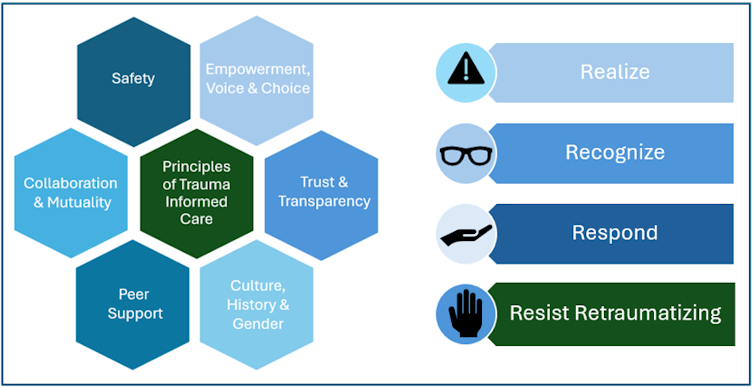

Substance Abuse and Mental Health Services Administration (SAMHSA), Author provided (no reuse)
Based on these TIC principles, organizations like the Society of Obstetricians and Gynaecologists of Canada heavily emphasize informed consent for exams and procedures. However, the aims of TIC extend well beyond this into areas such as physical environment, documentation and practitioner self-reflection.
While most practitioners would agree in principle that empowering patients through autonomy, consent, safety and trust can be a positive step to improve health-care experiences, this does not always translate into action. In practice, barriers to TIC include a lack of training, time constraints, competing demands in clinics, and viewing TIC as irrelevant to their specialty area or patient population.
Understandably, some practitioners also express concerns that querying patients’ trauma histories could “open a can of worms” they don’t feel equipped to address. Such feared consequences include feeling responsible to directly treat the trauma or experiencing personal discomfort, particularly when disclosures trigger re-traumatization from their own lived experiences.
Making TIC the norm in pelvic health care
In an effort to overcome these challenges, the clinical practice tool being specifically developed by Dr. Walker and Dr. Holland for pelvic health is based on the SAMHSA recommendations. From the outset of the tool’s design, they have engaged with health-care practitioners and invited input to assess feasibility, perceived importance and any barriers to implementation.
This consultation process is ongoing, so input is still welcome from health providers and patients. The team plans to launch the pelvic health tool in late 2026 and then disseminate it more broadly to health-care practitioners of all backgrounds, with the goal of making TIC the standard of care in Canada.


(Storyset), Author provided (no reuse)


